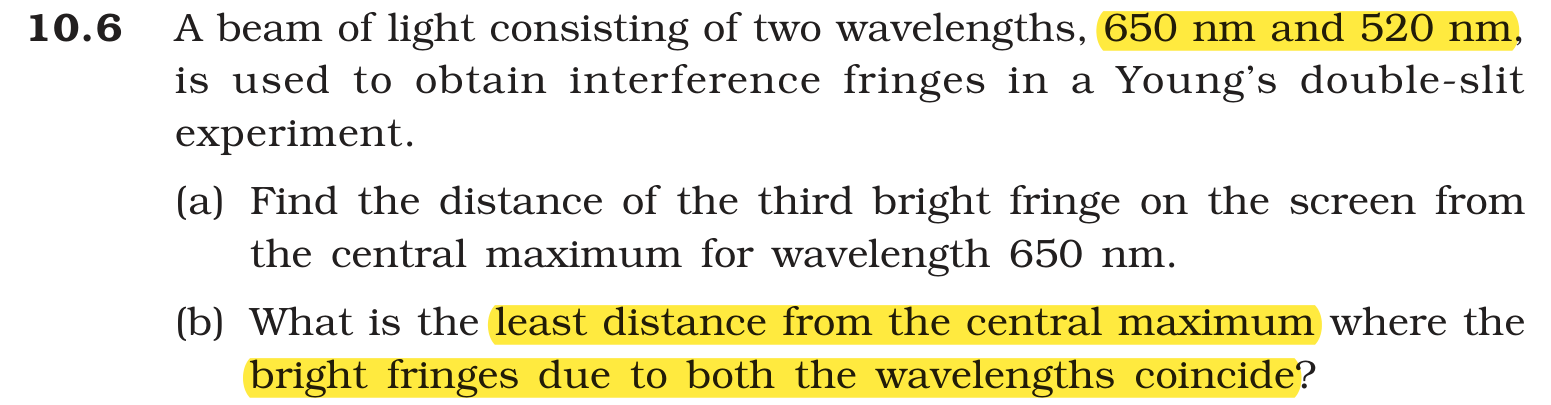
In a Young's double slit experiment, a beam of light consisting of two wavelengths, 650 nm and 520 nm, is used to obtain interference fringes. If the distance between the slits is 3 mm and the distance between the plane of slits and the screen is 1.5 m, the least distance from the central maximum where the bright fringes due to both the wavelengths coincide, will be
Answer & explanation
Correct answer: option 1
The correct answer is Option (1) → 1.3 × 10⁻³ m
The nth bright fringe is at \( y_n = n\lambda D/d \) from the central maximum. Bright fringes of the two wavelengths coincide where \( n_1\lambda_1 = n_2\lambda_2 \), and the least distance uses the smallest whole numbers that satisfy this.
\( \displaystyle \frac{n_1}{n_2} = \frac{\lambda_2}{\lambda_1} = \frac{520}{650} = \frac{4}{5} \)
So the 4th bright fringe of 650 nm falls on the 5th bright fringe of 520 nm.
\( \lambda_1 = 650\,\mathrm{nm} = 6.5\times10^{-7}\,\mathrm{m} \)
\( d = 3\,\mathrm{mm} = 3\times10^{-3}\,\mathrm{m} \)
\( D = 1.5\,\mathrm{m} \)
\( \displaystyle y = \frac{n_1\lambda_1 D}{d} \)
\( \displaystyle y = \frac{4\times(6.5\times10^{-7}\,\mathrm{m})\times(1.5\,\mathrm{m})}{3\times10^{-3}\,\mathrm{m}} \)
\( \displaystyle y = 1.3\times10^{-3}\,\mathrm{m} \)
Check with the other wavelength: \( 5\times520\,\mathrm{nm} = 2600\,\mathrm{nm} = 4\times650\,\mathrm{nm} \), giving the same distance.
Note: NTA picked this question from an NCERT (2026-27) exercise and added the figures. Do not ignore NCERT while practising numericals.
NCERT (2026-27):
Exercises – …