Based on following case study answer the question :
| Wages and salaries in cash | ₹ 5,000/- |
| Mixed Income of self employed | ₹ 3,500/- |
| Rent | ₹ 4,000/- |
| Corporate Profit Tax | ₹ 2,000/- |
| Dividend | ₹ 1,000/- |
| Employees contribution to provident fund | ₹ 500/- |
| Wages and salaries in kind | ₹ 2,000/- |
| Employer's contribution to social security schemes | ₹ 3,000/- |
| Corporate savings | ₹ 1,500/- |
| Net factor income from Abroad | (-)₹ 200/- |
Calculate the value of Domestic Income :
Answer & explanation
Correct answer: option 2
The correct answer is Option (2) → ₹ 22,000/-
Given:
Wages and salaries in cash = ₹ 5,000
Wages and salaries in kind = ₹ 2,000
Employer’s contribution to social security schemes = ₹ 3,000
Rent = ₹ 4,000
Corporate profit tax = ₹ 2,000
Dividend = ₹ 1,000
Corporate savings = ₹ 1,500
Mixed income of self-employed = ₹ 3,500
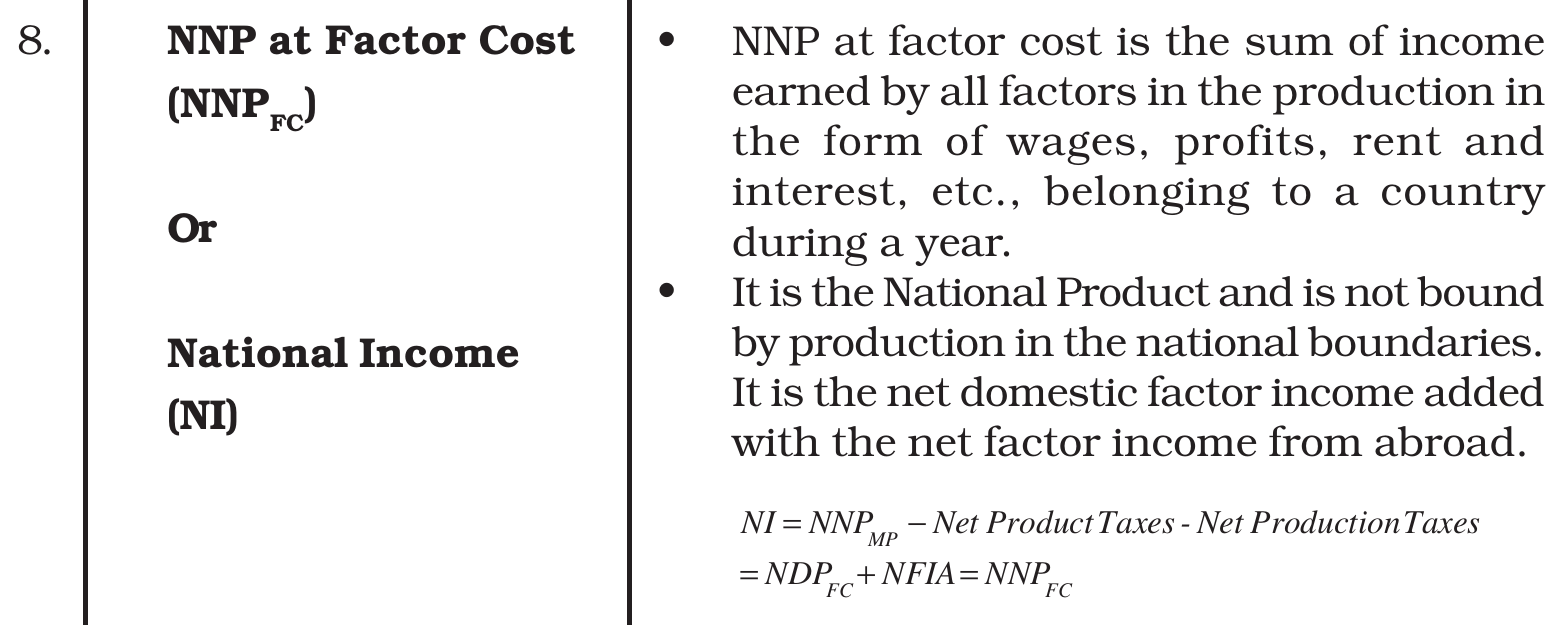
Domestic income is the net domestic product at factor cost (NDPFC). It is the total of the factor incomes earned within the country, so net factor income from abroad is not added.
Domestic income = compensation of employees + operating surplus + mixed income:
Compensation of employees = 5,000 + 2,000 + 3,000 = ₹ 10,000
Profit = 2,000 + 1,000 + 1,500 = ₹ 4,500
Operating surplus = rent + profit
Operating surplus = 4,000 + 4,500 = ₹ 8,500
Domestic income = 10,000 + 8,500 + 3,500 = ₹ 22,000
The employees’ contribution to provident fund (₹ 500) is already inside wages, so it is not added again. Adding the NFIA of (−) ₹ 200 would give ₹ 21,800, which is national income, not domestic income.
Note: ‘Compensation of employees’ and ‘mixed income’ are not used in any NCERT book (2026-27, 2025-26, 2023-24 or pre-rationalised). They are the standard names for what employees earn and what the self-employed earn. Employees’ earnings are wages, salaries and the employer’s social security contribution.
NCERT (2026-27): Introductory Macroeconomics — Chapter 2: National Income Accounting, Table 2.4: Basic National Income Aggregates
|