
CUETMOCK
  • Pricing
  • Mentors
Log inStart freeStart free mocks→

First test, then trust

Try a free CUET mock test.

Join 5,00,000+ students who rehearsed exam day on the exact NTA screen before sitting CUET. On the web and on Android.

Start free mocks →Get the Android app
CUETMOCK

India's #1 CUET Mock Test Platform. Original NCERT-based questions on the exact NTA exam screen — trusted by 5,00,000+ students since CUET 2022.

Get it onGoogle PlayScan to download the CUETMOCK app

Mock tests

  • CUET mock test series
  • Commerce mocks
  • Humanities (Arts) mocks
  • Science mocks
  • Languages & GAT mocks
  • Free practice questions
  • Pricing

Resources

  • CUET exam guide
  • CUET syllabus
  • Universities accepting CUET
  • Expert blogs
  • News & notifications
  • Webinars & counselling
  • CUET score calculator
  • How we estimate your rank
  • FAQs

Company

  • About us
  • Our leadership & team
  • Our toppers
  • Mentors
  • For schools
  • Contact us
  • Terms
  • Privacy
  • Refund policy

Talk to us

+91 7696 6630 56info@cuetmock.comWhatsApp us

Our other platforms

  • JEE Mock — For IIT-JEE aspirants
  • NEET Mock — For NEET aspirants

Newsletter

Exam updates, study material and offers — no spam.

© 2026 NYC Ventures Pvt. Ltd.

701-702, Royal Business Park, Zirakpur, Punjab - 140603

  • Terms of use
  • Privacy policy
  • Refund policy
  • Contact us

iCUETMOCK is an independent preparation platform, not affiliated with the National Testing Agency (NTA). Always check exam details on the official NTA website.

  • Home
  • Mock tests
  • CUET guide
  • Pricing
  • Log in
Home/Practice questions/Chemistry
ChemistryInorganic: D and F Block Elements

The silver UK coins and UK copper coins are respectively:

The silver UK coins and UK copper coins are respectively:

Answer & explanation+

Correct answer: option 1

The correct answer is Option (1) → Cu/Ni alloy & copper-coated steel.

Transition metals and their alloys are widely used for making coins because they are hard, resist corrosion and are cheaper than the precious metals the coins imitate.

The “silver” coins are cupronickel (a Cu/Ni alloy with a silvery colour); the “copper” coins are steel with a thin copper coat.

NCERT (2026-27 edition):
Some Applications of d- and f-Block Elements
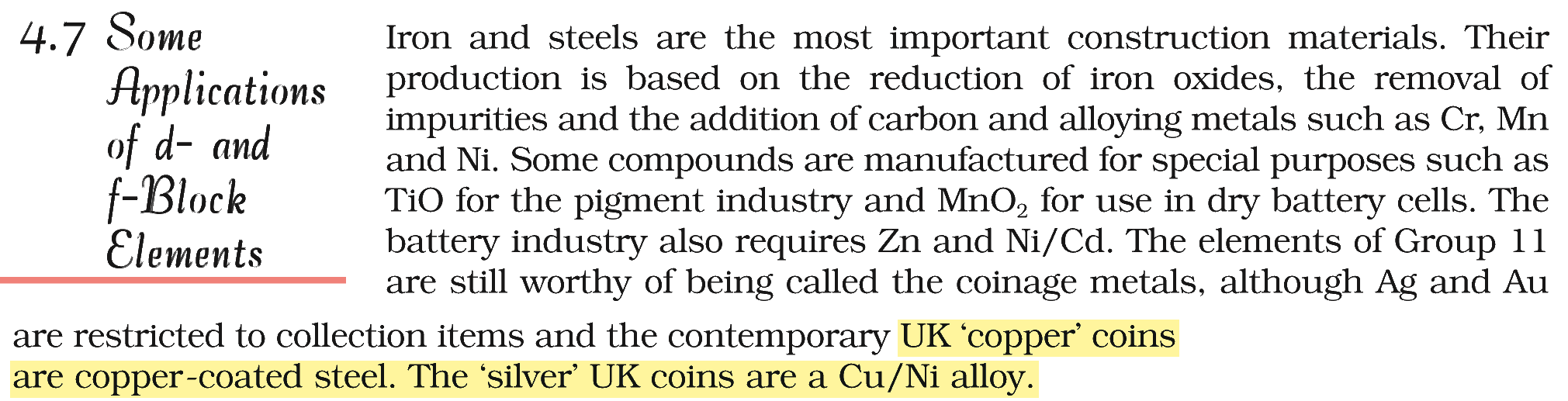
Textbook extract

Advertisement

Practise more on Inorganic: D and F Block Elements

Chapter-wise mocks on the real NTA exam screen, with solutions and your rank. Your first mocks are free.

Start free mocks →

Advertisement

Next questions

  1. Consider statements A and B given below and decide whether they are enough to find the time needed for two trains to cross each other when…General Aptitude Test · Numerical Ability
  2. Complete the sentence by choosing the best option from those given below-In Healthcare system, with the motive of Non-profit, SEWA is worki…Economics · Indian Economic Development: Infrastructure
  3. A log floating freely in a river drifts 6 km in 2 hours. A boat covers 45 km downstream in the same river in 3 hours. How long will the boa…General Aptitude Test · Numerical Ability
  4. Read the given statements and conclusions carefully. Assuming that the information given in the statements is true, even if it appears to b…General Aptitude Test · Verbal Reasoning
  5. The bond angle in methanol is :Chemistry · Organic: Alcohols, Phenols and Ethers
  6. The number 15287 is divisible by:General Aptitude Test · Numerical Ability
  7. Which of the following statements regarding ASEAN is correct? (A) ASEAN was established in 1967 by five countries-Indonesia, Malaysia, Sing…Political Science · Contemporary World Politics: Contemporary Centres of power
  8. बहना : नदी : : बंधा होना : ?Hindi · Analogy
  9. The temperature dependence of rate constant (A) of a chemical reaction is written in terms of the Arrhenius equation, =Ae^-E_a/RT , Activat…Chemistry · Physical: Chemical Kinetics
  10. Which of the following statements is/ are true in respect of Knowledge Processing Outsourcing (KPO) industry ?Geography · Fundamentals of Human Geography: Tertiary and Quaternary Activities