"Diverse family forms are found in different societies".
Keeping this statement in mind, select the family system that is protected in Khasi society.
Answer & explanation
Correct answer: option 4
The correct answer is Option (4) → Matrilineal and Patriarchal
Option (1) Patriarchal and Patrilineal — Incorrect. Patrilineal societies pass on property from father to son. Khasi custom passes ancestral property in the female line, so the Khasi family is not patrilineal.
Option (2) Matriarchal and Matrilineal — Incorrect. Matriarchy, where women exercise dominance, has been a theoretical rather than an empirical concept; there is no historical or anthropological evidence of it. Khasi women inherit, but they do not hold authority.
Option (3) Patrilineal and Matriarchal — Incorrect. Both halves are wrong for the Khasi: inheritance runs through women, not men, and authority lies with men, not women.
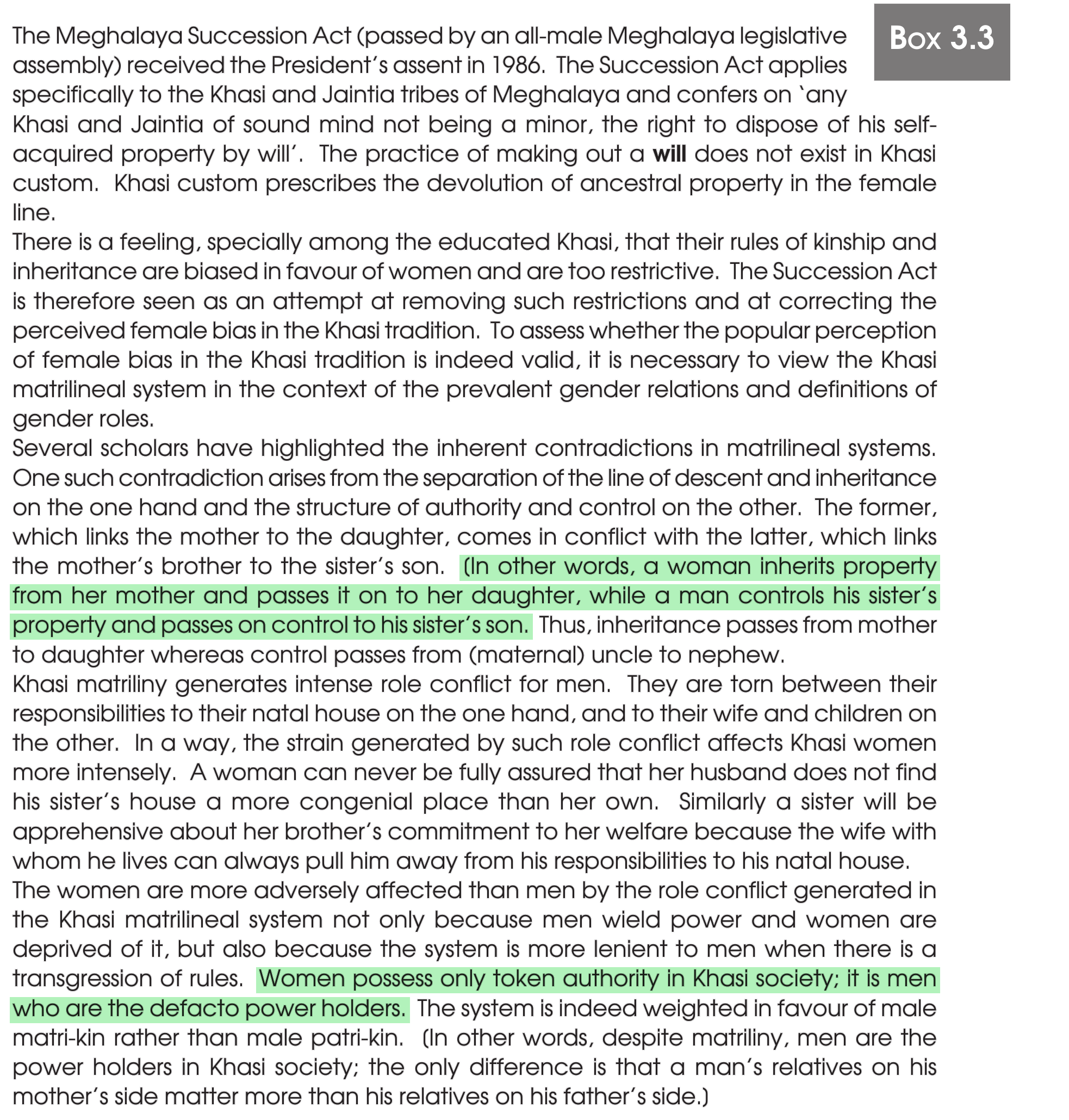
Option (4) Matrilineal and Patriarchal — Correct. In matrilineal societies women inherit property from their mothers but do not exercise control over it, nor are they the decision makers in public affairs. Among the Khasi a woman inherits property from her mother and passes it on to her daughter, while a man controls his sister’s property and passes on control to his sister’s son. Women possess only token authority, and men are the de facto power holders, so the structure of authority is patriarchal.
Note: Box 3.3, the account of Khasi matriliny, of the chapter ‘Social Institutions: Continuity and Change’, was there in the pre-rationalised NCERT, which NTA followed in 2023. This box has been deleted from the NCERT book (2025-26), though the chapter and its paragraph on matrilineal societies and matriarchy are still there.
NCERT (2025-26): “The Diverse Forms of the Family … Studies have shown how diverse family forms are found in different societies. With regard to the rule of residence, some societies are matrilocal in their marriage and family customs while others are patrilocal. In the first case, the newly married couple stays with the woman’s parents, whereas in the second case the couple lives with the man’s parents. With regard to the rules of inheritance, matrilineal societies pass on property from mother to daughter while patrilineal societies do so from father to son. A patriarchal family structure exists where the men exercise authority and dominance, and matriarchy where the women play a similarly dominant role. However, matriarchy – unlike patriarchy – has been a theoretical rather than an empirical concept. There is no historical or anthropological evidence of matriarchy – i.e., societies where women exercise dominance. However, there do exist matrilineal societies, i.e., societies where women inherit property from their mothers but do not exercise control over it, nor are they the decision makers in public affairs.”
Box 3.3, Khasi matriliny (Pre-rationalised NCERT) |