Read the following passage and answer the following questions.
MAM Limited, a prominent player in the food processing industry, enjoyed a surge in business attributed to its popular brand, quality products, and competitive prices. The expanding workforce and a growing market for processed food were positive indicators. However, as new entrants capitalized on the trend, the company opted for a short-term strategy by instructing existing employees to work overtime. This decision, though, led to a cascade of issues. The heightened workload resulted in a decline in worker efficiency, with instances of subordinates reporting to multiple superiors. Divisions that earlier worked on one product each were now made to work on two or more products, which caused overlap and wastage. The strain on employees led to a decline in discipline and teamwork, eroding the company's once-strong collaborative spirit. Workers felt disheartened, initiative dwindled, and product quality suffered, putting the company's market share at risk. Ultimately, it became evident that the company had implemented changes without establishing the necessary infrastructure to support such rapid expansion.
Which of the following aims of Fayol’s principles was defeated at MAM Limited, as described in the passage?
Answer & explanation
Correct answer: option 2
The correct answer is Option (2) → To prevent overlapping of activities
Option (1) To minimise employee turnover — Incorrect. This is the aim of stability of personnel. The passage does not show workers leaving or being moved.
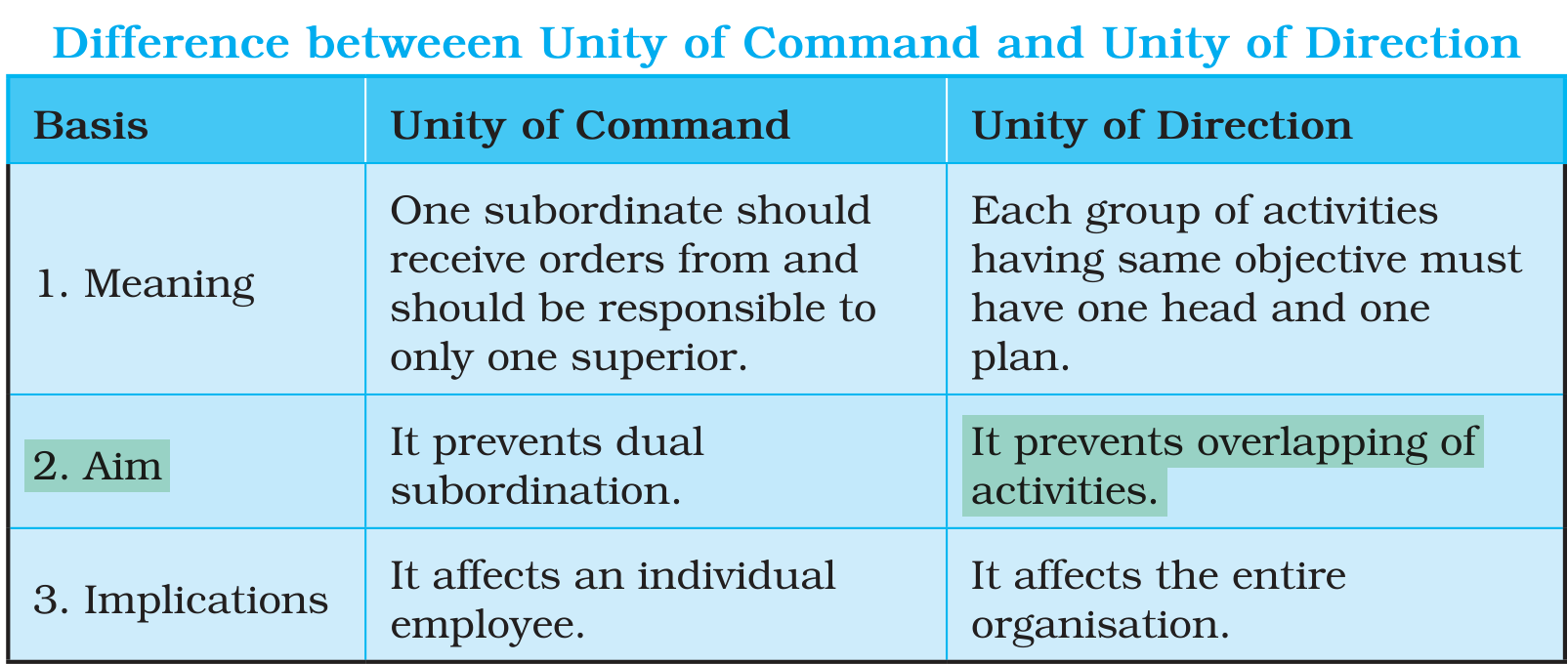
Option (2) To prevent overlapping of activities — Correct. This is the aim of unity of direction. Each group of activities with the same objective should have one head and one plan, and the work of two divisions should never overlap. At MAM Limited, divisions that each worked on one product were made to work on two or more. This caused overlap and wastage.
Option (3) To have a fixed place for everything and everyone — Incorrect. This is the aim of order. The passage says nothing about where things or people are kept.
Option (4) To keep pay within the paying capacity of the company — Incorrect. This is part of remuneration of employees: pay should be fair and within the company’s paying capacity. Pay is not discussed in the passage.
NCERT (2026-27 Edition): “(v) Unity of Direction: All the units of an organisation should be moving towards the same objectives through coordinated and focussed efforts. Each group of activities having the same objective must have one head and one plan. This ensures unity of action and coordination. For example, if a company is manufacturing motorcycles as well as cars then it should have two separate divisions for both of them. Each division should have its own incharge, plans and execution resources. On no account should the working of two divisions overlap. …”
|