Match List-I with List-II
| List-I | List-II |
|---|---|
| Geological periods | Plant forms |
| (A) Cretaceous | (I) Seed ferns |
| (B) Jurassic | (II) Progymnosperms |
| (C) Carboniferous | (III) Sphenopsids |
| (D) Devonian | (IV) Conifers |
Choose the correct answer from the options given below:
Answer & explanation
Correct answer: option 3
The correct answer is Option (3) → (A) - (III), (B) - (IV), (C) - (I), (D) - (II)
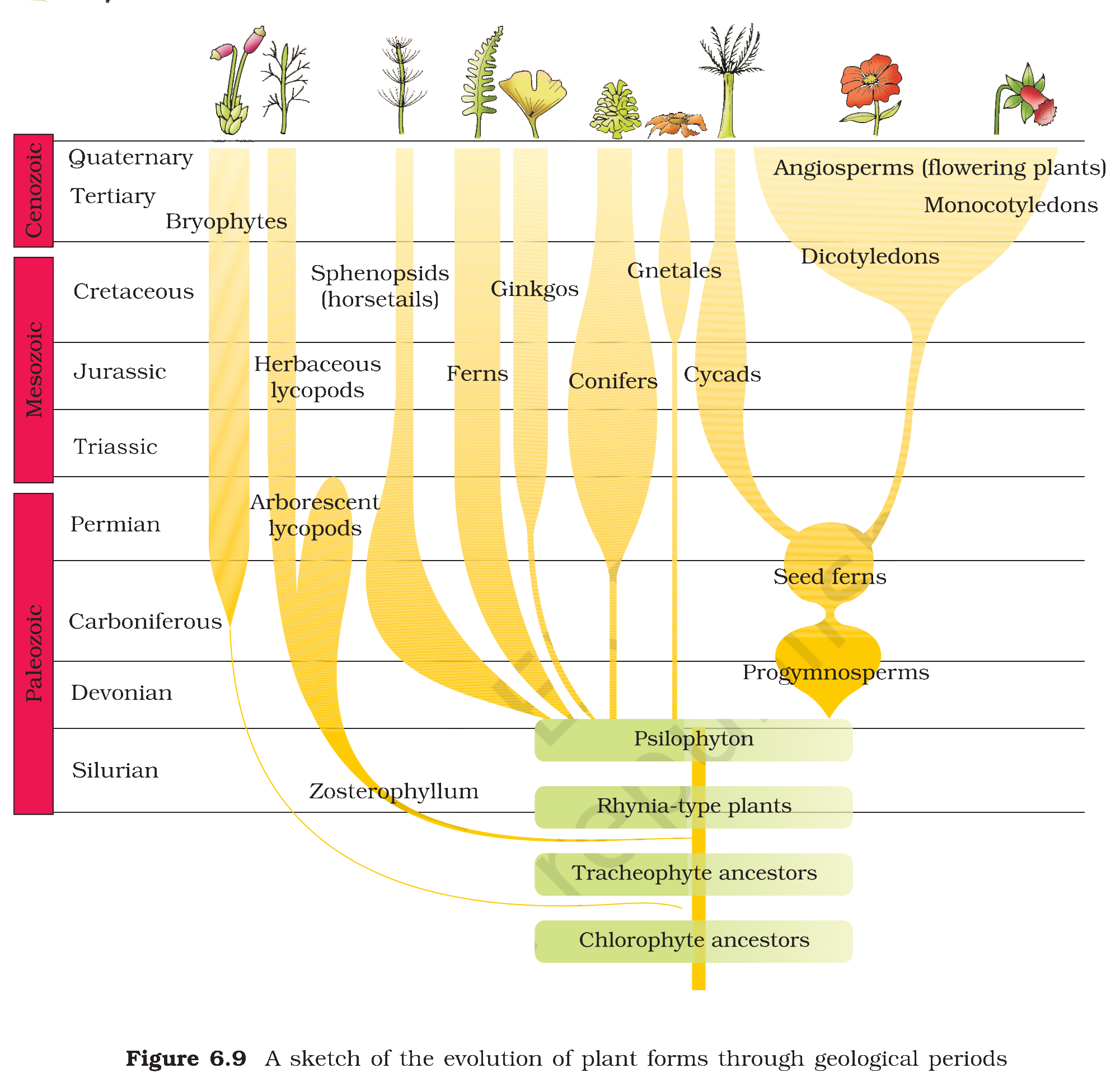
(A) Cretaceous — this matches (III) Sphenopsids. Sphenopsids are the horsetails, plants with jointed stems and small leaves in whorls. In the book’s sketch their label stands against the Cretaceous, the last period of the Mesozoic era, while their branch runs up from the Psilophyton-like ancestors.
(B) Jurassic — this matches (IV) Conifers. Conifers are cone-bearing gymnosperms such as pine. They were the main tall trees of the Jurassic, the middle period of the Mesozoic, and the sketch labels them there.
(C) Carboniferous — this matches (I) Seed ferns. Seed ferns were fern-like plants that bore seeds. They grew from the progymnosperms and spread in the Carboniferous; in the sketch their swelling sits just above the progymnosperms, at the top of the Carboniferous.
(D) Devonian — this matches (II) Progymnosperms. Progymnosperms were the forerunners of the seed plants. The sketch places them in the Devonian, the oldest of the four periods in the list, below the seed ferns.
(C) Carboniferous → both (I) Seed ferns and (III) Sphenopsids. The seed ferns swell out at the top of the Carboniferous, and the sphenopsid branch is also at its widest in the Carboniferous, while its label is printed against the Cretaceous.
Note 1: In the book’s figure a plant group is drawn as a branch that runs through several periods, so one item can be given a second match:
Note 2: A similar question was also asked in CUET (UG) 2025 on 02-06-2025 (Slot 2).
NCERT Extract:
A Brief Account of Evolution –