
The reaction in which a nucleophile replaces an existing group (the leaving group) in a molecule is called a nucleophilic substitution reaction. Haloalkanes are the substrates in these reactions. In this type of reaction, a nucleophile reacts with a haloalkane (the substrate) having a partial positive charge on the carbon atom bonded to the halogen. A substitution reaction takes place and the halogen atom, called the leaving group, departs as a halide ion. Since the substitution reaction is initiated by a nucleophile, it is called a nucleophilic substitution reaction.

It is one of the most useful classes of organic reactions of alkyl halides in which the halogen is bonded to an sp3 hybridised carbon.
What is the product formed when ethyl bromide reacts with KNO2?
Answer & explanation
Correct answer: option 2
The correct answer is Option (2) → Ethyl nitrite
As the passage describes, a nucleophile attacks the carbon bonded to bromine and bromide leaves. The nitrite ion is an ambident nucleophile: it can attack through oxygen or through nitrogen. With \( \ce{KNO2} \) the nitrite ion links to carbon through oxygen, so the product is an alkyl nitrite, R–O–N=O:
\( \displaystyle \ce{C2H5Br + KNO2 -> C2H5-O-N=O + KBr} \)
The product is ethyl nitrite.
Why the other options are incorrect
Option (1) Nitroethane — Incorrect. A nitroalkane, R–NO2, is the main product with silver nitrite, \( \ce{AgNO2} \), where the attack is through nitrogen, not with \( \ce{KNO2} \).
Option (3) Ethyl nitrate — Incorrect. A nitrate, R–O–NO2, would need the nitrate ion, \( \ce{NO3^-} \); the nitrite ion has only two oxygen atoms.
Option (4) No reaction — Incorrect. Ethyl bromide is a primary haloalkane with a good leaving group, and it undergoes nucleophilic substitution with the nitrite ion.
NCERT (2026-27 edition):
Table 6.4: Nucleophilic Substitution of Alkyl Halides (R–X)
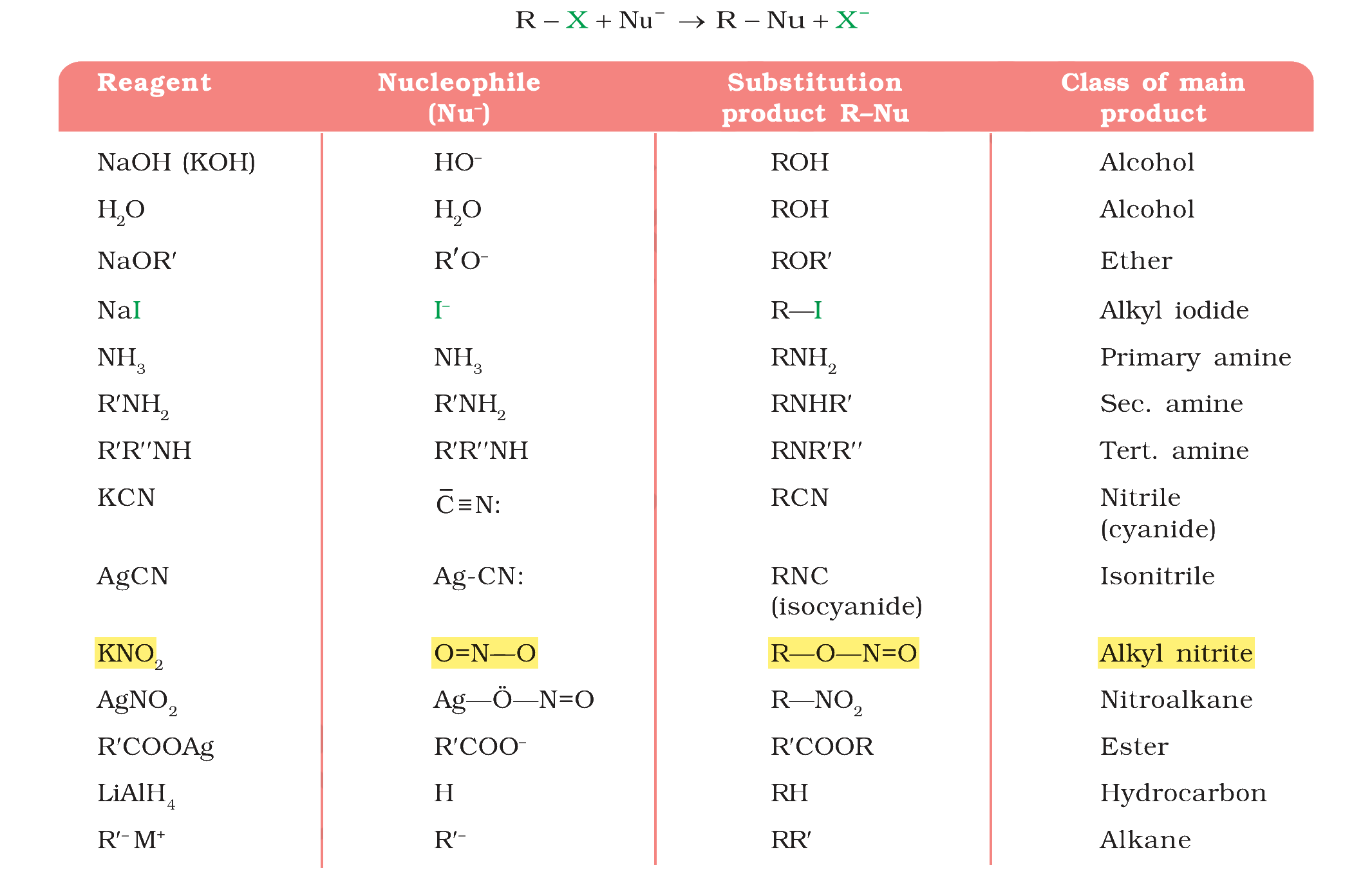
6.7.1 Reactions of Haloalkanes – “Groups like cyanides and nitrites possess two nucleophilic centres and are called ambident nucleophiles.”