
Which of the following compound will undergo azo coupling reaction with benzene diazonium chloride?
(A) Aniline
(B) Phenol
(C) p-Toluidine
(D) Nitrobenzene
Choose the correct answer from the options given below:
Answer & explanation
Correct answer: option 4
The correct answer is Option (4) → (A), (B) and (C) only
Core Concept
Azo coupling occurs with activated aromatic rings containing electron donating groups like $-OH$ and $-NH_2$, which increase electron density and facilitate electrophilic substitution.
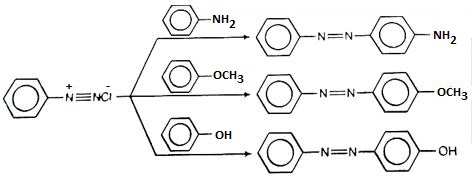
Detailed Explanation
Option A: Aniline
Aniline contains an $-NH_2$ group which is strongly activating and increases electron density in the aromatic ring. This allows the ring to undergo electrophilic substitution with benzene diazonium chloride, leading to azo coupling.
Option B: Phenol
Phenol contains an $-OH$ group which activates the ring through resonance donation of electrons. This makes the aromatic ring reactive towards electrophilic attack by the diazonium ion, enabling azo coupling.
Option C: p-Toluidine
p-Toluidine contains both $-NH_2$ and $-CH_3$ groups, both of which are electron donating. These groups strongly activate the aromatic ring and make azo coupling feasible.
Option D: Nitrobenzene
Nitro group is strongly electron withdrawing and deactivates the aromatic ring. This reduces electron density and prevents electrophilic substitution, so azo coupling does not occur.