
Arrange the following steps of the Hershey and Chase experiment in correct sequence:
(A) Labelling of some bacteriophages with radioactive phosphorus and some with radioactive sulfur.
(B) Agitating in blender followed by centrifugation.
(C) Infecting E. coli in two batches with two differently labelled bacteriophages.
(D) Identification of radioactivity in supernatant and sediment
Choose the correct answer from the options given below:
Answer & explanation
Correct answer: option 1
The correct answer is Option (1) → (A), (C), (B), (D)
(A) Labelling of some bacteriophages with radioactive phosphorus and some with radioactive sulfur.
(C) Infecting E. coli in two batches with two differently labeled bacteriophages.
(B) Agitating in a blender followed by centrifugation.
(D) Identification of radioactivity in supernatant and sediment
The unequivocal proof that DNA is the genetic material came from the experiments of Alfred Hershey and Martha Chase (1952). They worked with viruses that infect bacteria called bacteriophages. The bacteriophage attaches to the bacteria and its genetic material then enters the bacterial cell. The bacterial cell treats the viral genetic material as if it was its own and subsequently manufactures more virus particles. Hershey and Chase worked to discover whether it was protein or DNA from the viruses that entered the bacteria. They grew some viruses on a medium that contained radioactive phosphorus and some others on medium that contained radioactive sulfur. Viruses grown in the presence of radioactive phosphorus contained radioactive DNA but not radioactive protein because DNA contains phosphorus but protein does not. Similarly, viruses grown on radioactive sulfur contained radioactive protein but not radioactive DNA because DNA does not contain sulfur. Radioactive phages were allowed to attach to E. coli bacteria. Then, as the infection proceeded, the viral coats were removed from the bacteria by agitating them in a blender. The virus particles were separated from the bacteria by spinning them in a centrifuge. Bacteria which was infected with viruses that had radioactive DNA were radioactive, indicating that DNA was the material that passed from the virus to the bacteria. Bacteria that were infected with viruses that had radioactive proteins were not radioactive. This indicates that proteins did not enter the bacteria from the viruses. DNA is therefore the genetic material that is passed from virus to bacteria.
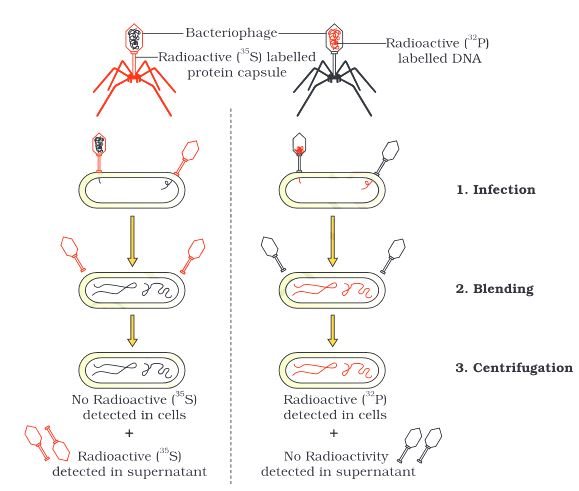
The Hershey-Chase experiment