
CUETMOCK
  • Pricing
  • Mentors
Log inStart freeStart free mocks→

First test, then trust

Try a free CUET mock test.

Join 5,00,000+ students who rehearsed exam day on the exact NTA screen before sitting CUET. On the web and on Android.

Start free mocks →Get the Android app
CUETMOCK

India's #1 CUET Mock Test Platform. Original NCERT-based questions on the exact NTA exam screen — trusted by 5,00,000+ students since CUET 2022.

Get it onGoogle PlayScan to download the CUETMOCK app

Mock tests

  • CUET mock test series
  • Commerce mocks
  • Humanities (Arts) mocks
  • Science mocks
  • Languages & GAT mocks
  • Free practice questions
  • Pricing

Resources

  • CUET exam guide
  • CUET syllabus
  • Universities accepting CUET
  • Expert blogs
  • News & notifications
  • Webinars & counselling
  • CUET score calculator
  • How we estimate your rank
  • FAQs

Company

  • About us
  • Our leadership & team
  • Our toppers
  • Mentors
  • For schools
  • Contact us
  • Terms
  • Privacy
  • Refund policy

Talk to us

+91 7696 6630 56info@cuetmock.comWhatsApp us

Our other platforms

  • JEE Mock — For IIT-JEE aspirants
  • NEET Mock — For NEET aspirants

Newsletter

Exam updates, study material and offers — no spam.

© 2026 NYC Ventures Pvt. Ltd.

701-702, Royal Business Park, Zirakpur, Punjab - 140603

  • Terms of use
  • Privacy policy
  • Refund policy
  • Contact us

iCUETMOCK is an independent preparation platform, not affiliated with the National Testing Agency (NTA). Always check exam details on the official NTA website.

  • Home
  • Mock tests
  • CUET guide
  • Pricing
  • Log in
Home/Practice questions/Chemistry
ChemistryOrganic: Haloalkanes and Haloarenes

Identify the compound which is chiral ?

Haloalkanes

The alkyl halides (haloalkanes) are formed by replacement of hydrogen atom(s) in an aliphatic hydrocarbon by halogen atom(s). The homologous series of haloalkanes is represented by CnH2n+1X. They are further classified as primary, secondary or tertiary according to the nature of carbon to which halogen is attached. If halogen is attached to a primary carbon atom in an alkyl halide, the alkyl halide is called primary alkyl halide or 1° alkyl halide. Similarly, if halogen is attached to secondary or tertiary carbon atom, the alkyl halide is called secondary alkyl halide (2°) and tertiary (3°) alkyl halide, respectively. These are very slightly soluble in water but soluble in organic solvents. The photochemical bromination of alkanes gives a complex mixture of isomeric haloalkanes. The free radical monobromination of compound “A” (C5H12) gives some chiral and achiral 1°, 2° and 3° structural isomers. The boiling points of isomeric haloalkanes decrease with increase in branching. Most common reactions of alkyl halides are nucleophilic substitution reactions (SN1 and SN2), elimination and reactions with metals. When a chiral bromoalkane isomer of “A” is treated with magnesium metal in dry ether, it gives an organometallic compound which further reacts with water to give the hydrocarbon “B”, but if this isomer is heated with sodium metal in dry ether yields a different hydrocarbon “C”. The SN1 reaction occurs in two steps. In step I, the polarised C—Br bond undergoes slow cleavage to produce a carbocation and a bromide ion followed by attack of nucleophile (like hydroxide ion) in step-2. The haloalkane which gives more stable carbocation undergoes SN1 reaction with faster rate. In elimination reaction, the formation of an alkene as major and minor products by dehydrohalogenation of an alkyl halide is governed by Saytzeff rule which states that “the preferred product is that alkene which has the greater number of alkyl groups attached to the doubly bonded carbon atoms.”

Identify the compound which is chiral ?

Answer & explanation+

Correct answer: option 3

The correct answer is Option (3) → 2-Bromo-3-methylbutane

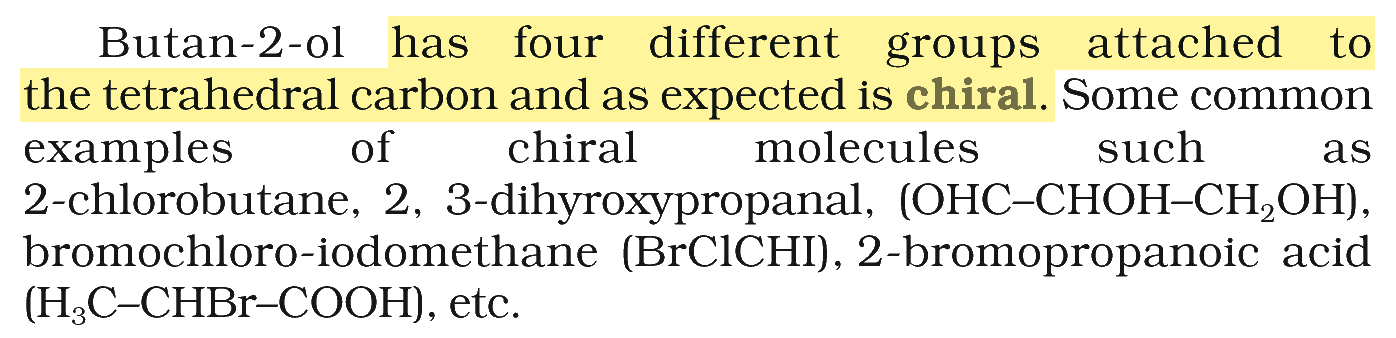
A molecule is chiral when it cannot be superimposed on its mirror image. The usual cause is a chiral carbon: an sp3 carbon attached to four different groups.

In 2-bromo-3-methylbutane, \( \ce{CH3-CHBr-CH(CH3)2} \), carbon C-2 carries H, Br, CH3 and CH(CH3)2: four different groups. So the compound is chiral.

Why the other options are incorrect

  • Option (1) 1-Bromopentane — Incorrect. \( \ce{BrCH2CH2CH2CH2CH3} \) has no carbon with four different groups (each \( \ce{CH2} \) has two H atoms).

  • Option (2) 2-Bromo-2-methylbutane — Incorrect. C-2 carries two identical \( \ce{CH3} \) groups, so it is not a chiral carbon.

  • Option (4) 3-Bromopentane — Incorrect. \( \ce{CH3CH2-CHBr-CH2CH3} \); C-3 carries two identical ethyl groups, so the molecule is achiral.

NCERT (2026-27 edition):
Reactions of Haloalkanes – …
Textbook extract

Advertisement

Practise more on Organic: Haloalkanes and Haloarenes

Chapter-wise mocks on the real NTA exam screen, with solutions and your rank. Your first mocks are free.

Start free mocks →

Advertisement

Next questions

  1. The two possible positions of an object kept in front of a lens of power +10\ D , so that the image formed in both cases is five times magn…Physics · Ray Optics
  2. To have a simple microscope of linear magnification = 7.25 for the image to be formed at the near point D = 25\ cm , the focal length of it…Physics · Ray Optics
  3. The order of a reaction with rate-constant, k = 4x10⁻⁵ mol L-1 s-1 isChemistry · Physical: Chemical Kinetics
  4. Match the idioms in List-I with their appropriate meanings in List-IILIST-I (IDIOMS)LIST-II (MEANINGS)A.Black and blueI.Sudden or unexpecte…English · Grammar: Idioms
  5. Which of the following is mainly responsible for the regional variation in the density of rural road in India?Geography · India-People and Economy: Transport and Communcation
  6. A long solenoid with 15 turns per cm has a small loop of area ≤ft(displaystyle6/(π)) cm2 placed inside the solenoid normal to its axis. If…Physics · Electromagnetic Induction
  7. Match the LIST-I with LIST-IILIST-I(Events)LIST-II(Country)A.Opposed policy of “coalition of the willing”I.SwedenB.The 28th member of the E…Political Science · Contemporary World Politics: Contemporary Centres of power
  8. The percentage (%) of photosynthetically active radiation (PAR) absorbed by plants is -Biology · Ecosystem
  9. Match List-I with List-II in the context of Young's double slit experiment.List-IList-II(A) Fringe width(I) path difference = ((2n+1)λ)/2 ;…Physics · Wave Optics
  10. Mr. Bean purchased a laptop for Rs. 75,000. The laptop is estimated to have a scrap value of Rs. 10,000 after a span of 8 years. The book v…Applied Maths. Section B2 · Financial Mathematics