
CUETMOCK
  • Pricing
  • Mentors
Log inStart freeStart free mocks→

First test, then trust

Try a free CUET mock test.

Join 5,00,000+ students who rehearsed exam day on the exact NTA screen before sitting CUET. On the web and on Android.

Start free mocks →Get the Android app
CUETMOCK

India's #1 CUET Mock Test Platform. Original NCERT-based questions on the exact NTA exam screen — trusted by 5,00,000+ students since CUET 2022.

Get it onGoogle PlayScan to download the CUETMOCK app

Mock tests

  • CUET mock test series
  • Commerce mocks
  • Humanities (Arts) mocks
  • Science mocks
  • Languages & GAT mocks
  • Free practice questions
  • Pricing

Resources

  • CUET exam guide
  • CUET syllabus
  • Universities accepting CUET
  • Expert blogs
  • News & notifications
  • Webinars & counselling
  • CUET score calculator
  • How we estimate your rank
  • FAQs

Company

  • About us
  • Our leadership & team
  • Our toppers
  • Mentors
  • For schools
  • Contact us
  • Terms
  • Privacy
  • Refund policy

Talk to us

+91 7696 6630 56info@cuetmock.comWhatsApp us

Our other platforms

  • JEE Mock — For IIT-JEE aspirants
  • NEET Mock — For NEET aspirants

Newsletter

Exam updates, study material and offers — no spam.

© 2026 NYC Ventures Pvt. Ltd.

701-702, Royal Business Park, Zirakpur, Punjab - 140603

  • Terms of use
  • Privacy policy
  • Refund policy
  • Contact us

iCUETMOCK is an independent preparation platform, not affiliated with the National Testing Agency (NTA). Always check exam details on the official NTA website.

  • Home
  • Mock tests
  • CUET guide
  • Pricing
  • Log in
Home/Practice questions/Chemistry
ChemistryPhysical: Chemical Kinetics

The order of a reaction with rate-constant, k = 4x10⁻⁵ mol L-1 s-1 is

The order of a reaction with rate-constant, k = 4x10⁻⁵ mol L-1 s-1 is

Answer & explanation+

Correct answer: option 3

The correct answer is Option (3) → Zero order

The rate of a reaction is the change in concentration per unit time, so the unit of rate is always mol L−1 s−1.

For a reaction of order n:

    \( \displaystyle \text{Rate}=k[\text{A}]^{n},\quad k=\frac{\text{Rate}}{[\text{A}]^{n}} \)

    \( \displaystyle \text{Unit of }k=\frac{\mathrm{mol\,L^{-1}\,s^{-1}}}{(\mathrm{mol\,L^{-1}})^{n}}=(\mathrm{mol\,L^{-1}})^{1-n}\,\mathrm{s^{-1}} \)

Zero order (n = 0):

    \( \displaystyle \text{Unit of }k=(\mathrm{mol\,L^{-1}})^{1}\,\mathrm{s^{-1}}=\mathrm{mol\,L^{-1}\,s^{-1}} \)

Third order (n = 3):

    \( \displaystyle \text{Unit of }k=(\mathrm{mol\,L^{-1}})^{-2}\,\mathrm{s^{-1}}=\mathrm{mol^{-2}\,L^{2}\,s^{-1}} \)

The given rate constant, 4 × 10⁻⁵ mol L−1 s−1, has the same unit as the rate itself. So the reaction is zero order.

Why the other options are incorrect

  • Option (1) First order — Incorrect. The unit of k would be s−1.

  • Option (2) Second order — Incorrect. The unit of k would be mol−1 L s−1.

  • Option (4) Third order — Incorrect. The unit of k would be mol−2 L2 s−1.

NCERT (2026-27 edition):
Order of a Reaction – …
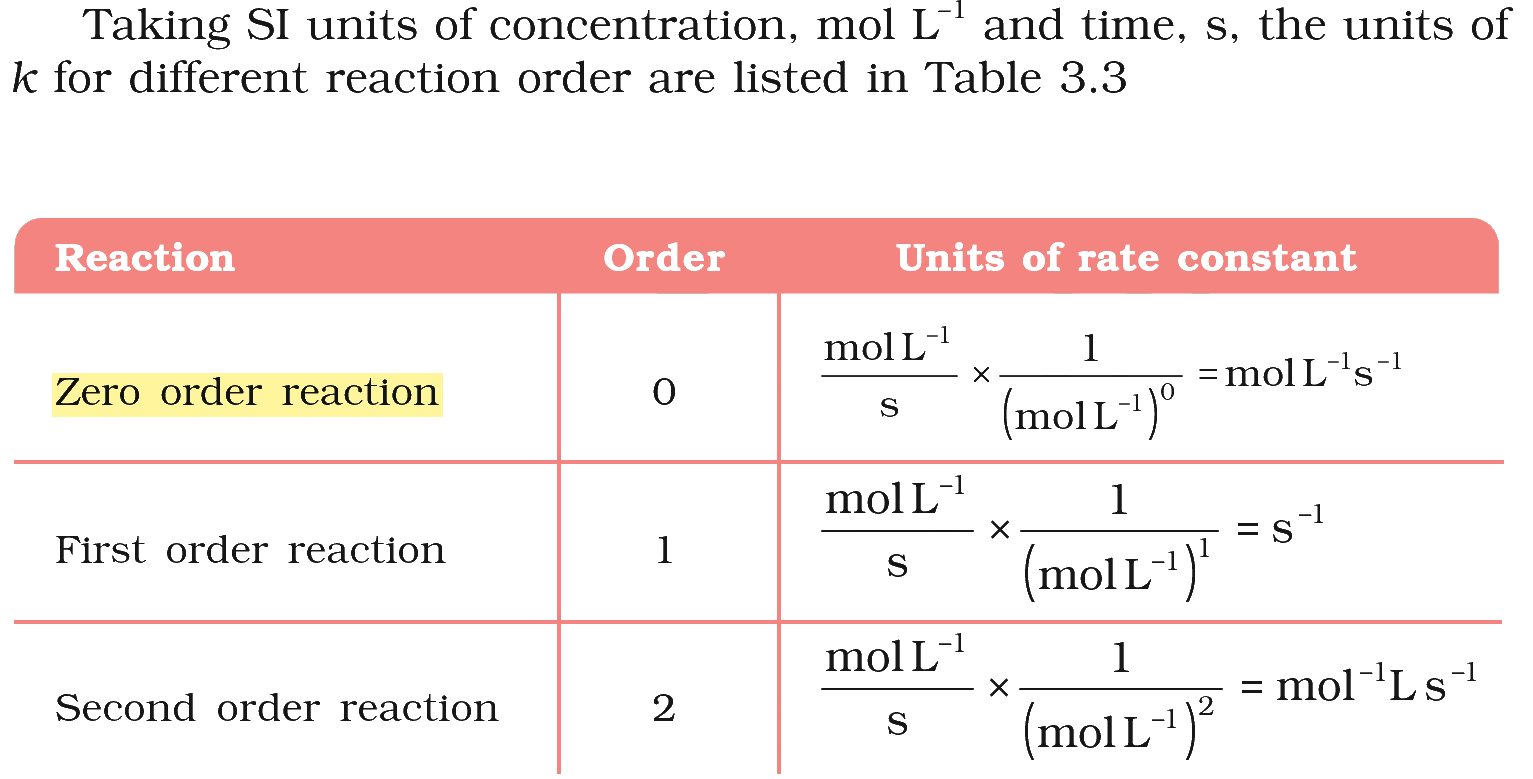
Textbook extract

Note: The same/similar question has been asked in different years by NTA as per the details given below:

20262025202420232022
18-05 S129-05 S1–––

Advertisement

Practise more on Physical: Chemical Kinetics

Chapter-wise mocks on the real NTA exam screen, with solutions and your rank. Your first mocks are free.

Start free mocks →

Advertisement

Next questions

  1. Match the idioms in List-I with their appropriate meanings in List-IILIST-I (IDIOMS)LIST-II (MEANINGS)A.Black and blueI.Sudden or unexpecte…English · Grammar: Idioms
  2. Which of the following is mainly responsible for the regional variation in the density of rural road in India?Geography · India-People and Economy: Transport and Communcation
  3. A long solenoid with 15 turns per cm has a small loop of area ≤ft(displaystyle6/(π)) cm2 placed inside the solenoid normal to its axis. If…Physics · Electromagnetic Induction
  4. Match the LIST-I with LIST-IILIST-I(Events)LIST-II(Country)A.Opposed policy of “coalition of the willing”I.SwedenB.The 28th member of the E…Political Science · Contemporary World Politics: Contemporary Centres of power
  5. The percentage (%) of photosynthetically active radiation (PAR) absorbed by plants is -Biology · Ecosystem
  6. Match List-I with List-II in the context of Young's double slit experiment.List-IList-II(A) Fringe width(I) path difference = ((2n+1)λ)/2 ;…Physics · Wave Optics
  7. Mr. Bean purchased a laptop for Rs. 75,000. The laptop is estimated to have a scrap value of Rs. 10,000 after a span of 8 years. The book v…Applied Maths. Section B2 · Financial Mathematics
  8. Choose the most appropriate passive construction of the given sentence from the options given below:-The owner himself showed them the hous…English · Grammar: Active Passive Voice
  9. Match the LIST-I with LIST-IILIST-I(Leaders)LIST-II(Known for)A.A K GopalanI.Founding President of the Congress Socialist PartyB.Acharya Na…Political Science · Politics in India Since Independence: Era of one Party Dominance
  10. Which of the following types of intelligences are included in Howard Gardner’s Multiple Intelligences Theory?A. MusicalB. SpatialC. Compone…Psychology · Variations in Psychological Attributes