
CUETMOCK
  • Pricing
  • Mentors
Log inStart freeStart free mocks→

First test, then trust

Try a free CUET mock test.

Join 5,00,000+ students who rehearsed exam day on the exact NTA screen before sitting CUET. On the web and on Android.

Start free mocks →Get the Android app
CUETMOCK

India's #1 CUET Mock Test Platform. Original NCERT-based questions on the exact NTA exam screen — trusted by 5,00,000+ students since CUET 2022.

Get it onGoogle PlayScan to download the CUETMOCK app

Mock tests

  • CUET mock test series
  • Commerce mocks
  • Humanities (Arts) mocks
  • Science mocks
  • Languages & GAT mocks
  • Free practice questions
  • Pricing

Resources

  • CUET exam guide
  • CUET syllabus
  • Universities accepting CUET
  • Expert blogs
  • News & notifications
  • Webinars & counselling
  • CUET score calculator
  • How we estimate your rank
  • FAQs

Company

  • About us
  • Our leadership & team
  • Our toppers
  • Mentors
  • For schools
  • Contact us
  • Terms
  • Privacy
  • Refund policy

Talk to us

+91 7696 6630 56info@cuetmock.comWhatsApp us

Our other platforms

  • JEE Mock — For IIT-JEE aspirants
  • NEET Mock — For NEET aspirants

Newsletter

Exam updates, study material and offers — no spam.

© 2026 NYC Ventures Pvt. Ltd.

701-702, Royal Business Park, Zirakpur, Punjab - 140603

  • Terms of use
  • Privacy policy
  • Refund policy
  • Contact us

iCUETMOCK is an independent preparation platform, not affiliated with the National Testing Agency (NTA). Always check exam details on the official NTA website.

  • Home
  • Mock tests
  • CUET guide
  • Pricing
  • Log in
Home/Practice questions/Chemistry
ChemistryPhysical: Electro Chemistry

A zero reading in the voltmeter indicates

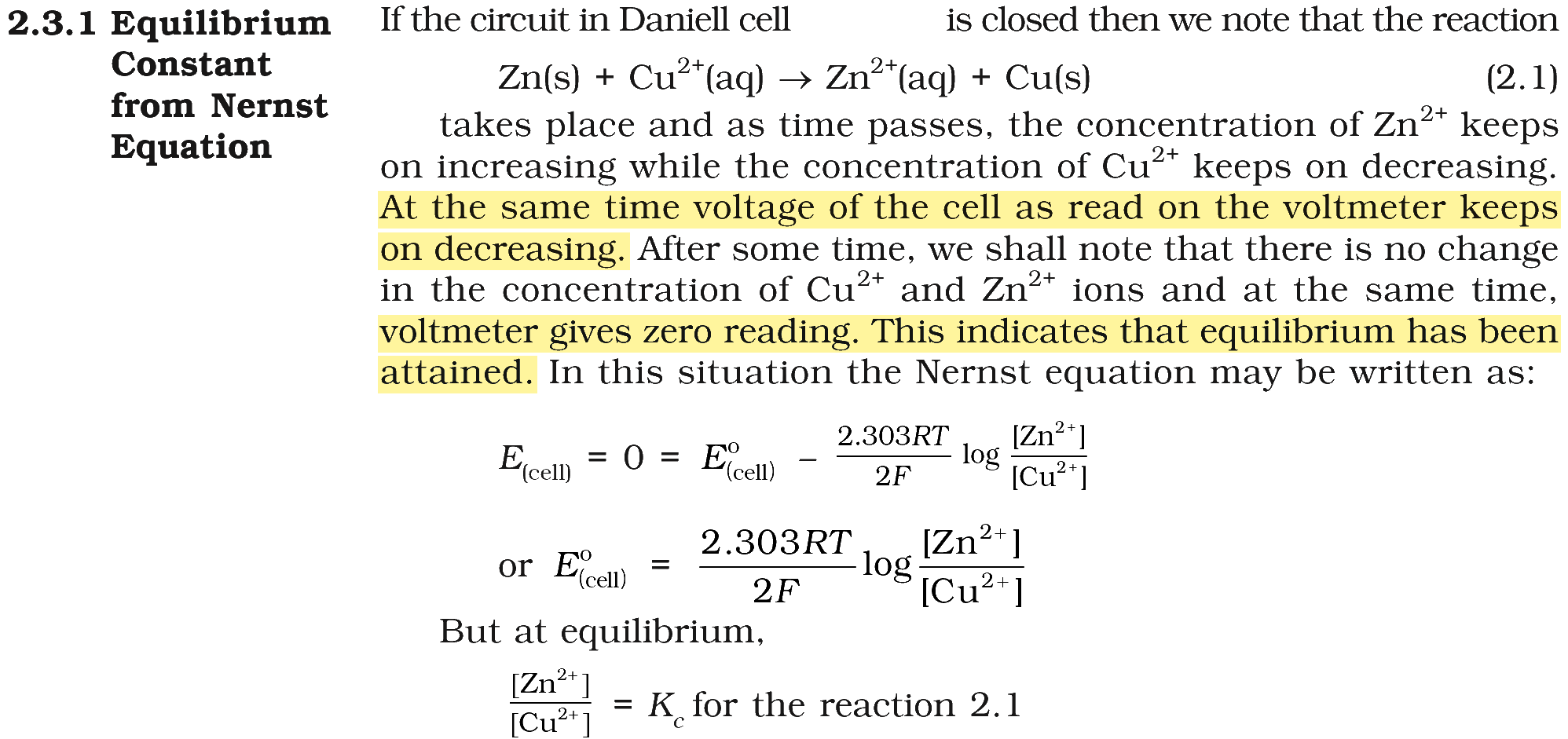
A Daniell Cell is an electrochemical cell that converts chemical energy into electrical energy through a spontaneous redox reaction. It is also referred as a galvanic or voltaic cell. It consists of two half-cells that are connected by a salt bridge to maintain electrical neutrality through the flow of ions. The first half-cell consists of a Zn rod dipped in a ZnSO4 solution, while the other half-cell consists of a Cu rod immersed in a CuSO4 solution. The two rods are connected by a wire to complete the circuit through which the electron flows, and a voltmeter may be connected in the circuit to measure the electrode potential. If the circuit in a Daniell cell represented by the cell notation, Zn | Zn2+ || Cu2+ | Cu, is closed, then it is observed that as time passes the concentration of Zn2+ keeps on increasing, while the concentration of Cu2+ keeps on decreasing. At the same time, the voltage of the cell as read on the voltmeter keeps on decreasing. After some time, the voltmeter shows zero reading.

A zero reading in the voltmeter indicates

Answer & explanation+

Correct answer: option 3

The correct answer is Option (3) → The equilibrium has been attained, and no change in the concentration of Cu2+ and Zn2+ ions is observed.

The potential of the Daniell cell depends on the ion concentrations through the Nernst equation (at 298 K, n = 2):

    \( \displaystyle E_{cell}=E^{\circ}_{cell}-\frac{0.059}{2}\log\frac{[\ce{Zn^2+}]}{[\ce{Cu^2+}]} \)

As the cell works, \( \ce{[Zn^{2+}]} \) rises and \( \ce{[Cu^{2+}]} \) falls, so the log term grows and Ecell keeps decreasing. It reaches zero when the ratio \( \ce{[Zn^{2+}]} \)/\( \ce{[Cu^{2+}]} \) becomes equal to the equilibrium constant Kc. At that point the forward and backward reactions go at the same rate: the reaction is at equilibrium, no net current flows, and the concentrations stop changing.

So a zero reading means that equilibrium has been attained.

Why the other options are incorrect

  • Option (1) The entire solid Zn has been consumed and converted to Zn2+ ions. — Incorrect. The reading falls to zero because the ion ratio has reached Kc, not because the zinc rod has been used up; zinc metal can still be present at equilibrium.

  • Option (2) All the Cu2+ ions have been converted to solid Cu. — Incorrect. At equilibrium some \( \ce{Cu^{2+}} \) ions are still left in the solution; the reaction stops at the equilibrium ratio, not at complete conversion.

  • Option (4) Ecell has attained a negative value. — Incorrect. The cell potential falls to zero and stays there at equilibrium. It does not turn negative on its own; the reaction runs in the reverse direction only when an external opposing potential greater than 1.1 V is applied.

NCERT (2026-27 edition):
Equilibrium Constant from Nernst Equation
Textbook extract

Note: The same/similar question has been asked in different years by NTA as per the details given below:

20262025202420232022
07-06 S2
29-05 S2
––––

Advertisement

Practise more on Physical: Electro Chemistry

Chapter-wise mocks on the real NTA exam screen, with solutions and your rank. Your first mocks are free.

Start free mocks →

Advertisement

Next questions

  1. Identify the chemicals produced by Calotropis that provide defense against grazers and browsers.Biology · Organisms and Populations
  2. Which of the following differential equations has y=x as one of the particular solution?Maths. Section B1 · Differential Equations
  3. Nithya, Sathya and Mithya were partners sharing profits and losses in the ratio of 5:3:2. Mithya dies on August 1, 2025. On this date, the…Accountancy Part A · Reconstitution of Partnership Firm: Retirement and Death
  4. If y=√((1-x)/(1+x)) , then the value of (1-x^2)displaystyledy/dx+y isMaths. Section A · Continuity and Differentiability
  5. The power of a lens is +5 D. This lens is cut vertically into two equal halves. An object is placed at 80 cm from one of the two lenses on…Physics · Ray Optics
  6. “It measures an individual’s potential for learning new skills”. The statement describes:Business Studies · Staffing
  7. What does the term “Business Environment” refer to?Business Studies · Business Environment
  8. Identify the compound which is chiral ?Chemistry · Organic: Haloalkanes and Haloarenes
  9. The two possible positions of an object kept in front of a lens of power +10\ D , so that the image formed in both cases is five times magn…Physics · Ray Optics
  10. To have a simple microscope of linear magnification = 7.25 for the image to be formed at the near point D = 25\ cm , the focal length of it…Physics · Ray Optics