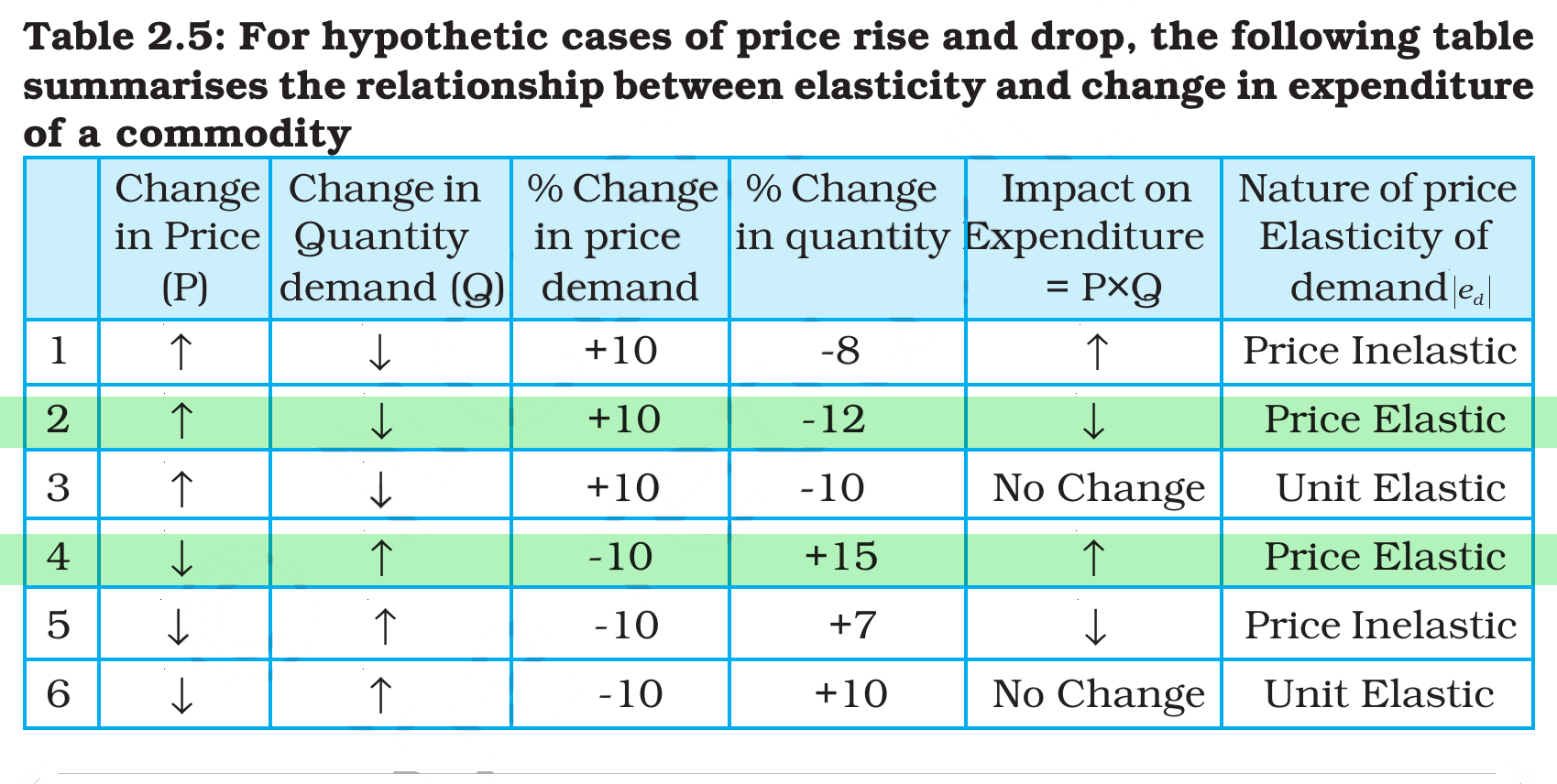
The expenditure on the good would change in the opposite direction as the price change if and only if the percentage change in quantity is greater than the percentage change in price, then the elasticity of good is:
Answer & explanation
Correct answer: option 4
The correct answer is Option (4) → Price Elastic
Price elasticity of demand measures how strongly buyers react to a change in price: it is the percentage change in quantity demanded divided by the percentage change in price. The spending, or expenditure, on a good is price × quantity. When the price rises, people buy less, so one factor goes up while the other comes down, and whichever changes by the larger percentage decides which way expenditure moves:
If the percentage change in quantity is greater than the percentage change in price, expenditure moves in the opposite direction to the price: demand is price elastic.
If it is smaller, expenditure moves in the same direction as the price: demand is price inelastic.
If the two are equal, expenditure does not change: demand is unit elastic.
Why the other options are incorrect
Option (1) Infinite — Incorrect. Infinite elasticity means a horizontal demand curve, where the slightest rise in price makes demand fall to zero. It is an extreme case, not the general condition.
Option (2) Unit Elastic — Incorrect. Unit elastic demand leaves expenditure unchanged when the price changes; it does not move against the price.
Option (3) Price Inelastic — Incorrect. Inelastic demand makes expenditure move with the price, not against it.
NCERT (2025-26): “2.6.3 Elasticity and Expenditure … The expenditure on the good would change in the opposite direction as the price change if and only if the percentage change in quantity is greater than the percentage change in price, ie if the good is price-elastic (see rows 2 and 4 in table 2.5). The expenditure on the good would change in the same direction as the price change if and only if the percentage change in quantity is less than the percentage change in price, i.e., if the good is price inelastic (see rows 1 and 5 in table 2.5). The expenditure on the good would remain unchanged if and only if the percentage change in quantity is equal to the percentage change in price, i.e., if the good is unit-elastic (see rows 3 and 6 in table 2.5).…”
|