Consider the following statements regarding the demand for money and choose the correct statements.
A. Speculative demand for money is inversely related to the rate of interest.
B. Demand for money balance is often referred to as transaction preference.
C. People desire to hold money broadly for speculative and transaction motive.
D. Transaction demand for money is inversely related to the real income of an economy.
Choose the correct answer from the options given below:
Answer & explanation
Correct answer: option 3
The correct answer is Option (3) → A and C only
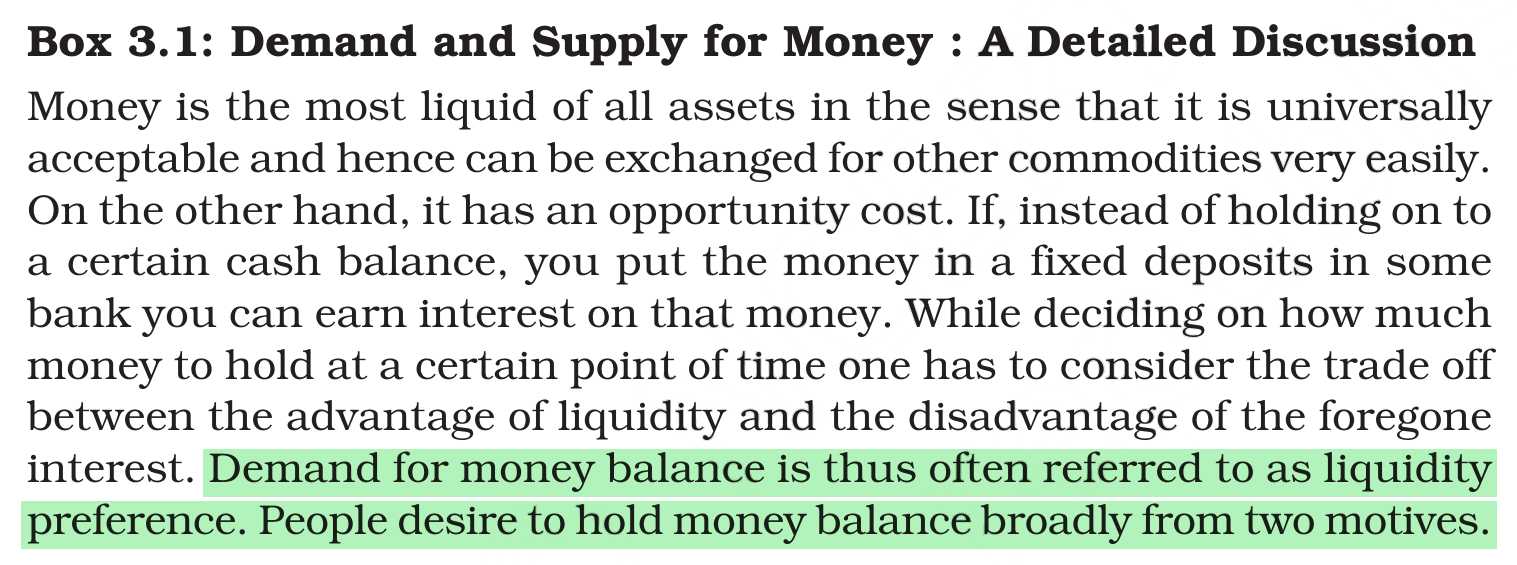
Money earns no interest, yet people keep part of their wealth as money because it can be used at once; this demand for money balance is called liquidity preference. They hold it for two broad motives:
Transaction motive: to pay for everyday purchases between one receipt of income and the next. The more people earn and spend, the more money they need, so transaction demand rises with real income (and with the price level).
Speculative motive: to gain from changes in bond prices, which move opposite to the rate of interest. When the rate is low, people expect it to rise and bond prices to fall, so they prefer holding money to bonds; speculative demand is inversely related to the rate of interest.
Taking the statements one by one:
A. Speculative demand for money is inversely related to the rate of interest. Correct. A low rate makes people expect falling bond prices, so they hold money rather than bonds: the lower the interest rate, the higher the speculative demand.
B. Demand for money balance is often referred to as transaction preference. Incorrect. The demand for money balance is called liquidity preference; the transaction motive is only one of the two reasons for holding money.
C. People desire to hold money broadly for speculative and transaction motive. Correct. These are the two broad motives for holding money balance.
D. Transaction demand for money is inversely related to the real income of an economy. Incorrect. A higher real income means more transactions to finance, so transaction demand is positively related to real income, not inversely.
NCERT: Introductory Macroeconomics — Chapter 3: Money and Banking, Box 3.1: Demand and Supply for Money (2025-26)
|