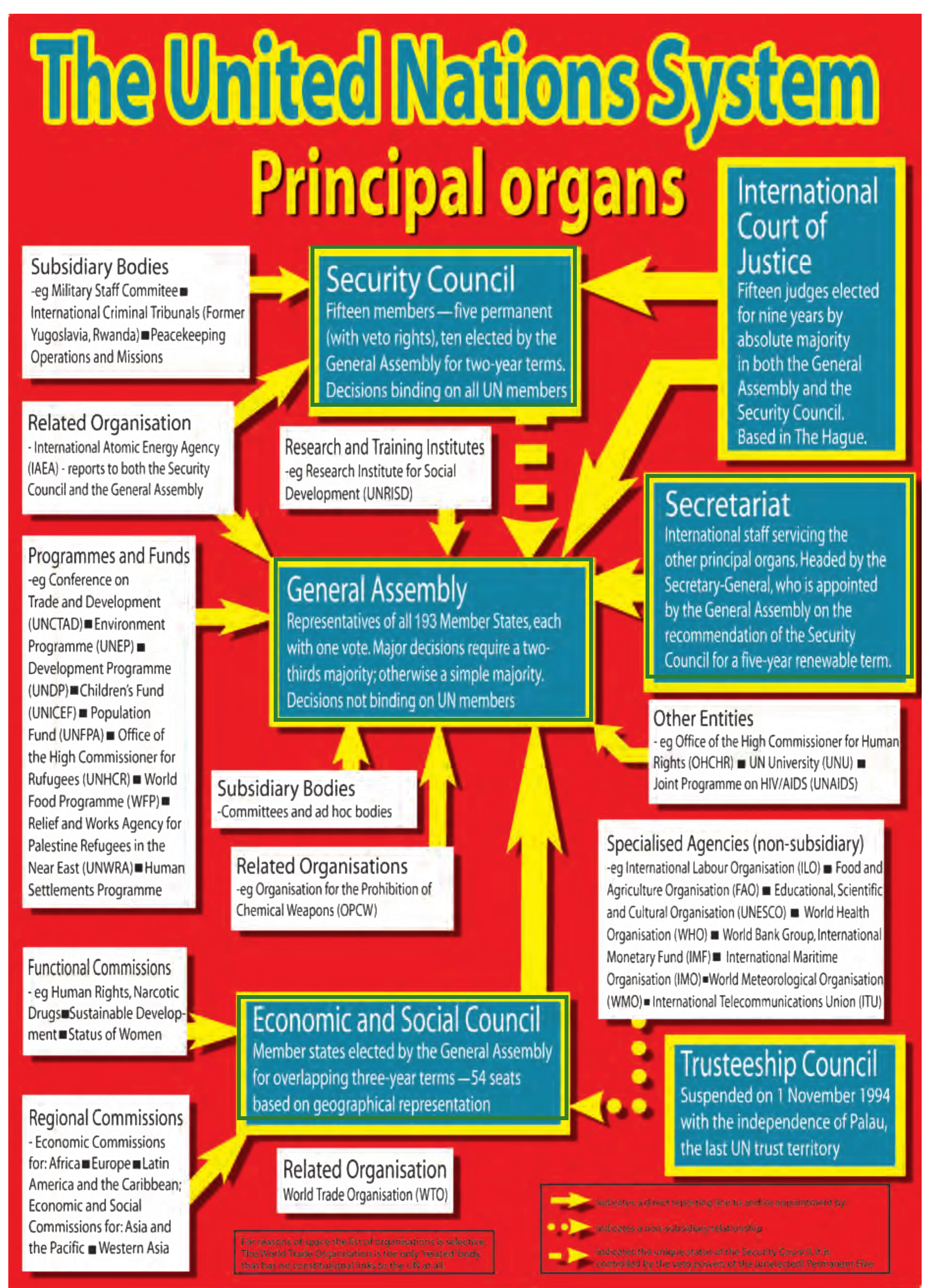
Match List-I with List-II
| List-I (UN Body) | List-II (Composition) |
| (A) Security Council | (I) International staff servicing the other principal organs, headed by the Secretary-General, who is appointed by the General Assembly on the recommendation of the Security Council. |
| (B) General Assembly | (II) Member states elected by the General Assembly for overlapping three-year terms – 54 seats based on geographical representation. |
| (C) Secretariat | (III) Fifteen members – five permanent (with veto rights), ten elected by the General Assembly for two-year terms. Decision binding on all UN members. |
| (D) Economic and Social Council | (IV) Representatives of all 193 Member States, each with one vote. Major decisions require a two-thirds majority; otherwise a simple majority. Decision not binding on UN members. |
Choose the correct answer from the options given below:
Answer & explanation
Correct answer: option 1
The correct answer is Option (1) → (A)-(III), (B)-(IV), (C)-(I), (D)-(II)
(A) Security Council — this matches (III) Fifteen members – five permanent (with veto rights), ten elected by the General Assembly for two-year terms. Decision binding on all UN members.
(B) General Assembly — this matches (IV) Representatives of all 193 Member States, each with one vote. Major decisions require a two-thirds majority; otherwise a simple majority. Decision not binding on UN members.
(C) Secretariat — this matches (I) International staff servicing the other principal organs, headed by the Secretary-General, who is appointed by the General Assembly on the recommendation of the Security Council.
(D) Economic and Social Council — this matches (II) Member states elected by the General Assembly for overlapping three-year terms – 54 seats based on geographical representation.
NCERT (2026-27): Contemporary World Politics — Chapter 4: International Organisations
The United Nations System — Principal organs: the Security Council, General Assembly, Secretariat and Economic and Social Council (outlined) |