
James Watson and Francis Crick gave a double strand helix structure for DNA. Two Nucleic acid chains are wound about each other and held together by hydrogen bonds between pairs of bases. The two strands are complementary to each other because the hydrogen bonds are formed between specific pairs of bases. Adenine forms hydrogen bonds with thymine whereas cytosine forms hydrogen bonds with guanine.
Match List I with List II
| LIST I | LIST II |
| A. Nucleic Acids | I. Phosphodiester linkage |
| B. Nucleotides | II. Base and Sugar |
| C. Nucleosides | III. Phosphoric acid |
| D. Dinucleotide | IV. Protein synthesis |
Choose the correct answer from the options given below:
Answer & explanation
Correct answer: option 1
The correct answer is Option (1) → A-IV, B-III, C-II, D-I
Nucleic acids are built in stages: base + sugar = nucleoside; nucleoside + phosphoric acid = nucleotide; nucleotides joined by phosphodiester links = dinucleotide → polynucleotide (nucleic acid).
A. Nucleic Acids — This matches IV. Protein synthesis. Nucleic acids carry the coded message for the proteins made in the cell, and RNA molecules carry out protein synthesis.
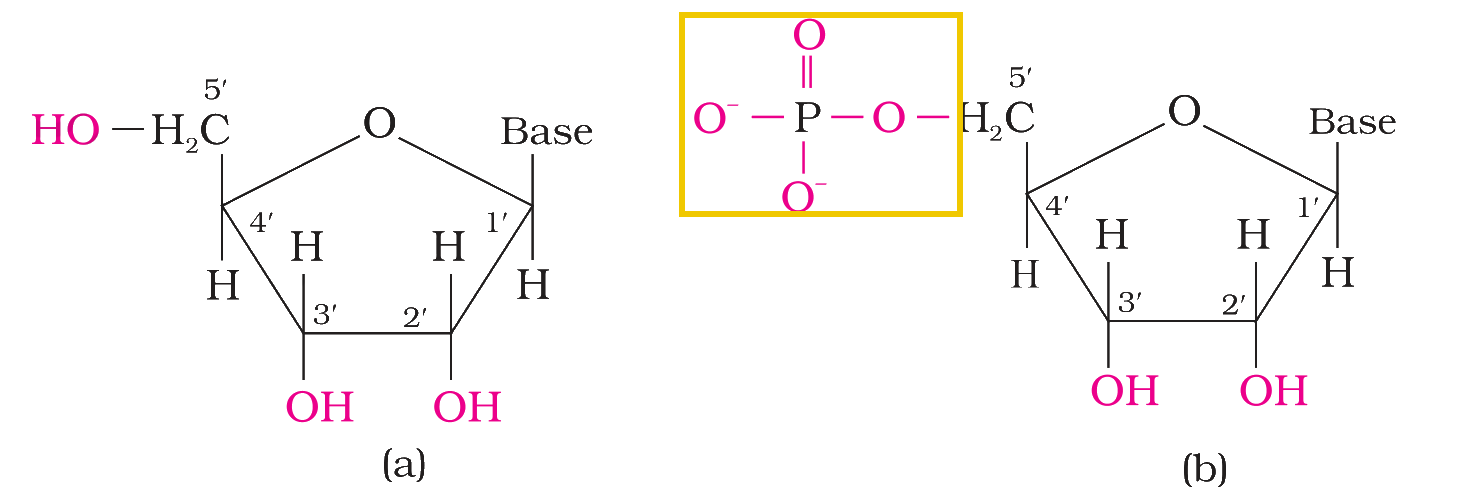
B. Nucleotides — This matches III. Phosphoric acid. A nucleotide is a nucleoside linked to phosphoric acid at the 5′ position of the sugar.
C. Nucleosides — This matches II. Base and Sugar. A nucleoside is a base attached to the 1′ position of the sugar, with no phosphate.
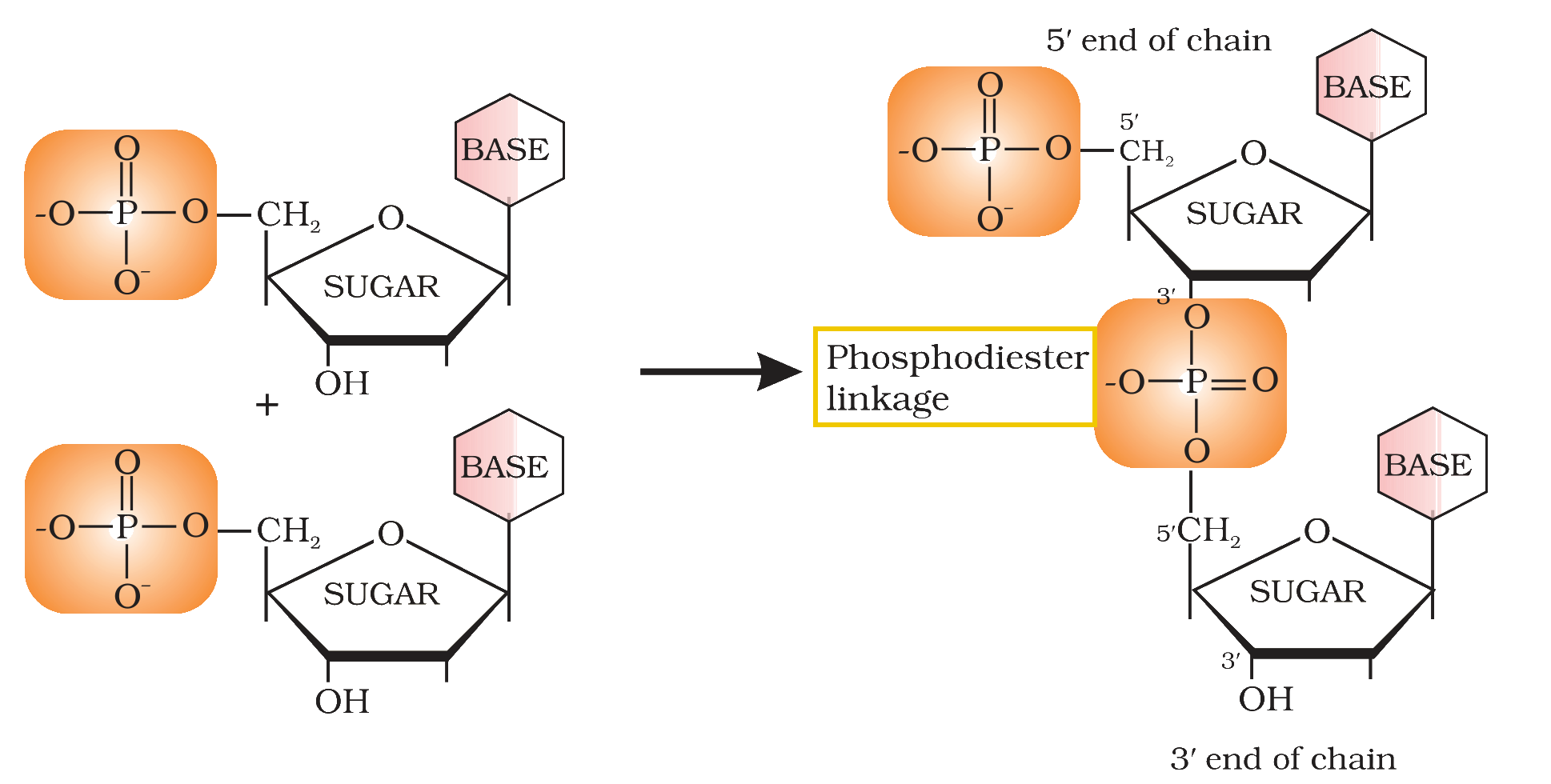
D. Dinucleotide — This matches I. Phosphodiester linkage. Two nucleotides are joined by a phosphodiester linkage between the 5′ and 3′ carbons of the sugars.
Shortcut: The pair B-III appears only in Option (1).
NCERT (2026-27 edition):
Structure of Nucleic Acids – “A unit formed by the attachment of a base to 1′ position of sugar is known as nucleoside. In nucleosides, the sugar carbons are numbered as 1′, 2′, 3′, etc. in order to distinguish these from the bases (Fig. 10.5a). When nucleoside is linked to phosphoric acid at 5′-position of sugar moiety, we get a nucleotide (Fig. 10.5).”
Structure of Nucleic Acids – “… Nucleotides are joined together by phosphodiester linkage between 5′ and 3′ carbon atoms of the pentose sugar. The formation of a typical dinucleotide is shown in Fig. 10.6.”
Biological Functions of Nucleic Acids – “DNA is the chemical basis of heredity and may be regarded as the reserve of genetic information. DNA is exclusively responsible for maintaining the identity of different species of organisms over millions of years. A DNA molecule is capable of self duplication during cell division and identical DNA strands are transferred to daughter cells. Another important function of nucleic acids is the protein synthesis in the cell. Actually, the proteins are synthesised by various RNA molecules in the cell but the message for the synthesis of a particular protein is present in DNA.”