
CUETMOCK
  • Pricing
  • Mentors
Log inStart freeStart free mocks→

First test, then trust

Try a free CUET mock test.

Join 5,00,000+ students who rehearsed exam day on the exact NTA screen before sitting CUET. On the web and on Android.

Start free mocks →Get the Android app
CUETMOCK

India's #1 CUET Mock Test Platform. Original NCERT-based questions on the exact NTA exam screen — trusted by 5,00,000+ students since CUET 2022.

Get it onGoogle PlayScan to download the CUETMOCK app

Mock tests

  • CUET mock test series
  • Browse all papers
  • Commerce mocks
  • Humanities (Arts) mocks
  • Science mocks
  • Languages & GAT mocks
  • Free practice questions
  • Pricing

Resources

  • CUET exam guide
  • CUET syllabus
  • Universities accepting CUET
  • Expert blogs
  • News & notifications
  • Webinars & counselling
  • CUET score calculator
  • How we estimate your rank
  • FAQs

Company

  • About us
  • Our leadership & team
  • Our toppers
  • Mentors
  • For schools
  • Contact us
  • Terms
  • Privacy
  • Refund policy

Talk to us

+91 7696 6630 56info@cuetmock.comWhatsApp us

Our other platforms

  • JEE Mock — For IIT-JEE aspirants
  • NEET Mock — For NEET aspirants

Newsletter

Exam updates, study material and offers — no spam.

© 2026 NYC Ventures Pvt. Ltd.

701-702, Royal Business Park, Zirakpur, Punjab - 140603

  • Terms of use
  • Privacy policy
  • Refund policy
  • Contact us

iCUETMOCK is an independent preparation platform, not affiliated with the National Testing Agency (NTA). Always check exam details on the official NTA website.

  • Home
  • Mock tests
  • CUET guide
  • Pricing
  • Log in
Home/Practice questions/Chemistry
ChemistryOrganic: Aldehydes, Ketones and Carboxylic Acids

Arrange the following compounds in increasing order of their reactivi…

Arrange the following compounds in increasing order of their reactivity towards HCN.
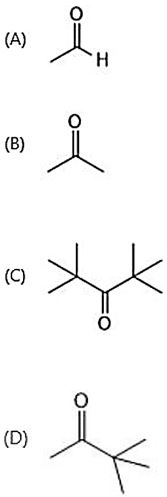
Figure for Q30

Choose the correct answer from the options given below:

Answer & explanation+

Correct answer: option 2

The correct answer is Option (2) → (C), (D), (B), (A)

Addition of HCN to a carbonyl compound is a nucleophilic addition: the cyanide ion attacks the carbonyl carbon, and the product is a cyanohydrin:

    \( \displaystyle \ce{CH3CHO + HCN} \xrightarrow{\ce{OH^-}} \ce{CH3CH(OH)CN} \)

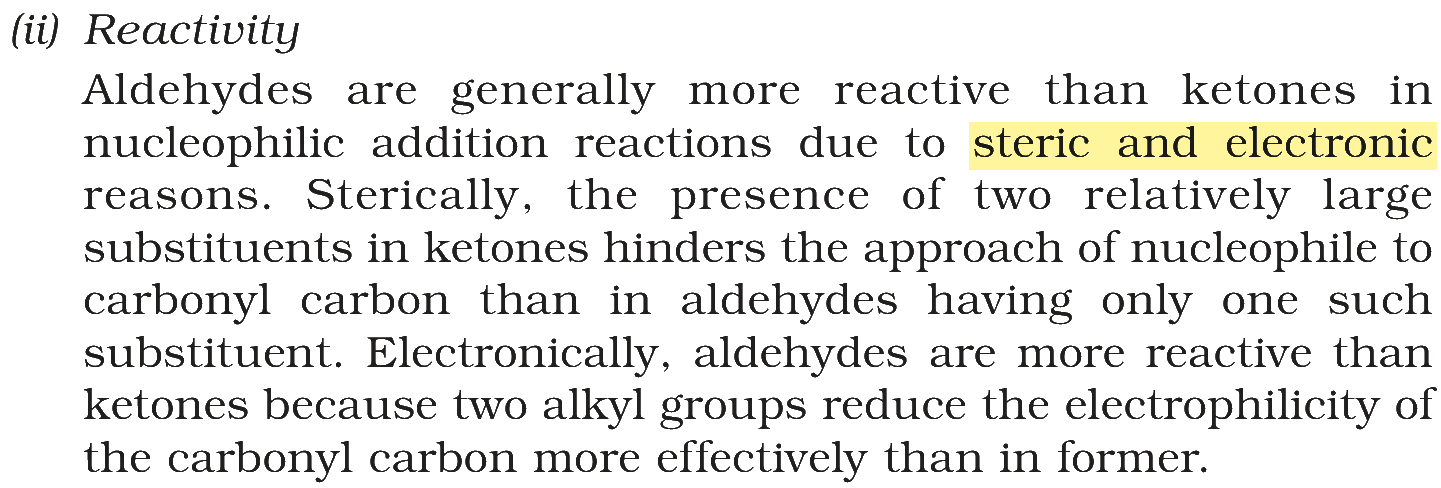
The reactivity depends on two factors. Steric: bulky groups around the carbonyl carbon hinder the approach of the nucleophile. Electronic: alkyl groups push electrons towards the carbonyl carbon and make it less positive. Both factors make aldehydes more reactive than ketones, and ketones with bulky groups the least reactive.

  • (A) Acetaldehyde, \( \ce{CH3CHO} \): one small methyl group and a hydrogen; the most reactive.

  • (B) Acetone, \( \ce{CH3COCH3} \): two methyl groups.

  • (D) Methyl tert-butyl ketone, \( \ce{CH3COC(CH3)3} \): one methyl and one bulky tert-butyl group.

  • (C) Di-tert-butyl ketone, \( \ce{(CH3)3CCOC(CH3)3} \): two bulky tert-butyl groups; the carbonyl carbon is the most crowded, so the least reactive.

NCERT (2026-27 edition):
Reactivity
Textbook extract

Advertisement

Practise more on Organic: Aldehydes, Ketones and Carboxylic Acids

Chapter-wise mocks on the real NTA exam screen, with solutions and your rank. Your first mocks are free.

Start free mocks →

Advertisement

Next questions

  1. Consider the following statements about prejudice and stereotypes.(A) Prejudices are examples of attitudes towards a particular group, and…Psychology · Attitudes and Social Cognition
  2. Which year was observed as International Year of Fresh Water?General Aptitude Test · General Knowledge
  3. Age structure represents the number of people based on which factor ?Geography · Fundamentals of Human Geography: Population Composition
  4. The passage also leaves out a line that contrasts accidental community membership with another kind of belonging. With what does that line…Sociology · Indian Society: Challenges of Cultural Diversity
  5. Function f(x)=cos ≤ft(log ≤ft(x+√(1+x^2))) is :Maths. Section B1 · Relations and Functions
  6. The solution of the differential equation (1+x y) x d y+(1-x y) y d x=0, isMaths. Section B1 · Differential Equations
  7. In which year did NFF (National Fishworkers’ Forum) fight its first legal battle with the Union government successfully?Political Science · Politics in India Since Independence: Rise of Popular Movements
  8. The following statement was given by which leader "Tomorrow we shall be free from the slavery of the British domination. But at midnight In…Political Science · Politics in India Since Independence: Challenges of nation Building
  9. The underlined part of the following sentence is an adverb clause of:Grandpa packed the mangoes so carefully that not one of them was bruis…English · Grammar: Clauses
  10. What is the height of the goal-post according to FIFA?General Aptitude Test · General Knowledge