
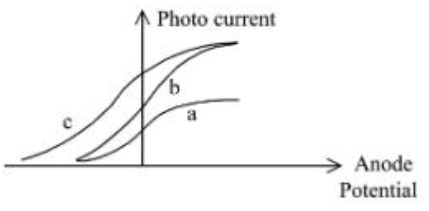
The figure shows the variation of photo current with anode potential for a photo-sensitive surface for three different radiations. Let \( I_{a}, I_{b} \) and \( I_{c} \) be the intensities and \( \gamma_{a}, \gamma_{b} \) and \( \gamma_{c} \) be the frequencies for the curves a, b and c respectively. Choose the correct statement.
Answer & explanation
Correct answer: option 1
The correct answer is Option (1) → \( \gamma_{a} = \gamma_{b};\ I_{b} = I_{c} \)
Two features of a photocurrent curve are read from the figure. The stopping potential is where the curve meets the potential axis on the negative side; the saturation current is the flat top of the curve.
By Einstein's photoelectric equation, for the same surface the stopping potential depends only on the frequency:
\( \displaystyle eV_0 = h\gamma - \phi_0 \)
The saturation current depends on the number of photoelectrons emitted per second, that is on the intensity of the radiation.
Readings from the figure:
\( \text{a and b start at the same negative potential: } V_{0a} = V_{0b} \;\Rightarrow\; \gamma_a = \gamma_b \)
\( \text{c starts at a larger negative potential: } V_{0c} \gt V_{0a} \;\Rightarrow\; \gamma_c \gt \gamma_a \)
\( \text{b and c reach the same saturation level: } I_b = I_c \)
\( \text{a saturates lower than b: } I_a \lt I_b \)
Option (1) \( \gamma_{a} = \gamma_{b};\ I_{b} = I_{c} \) — Correct. a and b have the same stopping potential, and b and c have the same saturation current.
Option (2) \( \gamma_{b} = \gamma_{c};\ I_{a} = I_{b} \) — Incorrect. c has a larger stopping potential than b, so \( \gamma_c \gt \gamma_b \); also \( I_a \lt I_b \).
Option (3) \( \gamma_{a} = \gamma_{c};\ I_{c} = I_{b} \) — Incorrect. c and a have different stopping potentials, so their frequencies are not equal.
Option (4) \( \gamma_{a} = \gamma_{b};\ I_{a} = I_{b} \) — Incorrect. \( \gamma_a = \gamma_b \) is right, but curve a saturates lower than curve b, so \( I_a \lt I_b \).
NCERT (2026-27):
Effect of Frequency of Incident Radiation on Stopping Potential – “… (ii) For a given photosensitive material and frequency of incident radiation, saturation current is found to be proportional to the intensity of incident radiation whereas the stopping potential is independent of its intensity (Fig. 11.3). … Above the threshold frequency, the stopping potential or equivalently the maximum kinetic energy of the emitted photoelectrons increases linearly with the frequency of the incident radiation, but is independent of its intensity (Fig. 11.5).”