
CUETMOCK
  • Pricing
  • Mentors
Log inStart freeStart free mocks→

First test, then trust

Try a free CUET mock test.

Join 5,00,000+ students who rehearsed exam day on the exact NTA screen before sitting CUET. On the web and on Android.

Start free mocks →Get the Android app
CUETMOCK

India's #1 CUET Mock Test Platform. Original NCERT-based questions on the exact NTA exam screen — trusted by 5,00,000+ students since CUET 2022.

Get it onGoogle PlayScan to download the CUETMOCK app

Mock tests

  • CUET mock test series
  • Commerce mocks
  • Humanities (Arts) mocks
  • Science mocks
  • Languages & GAT mocks
  • Free practice questions
  • Pricing

Resources

  • CUET exam guide
  • CUET syllabus
  • Universities accepting CUET
  • Expert blogs
  • News & notifications
  • Webinars & counselling
  • CUET score calculator
  • How we estimate your rank
  • FAQs

Company

  • About us
  • Our leadership & team
  • Our toppers
  • Mentors
  • For schools
  • Contact us
  • Terms
  • Privacy
  • Refund policy

Talk to us

+91 7696 6630 56info@cuetmock.comWhatsApp us

Our other platforms

  • JEE Mock — For IIT-JEE aspirants
  • NEET Mock — For NEET aspirants

Newsletter

Exam updates, study material and offers — no spam.

© 2026 NYC Ventures Pvt. Ltd.

701-702, Royal Business Park, Zirakpur, Punjab - 140603

  • Terms of use
  • Privacy policy
  • Refund policy
  • Contact us

iCUETMOCK is an independent preparation platform, not affiliated with the National Testing Agency (NTA). Always check exam details on the official NTA website.

  • Home
  • Mock tests
  • CUET guide
  • Pricing
  • Log in
Home/Practice questions/Physics
PhysicsDual Nature of Radiation and Matter

The experimental set-up used for the photoelectric effect is shown. I…

The experimental set-up used for the photoelectric effect is shown. It consists of an evacuated glass/quartz tube having a thin photosensitive plate C and another metal plate A. Light from the source S of sufficiently short wavelength passes through the quartz window and falls on the photosensitive plate C (emitter). The electrons emitted by the plate C are collected by the plate A (collector) by the electric field created by the battery. The battery maintains the potential difference between the plates C and A, which can be varied. Thus, the plate A can be maintained at a desired positive or negative potential with respect to the emitter C. When the collector plate A is positive with respect to the emitter plate C, the electrons are attracted to it. The emission of electrons causes a flow of electric current in the circuit, called the photoelectric current.
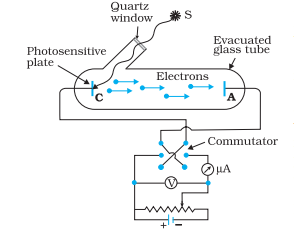
Figure for the question

How does the stopping potential vary with the frequency of the incident radiation?

Answer & explanation+

Correct answer: option 1

The correct answer is Option (1) → linearly

The stopping potential \( V_0 \) stops the most energetic photoelectrons, so \( eV_0=K_{\mathrm{max}} \). With Einstein’s photoelectric equation \( K_{\mathrm{max}}=h\nu-\phi_0 \), this gives, for \( \nu\ge\nu_0 \),

    \( \displaystyle V_0=\frac{h}{e}\,\nu-\frac{\phi_0}{e} \)

Option (1) linearly — Correct. \( V_0 \) against \( \nu \) is a straight line of slope \( h/e \), so above the threshold frequency the stopping potential rises linearly with the frequency.

Option (2) inversely — Incorrect. A higher frequency gives each photon more energy \( h\nu \). So the stopping potential increases with frequency.

Option (3) as its square — Incorrect. The photon energy \( h\nu \) is proportional to \( \nu \) itself, so \( V_0 \) has no \( \nu^{2} \) term.

Option (4) it does not depend on the frequency — Incorrect. The stopping potential does not depend on the intensity of the light. But it does depend on the frequency, and it grows with \( \nu \) above the threshold.

NCERT (2026-27):
Effect of Frequency of Incident Radiation on Stopping Potential – “The graph shows that (i) the stopping potential V0 varies linearly with the frequency of incident radiation for a given photosensitive material.”

Advertisement

Practise more on Dual Nature of Radiation and Matter

Chapter-wise mocks on the real NTA exam screen, with solutions and your rank. Your first mocks are free.

Start free mocks →

Advertisement

Next questions

  1. Which bacterium forms nodules on the roots of leguminous plants through a symbiotic association and fixes atmospheric nitrogen?Biology · Microbes in Human Welfare
  2. Workers in several cities struck work during the war years. Which of the following pairs of city and strike is correctly matched?Sociology · Social Change and Development in India: Social Movements
  3. Sahitya Akademi Award 2023 in Hindi was given to ‘Mujhe Pahachaano’ written by Sanjeev. Mujhe Pahachaano is a-General Aptitude Test · Current Affairs
  4. Apomictic embryos in Citrus are derived from:Biology · Sexual Reproduction in Flowering Plants
  5. In a certain code language, ‘FISHES’ is written as ‘69198519’, ‘BODY’ is written as ‘215425’. What is the code for ‘LEAD’ in that code lang…General Aptitude Test · Verbal Reasoning
  6. If 30th January 2003 was Thursday, what was the day of 2nd March 2003?General Aptitude Test · Verbal Reasoning
  7. Match the categories with correct explanations : LIST-I(Categories)LIST-II(Explanation)(A)Panchayati Raj System(I)Interest groups, dominant…Sociology · Social Change and Development in India: The Constitution and Social Change
  8. Select the most appropriate option to fill in the blank. The RTE Act bears many similarities to the US's No Child Left Behind Act, ______ s…English · Fill Blanks
  9. Match the beginnings of the sentences in List-I with their correct endings in List-II.List-I (Beginnings)List-II (Endings)(A) Little did Ka…English · Grammar: Formation of Sentence
  10. Rajan, 35, has slowly developed a problem of alcohol abuse over some years. Arrange the following in the order in which they appear in his…Psychology · Psychological Disorders