Match List I with List II
| LIST I Types of Minerals | LIST II Example | ||
| A. | Ferrous Mineral | I. | Bauxite |
| B. | Non-Ferrous | II. | Coal |
| C. | Fuel Mineral | III. | Manganese |
| D. | Non-Metallic | IV. | Graphite |
Choose the correct answer from the options given below:
Answer & explanation
Correct answer: option 2
The correct answer is Option (2) → A-III, B-I, C-II, D-IV
(A) Ferrous Mineral — this matches (III) Manganese. Ferrous minerals contain iron. Iron ore and manganese are ferrous minerals.
(B) Non-Ferrous — this matches (I) Bauxite. Bauxite has no iron content. It is the ore used to make aluminium.
(C) Fuel Mineral — this matches (II) Coal. Coal comes from buried plant and animal life and is a mineral fuel.
(D) Non-Metallic — this matches (IV) Graphite. Graphite, like mica and limestone, is a non-metallic mineral of inorganic origin.
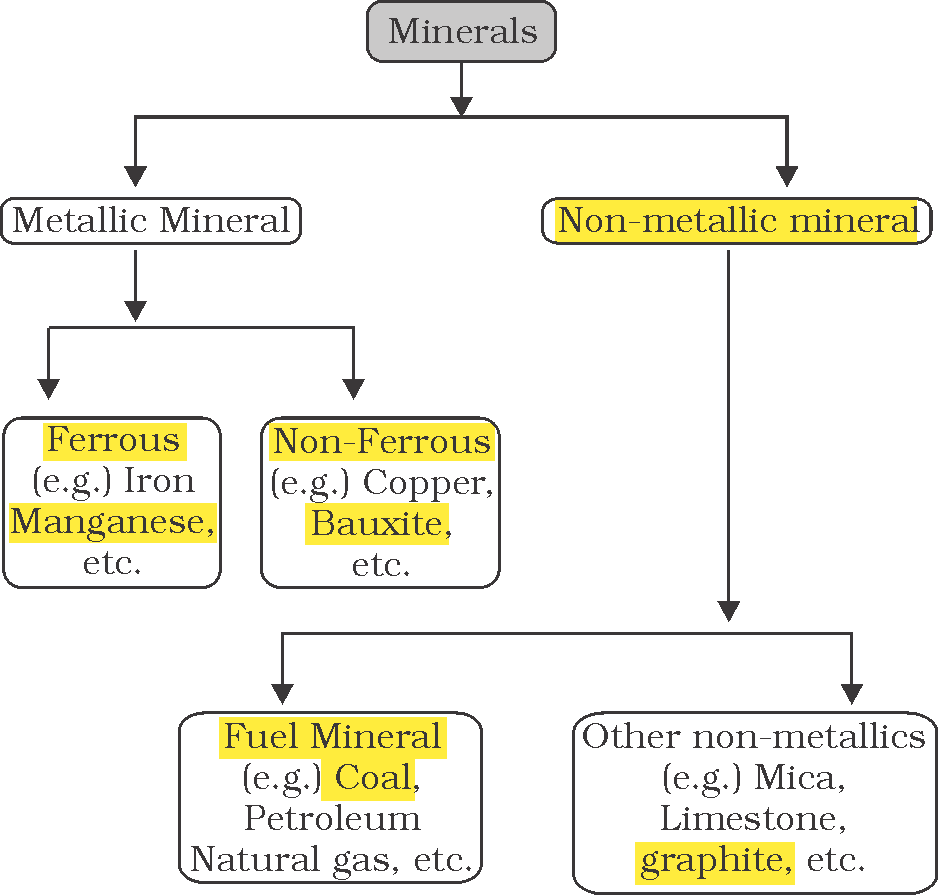
NCERT (2026-27): “As, it is clear from the Fig. 5.1 metallic minerals are the sources of metals. Iron ore, copper, gold produce metal and are included in this category. Metallic minerals are further divided into ferrous and non-ferrous metallic minerals. Ferrous, as you know, refers to iron. All those minerals which have iron content are ferrous such as iron ore itself and those which do not have iron content are non-ferrous such as copper, bauxite, etc.” “Non-metallic minerals are either organic in origin such as fossil fuels also known as mineral fuels which are derived from the buried animal and plant life such as coal and petroleum. Other type of non-metallic minerals are inorganic in origin such as mica, limestone and graphite, etc.”
Fig. 5.1 : Classification of Minerals |