CUETMOCK
  • Pricing
  • Mentors
Log inStart freeStart free mocks→

First test, then trust

Try a free CUET mock test.

Join 5,00,000+ students who rehearsed exam day on the exact NTA screen before sitting CUET. On the web and on Android.

Start free mocks →Get the Android app
CUETMOCK

India's #1 CUET Mock Test Platform. Original NCERT-based questions on the exact NTA exam screen — trusted by 5,00,000+ students since CUET 2022.

Get it onGoogle PlayScan to download the CUETMOCK app

Mock tests

  • CUET mock test series
  • Browse all papers
  • Commerce mocks
  • Humanities (Arts) mocks
  • Science mocks
  • Languages & GAT mocks
  • Free practice questions
  • Pricing

Resources

  • CUET exam guide
  • CUET syllabus
  • Universities accepting CUET
  • Expert blogs
  • News & notifications
  • Webinars & counselling
  • CUET score calculator
  • How we estimate your rank
  • FAQs

Company

  • About us
  • Our leadership & team
  • Our toppers
  • Mentors
  • For schools
  • Contact us
  • Terms
  • Privacy
  • Refund policy

Talk to us

+91 7696 6630 56info@cuetmock.comWhatsApp us

Our other platforms

  • JEE Mock — For IIT-JEE aspirants
  • NEET Mock — For NEET aspirants

Newsletter

Exam updates, study material and offers — no spam.

© 2026 NYC Ventures Pvt. Ltd.

701-702, Royal Business Park, Zirakpur, Punjab - 140603

  • Terms of use
  • Privacy policy
  • Refund policy
  • Contact us

iCUETMOCK is an independent preparation platform, not affiliated with the National Testing Agency (NTA). Always check exam details on the official NTA website.

  • Home
  • Mock tests
  • CUET guide
  • Pricing
  • Log in
Home/Practice questions/Physics
PhysicsSemiconductors and Electronic Devices

Match List-I with List-IIList-I (Statement)List-II (Energy band diagr…

Match List-I with List-II

List-I (Statement)List-II (Energy band diagram)
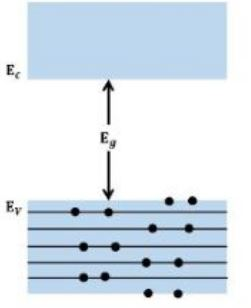
(A) An intrinsic semiconductor at \( T = 0\,\mathrm{K} \)(I) Figure for the question
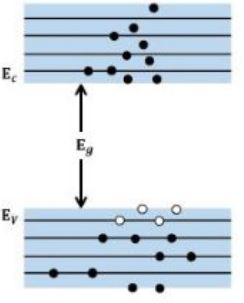
(B) An intrinsic semiconductor at \( T \gt 0\,\mathrm{K} \) with thermally generated electron-hole pairs.(II) Figure for the question
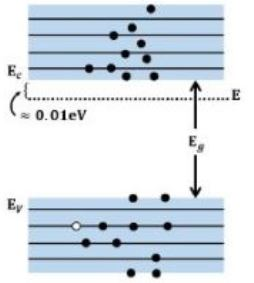
(C) Energy bands of n-type semiconductor at \( T \gt 0\,\mathrm{K} \)(III) Figure for the question
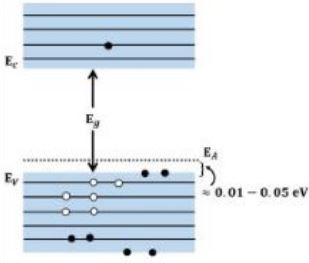
(D) Energy bands of p-type semiconductor at \( T \gt 0\,\mathrm{K} \)(IV) Figure for the question

Choose the correct answer from the options given below:

Answer & explanation+

Correct answer: option 4

The correct answer is Option (4) → (A)-(III), (B)-(IV), (C)-(I), (D)-(II)

Read each diagram for two things: whether there is an impurity level in the gap, and how many electrons (filled dots) are in the conduction band compared with holes (open circles) in the valence band.

(A) An intrinsic semiconductor at \( T = 0\,\mathrm{K} \) — this matches (III). At 0 K no electron has the energy to cross the gap, so the valence band is completely filled and the conduction band is empty; there are no holes.

(B) An intrinsic semiconductor at \( T \gt 0\,\mathrm{K} \) with thermally generated electron-hole pairs. — this matches (IV). Every electron that jumps to the conduction band leaves one hole behind, so the electrons and holes are equal in number, and there is no impurity level.

(C) Energy bands of n-type semiconductor at \( T \gt 0\,\mathrm{K} \) — this matches (I). The donor level \( E_D \) lies about 0.01 eV below \( E_c \); the donor electrons move easily into the conduction band, so electrons far outnumber holes.

(D) Energy bands of p-type semiconductor at \( T \gt 0\,\mathrm{K} \) — this matches (II). The acceptor level \( E_A \) lies 0.01-0.05 eV above \( E_v \); valence electrons move up into it, so holes far outnumber electrons.

NCERT (2026-27):
Intrinsic Semiconductor – “… An intrinsic semiconductor will behave like an insulator at T = 0 K as shown in Fig. 14.6(a). It is the thermal energy at higher temperatures (T > 0K), which excites some electrons from the valence band to the conduction band. … Here, some electrons are shown in the conduction band. These have come from the valence band leaving equal number of holes there.”


Extrinsic Semiconductor – “… In the energy band diagram of n-type Si semiconductor, the donor energy level ED is slightly below the bottom EC of the conduction band and electrons from this level move into the conduction band with very small supply of energy.”


Extrinsic Semiconductor – “… Similarly, for p-type semiconductor, the acceptor energy level EA is slightly above the top EV of the valence band as shown in Fig. 14.9(b).”
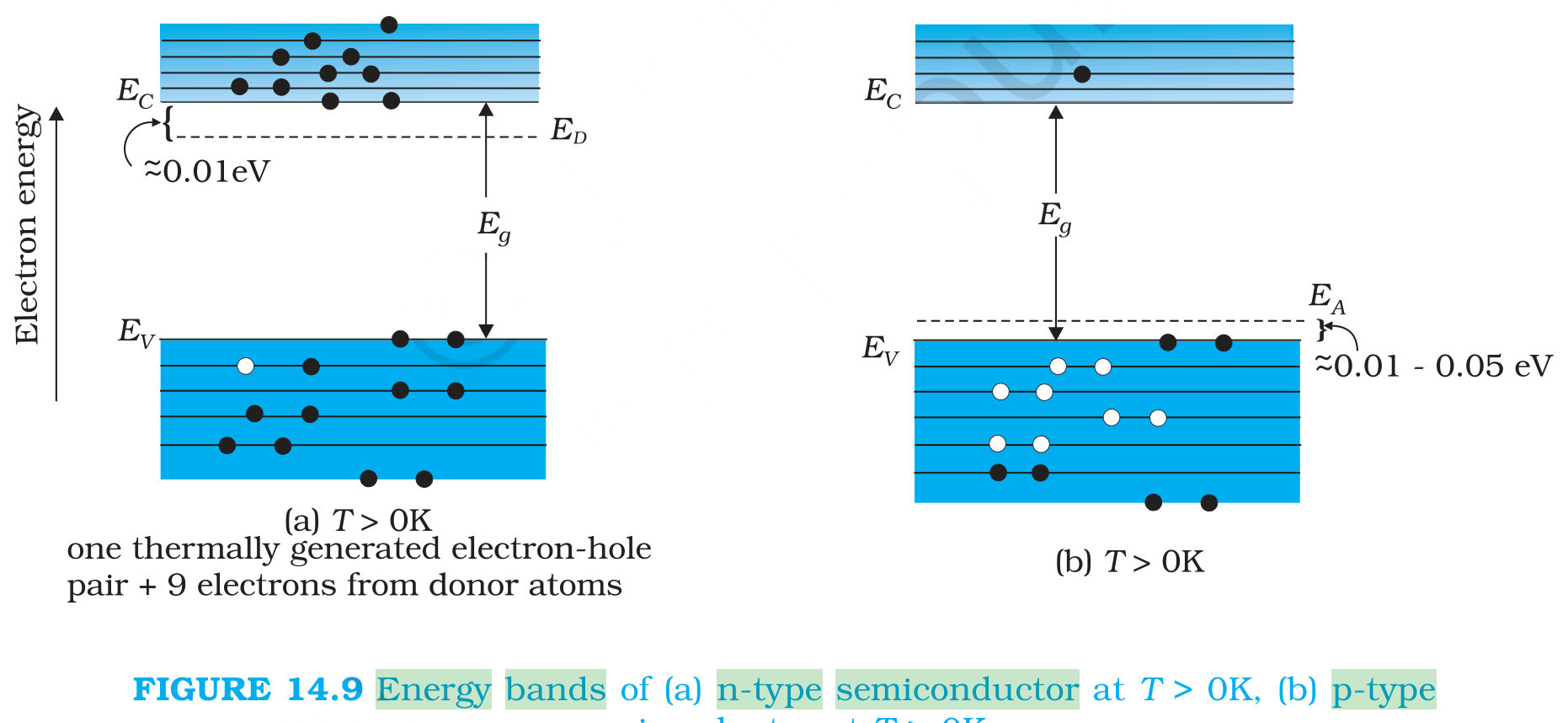
NCERT Fig. 14.9(b)

Advertisement

Practise more on Semiconductors and Electronic Devices

Chapter-wise mocks on the real NTA exam screen, with solutions and your rank. Your first mocks are free.

Start free mocks →

Advertisement

Next questions

  1. The electric field at a point on the axis of an electric dipole, at a distance r from its centre, is E=displaystyle1/(4πε_0) 4qar/((r^2-a^2…Physics · Electric Charges and Fields
  2. Select the most appropriate synonym of the given word. NumerousEnglish · Synonyms
  3. Ninth Schedule of the Indian Constitution was added by which Constitutional Amendment?General Aptitude Test · General Knowledge
  4. Given below are two statements: one is labelled as Assertion A and the other is labelled as Reason R Assertion A: The critics argue that co…Political Science · Contemporary World Politics: Globalisation
  5. Oracle, SQL Server, IBM-DB2 are examples of:Accountancy Part A · Database Management System for Accounting
  6. Match the homonym in List I with their meanings in List II- LIST I LIST II A. Vane I. Proud B. Vain II. A blood vein C. Wane III. Weatherco…English · Homonyms
  7. In the second phase of the Indian women's movement, changes took place in which of the following?Sociology · Social Change and Development in India: Social Movements
  8. Amar buys an old washing machine for Rs.4,500 and spends Rs.500 on its repair. If he sells the washing machine for Rs.4,500, then what is h…General Aptitude Test · Numerical Ability
  9. What historical period is known as the Age of Reason and Enlightenment?Psychology · Psychological Disorders
  10. In a certain town 25% families own a phone and 15% own a car, 65% families own neither a phone nor a car. 2000 families own both a car and…Maths. Section B1 · Relations and Functions