
Which one of the following represents a forward biased diode?
Answer & explanation
Correct answer: option 4
The correct answer is Option (4)

A p-n junction diode is forward biased when its p-side (the anode, the triangle in the symbol) is at a higher potential than its n-side (the cathode, the bar). In every circuit shown, the triangle is on the left and the bar faces the resistor, so the diode is forward biased only if the left terminal is at a higher potential than the right terminal.
In Option (4) the left terminal is at 0 V and the right terminal at \( -4\,\mathrm{V} \), so the left is higher and the diode conducts.
Why the other options are incorrect
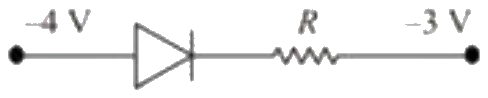
Option (1) — Incorrect. The left terminal is at \( -4\,\mathrm{V} \) and the right at \( -3\,\mathrm{V} \); the p-side is lower, so the diode is reverse biased.

Option (2) — Incorrect. The left terminal is at \( -2\,\mathrm{V} \) and the right at \( +2\,\mathrm{V} \); the p-side is lower, so the diode is reverse biased.

Option (3) — Incorrect. The left terminal is at \( 3\,\mathrm{V} \) and the right at \( 5\,\mathrm{V} \); the p-side is lower, so the diode is reverse biased.
NCERT (2026-27):
p-n Junction Diode Under Forward Bias – “When an external voltage V is applied across a semiconductor diode such that p-side is connected to the positive terminal of the battery and n-side to the negative terminal [Fig. 14.13(a)], it is said to be forward biased.”