
CUETMOCK
  • Pricing
  • Mentors
Log inStart freeStart free mocks→

First test, then trust

Try a free CUET mock test.

Join 5,00,000+ students who rehearsed exam day on the exact NTA screen before sitting CUET. On the web and on Android.

Start free mocks →Get the Android app
CUETMOCK

India's #1 CUET Mock Test Platform. Original NCERT-based questions on the exact NTA exam screen — trusted by 5,00,000+ students since CUET 2022.

Get it onGoogle PlayScan to download the CUETMOCK app

Mock tests

  • CUET mock test series
  • Browse all papers
  • Commerce mocks
  • Humanities (Arts) mocks
  • Science mocks
  • Languages & GAT mocks
  • Free practice questions
  • Pricing

Resources

  • CUET exam guide
  • CUET syllabus
  • Universities accepting CUET
  • Expert blogs
  • News & notifications
  • Webinars & counselling
  • CUET score calculator
  • How we estimate your rank
  • FAQs

Company

  • About us
  • Our leadership & team
  • Our toppers
  • Mentors
  • For schools
  • Contact us
  • Terms
  • Privacy
  • Refund policy

Talk to us

+91 7696 6630 56info@cuetmock.comWhatsApp us

Our other platforms

  • JEE Mock — For IIT-JEE aspirants
  • NEET Mock — For NEET aspirants

Newsletter

Exam updates, study material and offers — no spam.

© 2026 NYC Ventures Pvt. Ltd.

701-702, Royal Business Park, Zirakpur, Punjab - 140603

  • Terms of use
  • Privacy policy
  • Refund policy
  • Contact us

iCUETMOCK is an independent preparation platform, not affiliated with the National Testing Agency (NTA). Always check exam details on the official NTA website.

  • Home
  • Mock tests
  • CUET guide
  • Pricing
  • Log in
Home/Practice questions/Fine Arts
Fine ArtsThe Living Art Traditions of India

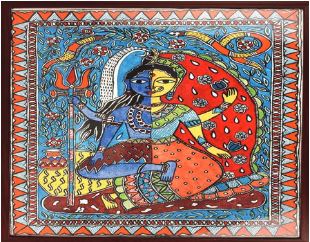
Identify the painting tradition to which the shown artwork belongs:

Identify the painting tradition to which the shown artwork belongs:

Answer & explanation+

Correct answer: option 1

The correct answer is option 1-  Mithila or Madhubani painting of Bihar.

Madhubani paintings, characterised by bright colours, are largely painted in three areas of the house — central or outer courtyards, eastern part of the house, which is the dwelling place of Kuladevi, usually, Kali, and a room in the southern part of the house, which houses the most significant images. Various armed gods and animals or images of women at work like carrying waterpots or winnowing grain, etc., are vividly portrayed in the outer central courtyard. The inner verandah, where the family shrine — devasthana or gosain ghar is located, griha devatas and kula devatas are painted. In the recent past, many paintings are done on fabric, paper, pots, etc., for commercial purposes. The most extraordinary and colourful painting, however, is done in the part of the house known as the kohbar ghar or inner room, where magnificent representations of kohbar, a lotus with a stalk in full bloom having metaphoric and tantric connotation along with images of gods and goddesses are painted on freshly plastered walls of the room.

Advertisement

Practise more on The Living Art Traditions of India

Chapter-wise mocks on the real NTA exam screen, with solutions and your rank. Your first mocks are free.

Start free mocks →

Advertisement

Next questions

  1. The famous UNESCO heritage site, Robben Island served as the political prison of which of the following leaders?General Aptitude Test · General Knowledge
  2. Raman bought a car in 2020 worth Rs. 5.95 lakh. He made a down payment of Rs. 1.5 lakh and took an auto loan for the rest of the amount at…Applied Maths. Section B2 · Financial Mathematics
  3. 'परिणाम' का सही संधि विच्छेद है-Hindi · संधि
  4. Method of Codification should be:Accountancy Part C · Overview of Computerised Accounting System
  5. Which of the following statements is NOT correct about Ahmadullah Shah in the context of the 1857 uprising?History · Modern India: Rebels and the Raj
  6. What is the security policy of a country which aims at preventing war called?Political Science · Contemporary World Politics: Security in the Contemporary World
  7. The limiting molar conductivities for H^+, Na^+, Cl^-, CH_3COO^- are 349.6, 50.1, 76.3, 40.9 S cm^2 mol^-1 , respectively, in water at 298…Chemistry · Physical: Electro Chemistry
  8. Which of the following is a feature of Fayol’s principle of Unity of Direction?Business Studies · Principles of Management
  9. 'आगमन' शब्द में कौन-सा उपसर्ग लगा है?Hindi · व्याकरण - सउपसर्ग
  10. Why were India, China and other developing countries exempted from the requirements of the Kyoto Protocol?Political Science · Contemporary World Politics: Environment and Natural Resources