
CUETMOCK
  • Pricing
  • Mentors
Log inStart freeStart free mocks→

First test, then trust

Try a free CUET mock test.

Join 5,00,000+ students who rehearsed exam day on the exact NTA screen before sitting CUET. On the web and on Android.

Start free mocks →Get the Android app
CUETMOCK

India's #1 CUET Mock Test Platform. Original NCERT-based questions on the exact NTA exam screen — trusted by 5,00,000+ students since CUET 2022.

Get it onGoogle PlayScan to download the CUETMOCK app

Mock tests

  • CUET mock test series
  • Browse all papers
  • Commerce mocks
  • Humanities (Arts) mocks
  • Science mocks
  • Languages & GAT mocks
  • Free practice questions
  • Pricing

Resources

  • CUET exam guide
  • CUET syllabus
  • Universities accepting CUET
  • Expert blogs
  • News & notifications
  • Webinars & counselling
  • CUET score calculator
  • How we estimate your rank
  • FAQs

Company

  • About us
  • Our leadership & team
  • Our toppers
  • Mentors
  • For schools
  • Contact us
  • Terms
  • Privacy
  • Refund policy

Talk to us

+91 7696 6630 56info@cuetmock.comWhatsApp us

Our other platforms

  • JEE Mock — For IIT-JEE aspirants
  • NEET Mock — For NEET aspirants

Newsletter

Exam updates, study material and offers — no spam.

© 2026 NYC Ventures Pvt. Ltd.

701-702, Royal Business Park, Zirakpur, Punjab - 140603

  • Terms of use
  • Privacy policy
  • Refund policy
  • Contact us

iCUETMOCK is an independent preparation platform, not affiliated with the National Testing Agency (NTA). Always check exam details on the official NTA website.

  • Home
  • Mock tests
  • CUET guide
  • Pricing
  • Log in
Home/Practice questions/General Aptitude Test
General Aptitude TestVerbal ReasoningSyllogism

Two Statements are given followed by two conclusions numbered I and I…

Two Statements are given followed by two conclusions numbered I and II. Assuming that the information given in the statements is true, even if it appears to be at variance with commonly known facts, decide which of the given conclusion logically follow(s) from the statements.

Statements:

1. All tables are strong.

2. No strong is weak.

Conclusions:

(I) No tables are weak.

(II) Some weak are tables.

Answer & explanation+

Correct answer: option 4

A Venn diagram based on the given statements is:
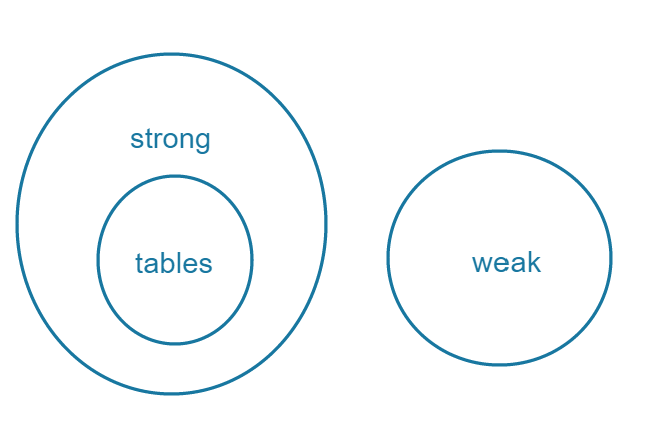
1. Since all tables are strong and no tables are weak, thus no tables can be weak and conclusion I follows.

2. There is no overlap between tables and weak, thus conclusion II does not follow.

⇒ Only conclusion I follows.

Advertisement

Practise more on Verbal Reasoning

Chapter-wise mocks on the real NTA exam screen, with solutions and your rank. Your first mocks are free.

Start free mocks →

Advertisement

Next questions

  1. The orthogonal trajectories of the circles x^2+y^2-a y=0, (where a is a parameter), isMaths. Section A · Differential Equations
  2. If × stands for −, ÷ stands for +, + stands for ÷ and − stands for ×, then15 − 5 ÷ 5 × 20 + 10 is equal toGeneral Aptitude Test · Verbal Reasoning
  3. Select the appropriate pair of words to fill in the blanks in the following sentence:- The diligent investigator posed several ____ questio…English · Fill Blanks
  4. Who took the first detailed photographs of archaeological remains at Hampi?History · Medieval India: An Imperial Capital: Vijayanagara
  5. An electron enters a region where magnetic (B) and electric (E) fields are mutually perpendicular, thenPhysics · Moving Charges and Magnetism
  6. Why did the USA launch its invasion of Iraq?Political Science · Contemporary World Politics: US Hegemony in World Politics
  7. The extraction of separated bands of DNA from the gel piece is called:Biology · Biotechnology -Principles and Processes
  8. In which of the following places is the Malabar Coast?History · Ancient India: Kings, Farmers and Towns
  9. कारक चिह्न के साथ मिलान करें सूची I सूची II A. करण I. से (अलगाव) B. कर्ता II. से (साधन) C. अधिकरण III. ने D. अपादान IV. में निम्नलिखित विकल…Hindi · व्याकरण - सकारक
  10. Followers of the older tradition of Buddhism, that is, those who followed the path of the old, respected teachers, described themselves as:History · Ancient India: Thinkers, Beliefs and Buildings