
Identify the graph which correctly represents the variation of capacitive reactance (\( X_C \)) with frequency (\( f \))
Answer & explanation
Correct answer: option 3
The correct answer is Option (3)
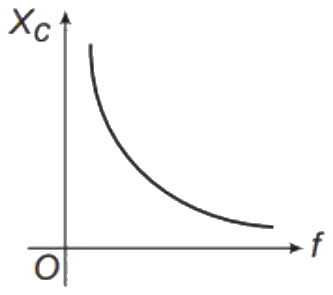
The capacitive reactance is inversely proportional to the frequency:
\( \displaystyle X_C = \frac{1}{2\pi f C} \;\Rightarrow\; X_C \propto \frac{1}{f} \)
So the graph must be a rectangular hyperbola: \( X_C \) is very large at low frequency, falls steadily as \( f \) increases, approaches zero for very large \( f \) without ever touching the axes, and is a smooth curve with no oscillation.
Why the other options are incorrect
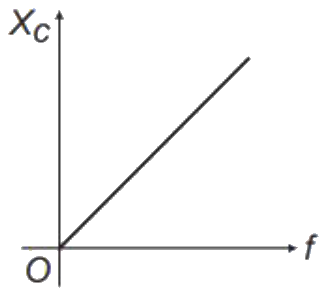
Option (1) — Incorrect. \( X_C \) would rise with \( f \) and be zero at \( f = 0 \); this is the graph of the inductive reactance \( X_L = 2\pi f L \).
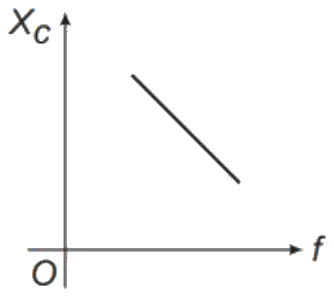
Option (2) — Incorrect. A straight line with a negative slope would mean \( X_C \) decreases uniformly and reaches zero at a finite frequency; but \( X_C \propto 1/f \) is not a straight line.
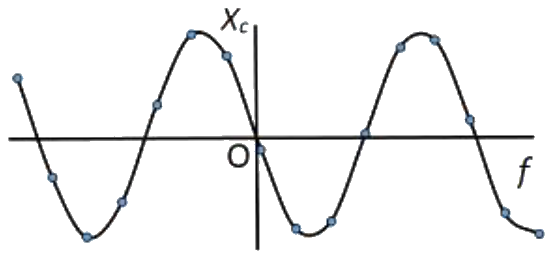
Option (4) — Incorrect. \( X_C \) does not oscillate with frequency; a wave-like curve that takes negative values has no relation to \( 1/(2\pi f C) \).
NCERT (2026-27):
AC Voltage Applied to a Capacitor – “… Comparing it to im = vm/R for a purely resistive circuit, we find that (1/ωC) plays the role of resistance. It is called capacitive reactance and is denoted by Xc,
\( \displaystyle X_c = 1/\omega C \qquad (7.17) \)
… But it is inversely proportional to the frequency and the capacitance.”