
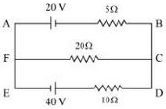
Using Kirchhoff's rules, calculate the current through \( 20\,\Omega \) and \( 10\,\Omega \) resistance in the given circuit:
Answer & explanation
Correct answer: option 4
The correct answer is Option (4) → 0 A, 4 A
Use Kirchhoff's junction rule at C and the loop rule on the two loops. The longer plate of a cell is its positive terminal, so the 20 V cell drives current from B towards A and the 40 V cell from E towards D.
Let \( I_1 \) flow from B to A through the 5 Ω branch, \( I_2 \) from E to D through the 10 Ω branch, and \( I_3 \) from F to C through the 20 Ω branch.
Junction C
\( I_1 = I_2 + I_3 \)
Loop F-A-B-C-F
\( -20 + 5I_1 + 20I_3 = 0 \Rightarrow I_1 + 4I_3 = 4 \)
Loop F-E-D-C-F
\( +40 - 10I_2 + 20I_3 = 0 \Rightarrow I_2 - 2I_3 = 4 \)
Putting \( I_1 = 4 - 4I_3 \) and \( I_2 = 4 + 2I_3 \) in the junction equation:
\( 4 - 4I_3 = 4 + 2I_3 + I_3 \Rightarrow 7I_3 = 0 \Rightarrow I_3 = 0 \)
\( I_2 = 4 + 0 = 4\,\mathrm{A} \)
The current through the 20 Ω resistor is 0 A and through the 10 Ω resistor is 4 A.
Shortcut: If the 20 Ω branch carries no current, the two cells drive \( I = \frac{20 + 40}{5 + 10} = 4\,\mathrm{A} \) round the outer loop. The 5 Ω resistor then drops \( 4\times5 = 20\,\mathrm{V} \), exactly cancelling the 20 V cell, so F and C are at the same potential and the 20 Ω branch indeed carries no current.