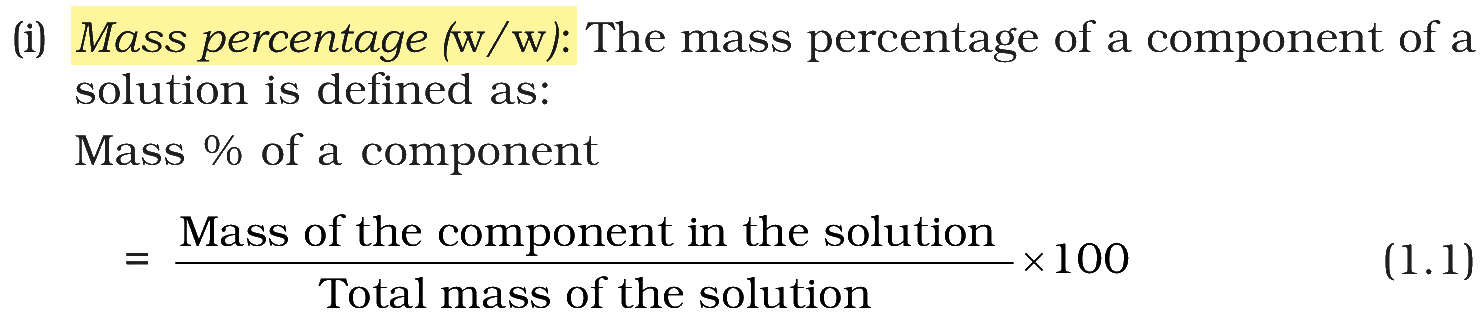
The mass percentage of a component of solution is defined as:
Answer & explanation
Correct answer: option 2
The correct answer is Option (2) → \(=\frac{\text{Mass of component in the solution}}{\text{Total mass of solution}}×100\)
The mass percentage (w/w) of a component is the mass of that component in 100 g of the solution. Both masses refer to the solution, which is solute plus solvent:
\( \displaystyle \text{Mass \% of a component} = \frac{\text{Mass of the component in the solution}}{\text{Total mass of the solution}} \times 100 \)
For example, 10% glucose in water by mass means 10 g of glucose dissolved in 90 g of water, giving 100 g of solution.
Why the other options are incorrect
Option (1) — Incorrect. (mass of component / total mass of solvent) The denominator must be the mass of the whole solution, not of the solvent alone; 10 g glucose in 90 g water is 10%, not 11.1%.
Option (3) — Incorrect. (mass of component / total volume of solvent) Mass is divided by a volume of the solvent; this is not a standard way of expressing concentration.
Option (4) — Incorrect. (mass of component / total volume of solution) This is the mass by volume percentage (w/V), used in medicine and pharmacy, not the mass percentage.
NCERT (2026-27 edition):
Mass Percentage (w/w)