Read the passage and answer the questions:
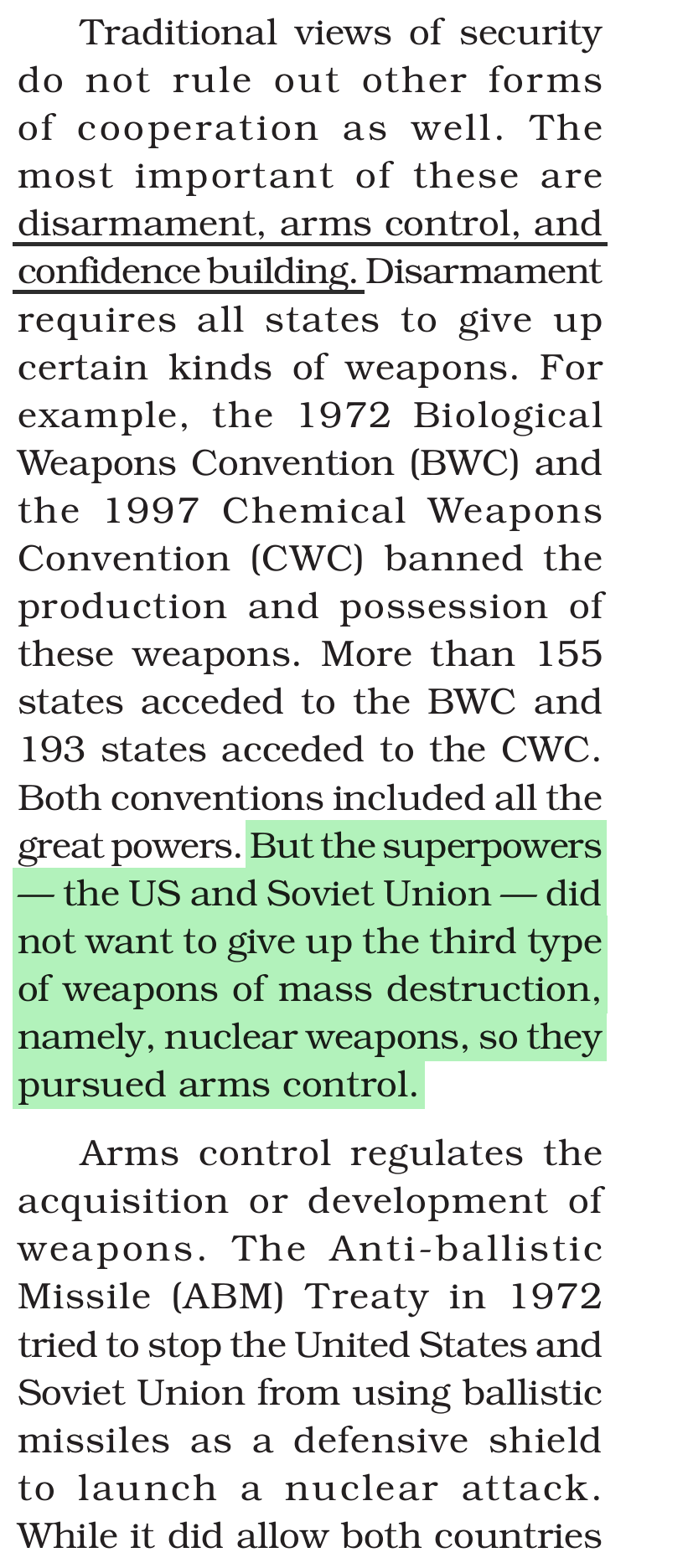
Traditional views of security do not rule out other forms of cooperation as well. The most important of these are disarmament, arms control, and confidence building. The 1972 Biological Weapons Convention (BWC) and the 1997 Chemical Weapons Convention (CWC) banned the production and possession of these weapons. More than 155 states acceded to the BWC and 193 states acceded to the CWC. Both conventions included all the great powers. But the superpowers — the US and Soviet Union — did not want to give up the third type of weapons of mass destruction, namely, nuclear weapons, so they pursued arms control.
Arms control regulates the acquisition or development of weapons. The Anti-ballistic Missile (ABM) Treaty in 1972 tried to stop the United States and Soviet Union from using ballistic missiles as a defensive shield to launch a nuclear attack. While it did allow both countries to deploy a very limited number of defensive systems, it stopped them from large-scale production of those systems.
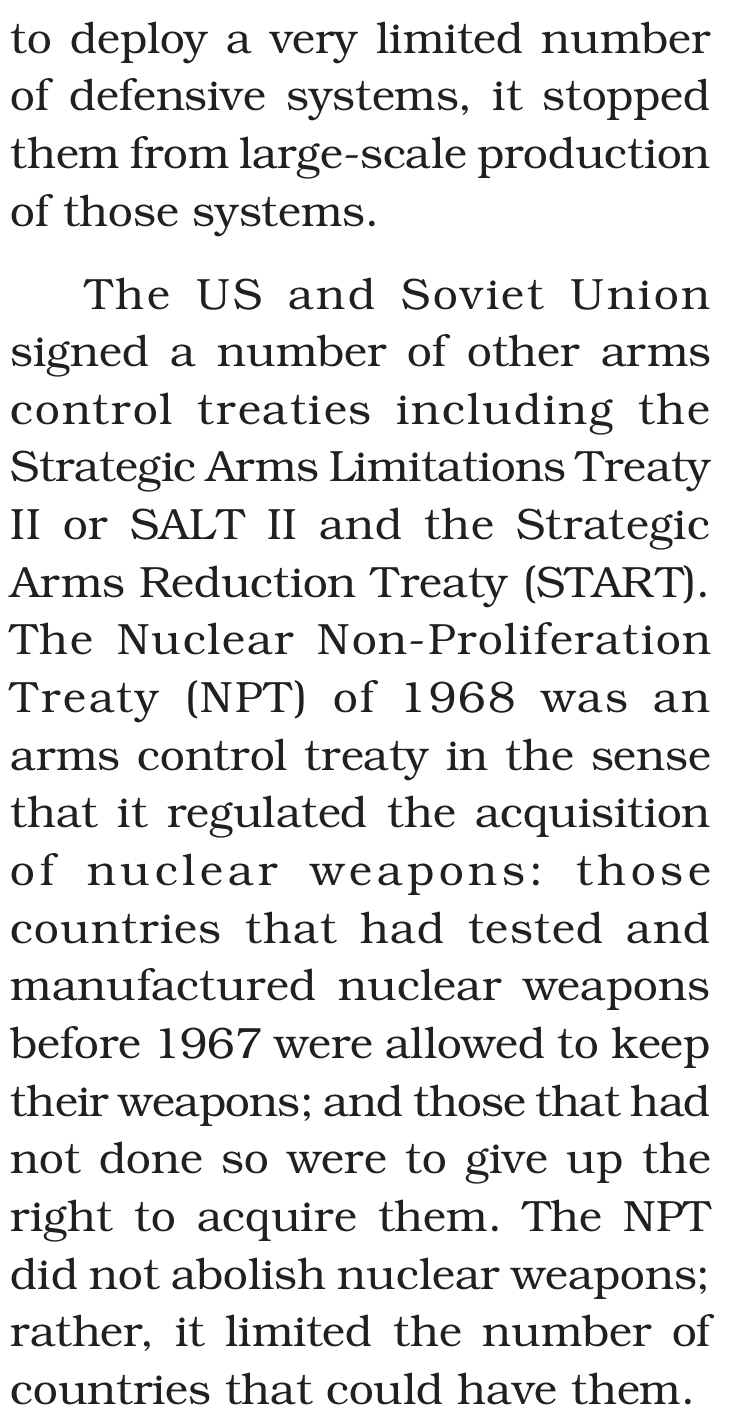
The US and Soviet Union signed a number of other arms control treaties including the Strategic Arms Limitations Treaty II or SALT II and the Strategic Arms Reduction Treaty (START). The Nuclear Non-Proliferation Treaty (NPT) of 1968 was an arms control treaty in the sense that it regulated the acquisition of nuclear weapons: those countries that had tested and manufactured nuclear weapons before 1967 were allowed to keep their weapons; and those that had not done so were to give up the right to acquire them. The NPT did not abolish nuclear weapons; rather, it limited the number of countries that could have them.
What alternative form of cooperation did the superpowers seek when they did not want to give up nuclear weapons?
Answer & explanation
Correct answer: option 3
The correct answer is Option (3) → Arms control
Option (1) Weapons of mass destruction path — Incorrect. Biological, chemical and nuclear weapons are the three types of weapons of mass destruction. They are what cooperation tries to control, not a form of cooperation.
Option (2) Human security perspective — Incorrect. Human security is about the protection of people more than the protection of states. It is a non-traditional notion of security, not the form of cooperation the superpowers chose over their nuclear weapons.
Option (3) Arms control — Correct. The superpowers did not want to give up nuclear weapons, the third type of weapons of mass destruction, so they pursued arms control, which regulates the acquisition or development of weapons.
Option (4) Confidence Building Measures — Incorrect. Confidence building is a process in which countries share ideas and information with their rivals, such as their military intentions and the forces they possess, so that rivals do not go to war by surprise. It is a form of cooperation, but not the one the passage names for keeping nuclear weapons while limiting them.
NCERT: Contemporary World Politics — Chapter 5: Security in the Contemporary World (2025-26)
|