
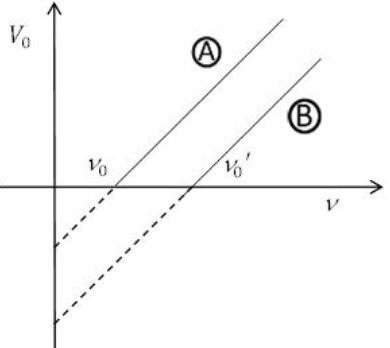
The graphs of stopping potential versus frequency of incident radiation for two metals A and B are given.
Identify the correct statement(s) from the following
(A) The slope of the graphs is equal to the Planck's constant.
(B) Intercept on the (-y) axis is equal to (work function/e).
(C) Threshold frequency for metal A is higher than metal B
(D) Work function for metal B is greater than metal A
Choose the correct answer from the options given below:
Answer & explanation
Correct answer: option 4
The correct answer is Option (4) → (B) and (D) only
The photoelectric equation is:
$eV_0 = h\nu - \phi$
or equivalently,
$V_0 = \frac{h}{e}\nu - \frac{\phi}{e}$
From this relation:
- Slope of the graph $V_0$ vs $ \nu$ = $\frac{h}{e}$ (not $h$). Hence, statement (A) is incorrect.
- Y–intercept = $-\frac{\phi}{e}$. Therefore, the magnitude of the intercept on the negative $y$–axis equals $\frac{\text{work function}}{e}$. So, statement (B) is correct.
- Threshold frequency $\nu_0 = \frac{\phi}{h}$. From the graph, $\nu_0'$ (for metal B) is greater than $\nu_0$ (for metal A), meaning $\phi_B > \phi_A$. Hence, statement (C) is incorrect and (D) is correct.
Final Answer: The correct statements are (B) and (D).