
Which of the following compound(s) does not react with Fehling solution?
(A) \( CH_3CHO \)
(B) \( Ph-CHO \)
(C) Glucose
(D) 
Choose the correct answer from the options given below:
Answer & explanation
Correct answer: option 1
The correct answer is Option (1) → (B) and (D) only
Fehling’s reagent is an alkaline solution of \( \ce{Cu^2+} \) held as a tartrate complex. It is a mild oxidising agent: aliphatic aldehydes (and reducing sugars) reduce it to a reddish-brown precipitate of \( \ce{Cu2O} \) and are oxidised to carboxylate ions. Aromatic aldehydes and ketones do not respond to this test.
(A) \( \ce{CH3CHO} \) — Reacts. Ethanal is an aliphatic aldehyde:
\( \displaystyle \ce{CH3CHO + 2Cu^2+ + 5OH- -> CH3COO- + Cu2O v + 3H2O} \)
(B) Ph–CHO — Does not react. Benzaldehyde is an aromatic aldehyde; it gives Tollens’ test but not Fehling’s test.
(C) Glucose — Reacts. Glucose has an aldehyde group and is a reducing sugar, so it reduces Fehling’s solution to \( \ce{Cu2O} \):
\( \displaystyle \ce{CH2OH(CHOH)4CHO + 2Cu^2+ + 5OH- -> CH2OH(CHOH)4COO- + Cu2O v + 3H2O} \)
(D) Propanone (acetone), \( \ce{CH3COCH3} \) — Does not react. Ketones are not oxidised by mild oxidising agents such as Fehling’s reagent.
NCERT (2026-27 edition):
Fehling’s Test
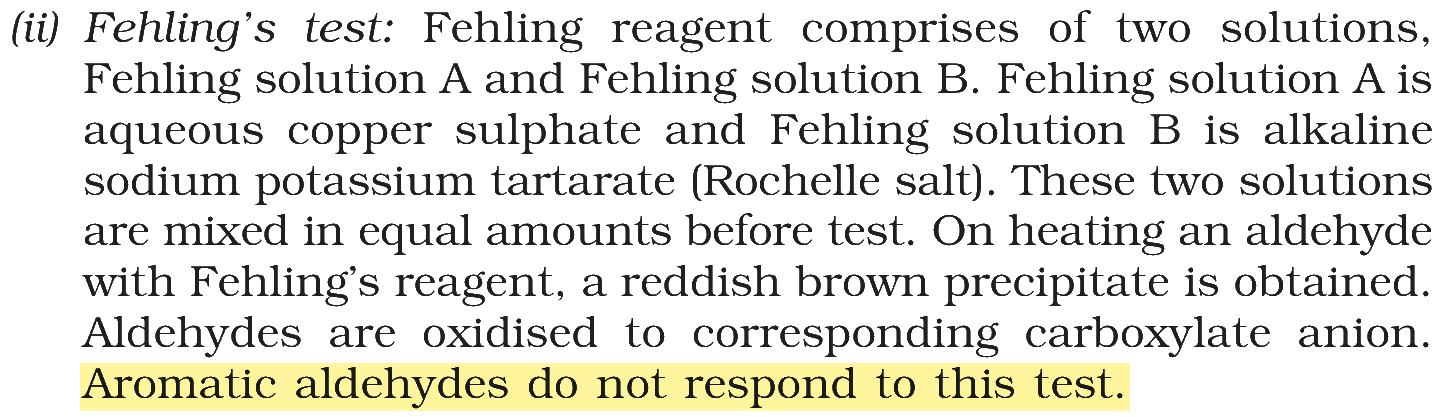
Oxidation – “… Ketones are generally oxidised under vigorous conditions, i.e., strong oxidising agents and at elevated temperatures. Their oxidation involves carbon-carbon bond cleavage to afford a mixture of carboxylic acids having lesser number of carbon atoms than the parent ketone.”