The outer layer of blastocyst is called as:
Answer & explanation
Correct answer: option 2
The correct answer is Option (2) → Trophoblast
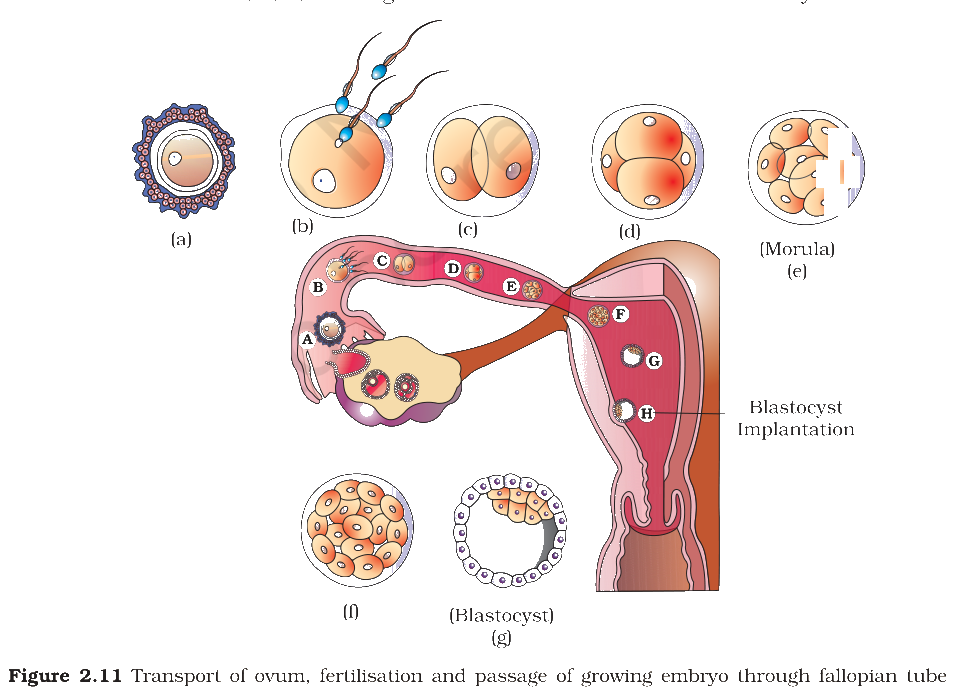
After fertilisation the zygote divides into a morula, which becomes a blastocyst in the uterus. The blastomeres of the blastocyst form an outer layer and an inner group of cells. The outer layer attaches to the endometrium, and the inner cell mass becomes the embryo.
Option (1) Exine — Incorrect. The exine is the hard outer wall of a pollen grain, made of sporopollenin.
Option (2) Trophoblast — Correct. In the blastocyst, the blastomeres are arranged into an outer layer called the trophoblast and an inner group of cells called the inner cell mass. The trophoblast attaches to the endometrium, and the inner cell mass becomes the embryo.
Option (3) Intine — Incorrect. The intine is the thin inner wall of a pollen grain.
Option (4) Antrum — Incorrect. The antrum is the fluid-filled cavity of a tertiary ovarian follicle.
NCERT Extract:
Fertilisation and Implantation – “… The mitotic division starts as the zygote moves through the isthmus of the oviduct called cleavage towards the uterus (Figure 2.11) and forms 2, 4, 8, 16 daughter cells called blastomeres. The embryo with 8 to 16 blastomeres is called a morula (Figure 2.11e). The morula continues to divide and transforms into blastocyst (Figure 2.11g) as it moves further into the uterus. The blastomeres in the blastocyst are arranged into an outer layer called trophoblast and an inner group of cells attached to trophoblast called the inner cell mass.”