
Which of the following statements is incorrect?
Answer & explanation
Correct answer: option 3
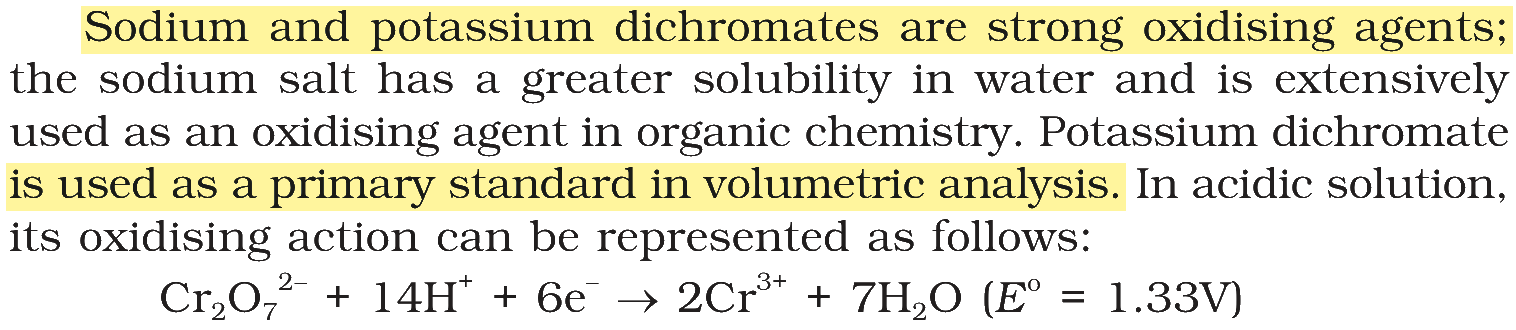
The correct answer is Option (3) → during oxidizing action in an acidic solution, \({Cr_2O_7}^{2-}\), gets converted to \(Cr^{2+}\)
In acidic solution the dichromate ion is a strong oxidising agent. Each chromium is reduced from +6 to +3, taking up three electrons, so the green \( \ce{Cr^3+} \) ion is formed, not \( \ce{Cr^2+} \):
\( \displaystyle \ce{Cr2O7^2- + 14H^+ + 6e^- -> 2Cr^3+ + 7H2O} \qquad (E^\circ = 1.33\ \text{V}) \)
The oxidation state of Cr in \( \ce{Cr2O7^2-} \): 2x + 7(−2) = −2, so x = +6. \( \ce{Cr^2+} \) is itself a strong reducing agent and is not the product of an oxidising action.
Option (1) chromate ion has tetrahedral geometry — A correct statement. In \( \ce{CrO4^2-} \) four oxygens surround the chromium tetrahedrally; the dichromate ion is two such tetrahedra sharing one corner (Cr–O–Cr angle 126°).
Option (2) sodium and potassium dichromates are strong oxidising agents — A correct statement. Both oxidise, for example, iodide to iodine and \( \ce{Fe^2+} \) to \( \ce{Fe^3+} \); the more soluble sodium salt is widely used in organic chemistry.
Option (3) during oxidizing action in an acidic solution, \( {Cr_2O_7}^{2-} \), gets converted to \( Cr^{2+} \) — Not a correct statement. Dichromate is reduced to Cr3+, not Cr2+.
Option (4) potassium dichromate is used as a primary standard in volumetric analysis. — A correct statement. It is obtained very pure, is not hygroscopic and keeps unchanged, so its standard solution can be made by direct weighing.
NCERT (2026-27 edition):
Oxides and Oxoanions of Metals – …
Oxides and Oxoanions of Metals – “… The structures of chromate ion, CrO42– and the dichromate ion, Cr2O72– are shown below. The chromate ion is tetrahedral whereas the dichromate ion consists of two tetrahedra sharing one corner with Cr–O–Cr bond angle of 126°.”