


CUET Preparation Today
The chromosomal disorders are caused due to absence, excess or abnormal arrangement of one or more chromosomes. Failure of segregation of chromatids during cell division results in the gain or loss of chromosome(s), called aneuploidy. |
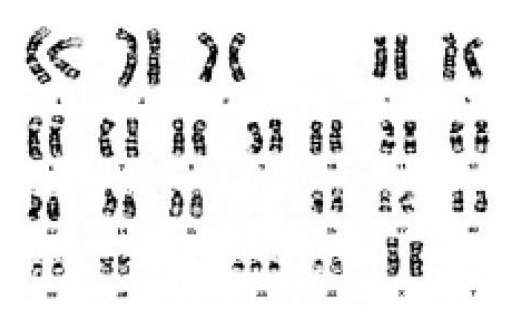
Identify the symptoms of the disorder represented in figure. |
There is formation of abnormal haemoglobin in the individual. The individual shows gynaecomastia. The short statured individual has broad palm with characteristic palm crease. The affected individual has elongated sickle like RBCs. |
The short statured individual has broad palm with characteristic palm crease. |
The correct answer is Option (3) → The short statured individual has broad palm with characteristic palm crease. Down's syndrome, also known as Trisomy 21, is a genetic disorder caused by the presence of an extra copy of chromosome 21. Instead of the typical two copies of chromosome 21, individuals with Down's syndrome have three copies, leading to a total of 47 chromosomes in their cells instead of the usual 46. Down's syndrome (Trisomy 21) affects both males and females because it is related to the gain of an autosome (chromosome 21) and not to sex chromosomes.The affected individual is short statured with small round head, furrowed tongue and partially open mouth. Palm is broad with characteristic palm crease. Physical, psychomotor and mental development is retarded. |