CUETMOCK
  • Pricing
  • Mentors
Log inStart freeStart free mocks→

First test, then trust

Try a free CUET mock test.

Join 5,00,000+ students who rehearsed exam day on the exact NTA screen before sitting CUET. On the web and on Android.

Start free mocks →Get the Android app
CUETMOCK

India's #1 CUET Mock Test Platform. Original NCERT-based questions on the exact NTA exam screen — trusted by 5,00,000+ students since CUET 2022.

Get it onGoogle PlayScan to download the CUETMOCK app

Mock tests

  • CUET mock test series
  • Browse all papers
  • Commerce mocks
  • Humanities (Arts) mocks
  • Science mocks
  • Languages & GAT mocks
  • Free practice questions
  • Pricing

Resources

  • CUET exam guide
  • CUET syllabus
  • Universities accepting CUET
  • Expert blogs
  • News & notifications
  • Webinars & counselling
  • CUET score calculator
  • How we estimate your rank
  • FAQs

Company

  • About us
  • Our leadership & team
  • Our toppers
  • Mentors
  • For schools
  • Contact us
  • Terms
  • Privacy
  • Refund policy

Talk to us

+91 7696 6630 56info@cuetmock.comWhatsApp us

Our other platforms

  • JEE Mock — For IIT-JEE aspirants
  • NEET Mock — For NEET aspirants

Newsletter

Exam updates, study material and offers — no spam.

© 2026 NYC Ventures Pvt. Ltd.

701-702, Royal Business Park, Zirakpur, Punjab - 140603

  • Terms of use
  • Privacy policy
  • Refund policy
  • Contact us

iCUETMOCK is an independent preparation platform, not affiliated with the National Testing Agency (NTA). Always check exam details on the official NTA website.

  • Home
  • Mock tests
  • CUET guide
  • Pricing
  • Log in
Home/Practice questions/History
HistoryModern India: Rebels and the Raj

When was Shah Mal killed?

Read the passage and answer the question:

Two rebels of 1857: Shah Mal

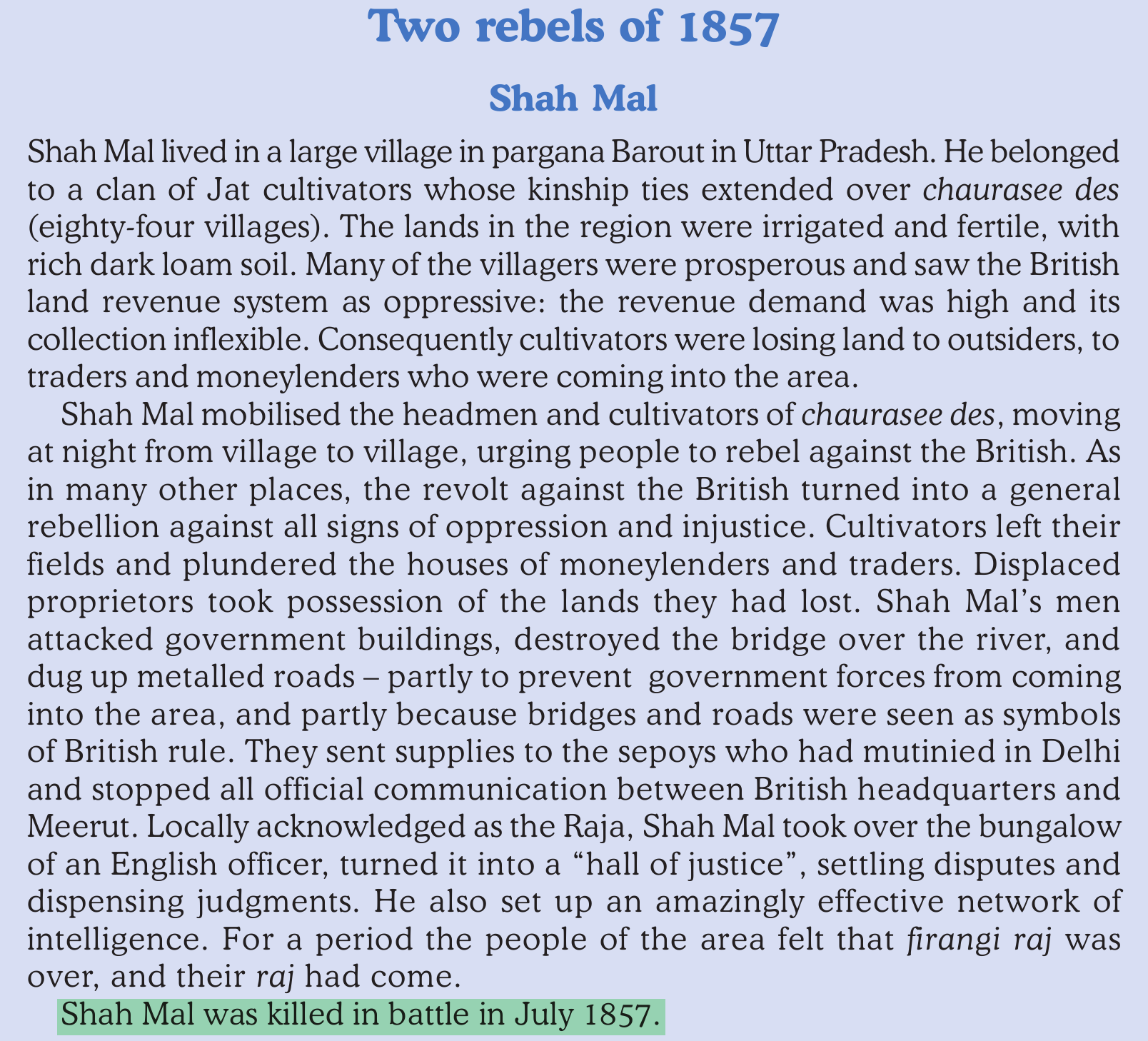
Shah Mal lived in a large village in pargana Barout in Uttar Pradesh. He belonged to a clan of Jat cultivators whose kinship ties extended over chaurasee des (eighty-four villages). The lands in the region were irrigated and fertile, with rich dark loam soil. Many of the villagers were prosperous and saw the British land revenue system as oppressive: the revenue demand was high and its collection inflexible. Consequently cultivators were losing land to outsiders, to traders and moneylenders who were coming into the area. Shah Mal mobilised the headmen and cultivators of chaurasee des, moving at night from village to village, urging people to rebel against the British. As in many other places, the revolt against the British turned into a general rebellion against all signs of oppression and injustice.

Cultivators left their fields and plundered the houses of moneylenders and traders. Displaced proprietors took possession of the lands they had lost. Shah Mal's men attacked government buildings, destroyed the bridge over the river, and dug up metalled roads partly to prevent government forces from coming into the area, and partly because bridges and roads were seen as symbols of British rule. They sent supplies to the sepoys who had mutinied in Delhi and stopped all official communication between British headquarters and Meerut.

Locally acknowledged as the Raja, Shah Mal took over the bungalow of an English officer, turned it into a "hall of justice", settling disputes and dispensing judgments. He also set up an amazingly effective network of intelligence. For a period the people of the area felt that firangi raj was over, and their raj had come.

Shah Mal was killed in battle in July 1857.

When was Shah Mal killed?

Answer & explanation+

Correct answer: option 1

The correct answer is Option (1) → July 1857

Shah Mal, who had been locally acknowledged as the Raja, was killed in battle in July 1857.


NCERT: Themes in Indian History Part III — Chapter 10: Rebels and the Raj (2026-27)

NCERT extract

Advertisement

Practise more on Modern India: Rebels and the Raj

Chapter-wise mocks on the real NTA exam screen, with solutions and your rank. Your first mocks are free.

Start free mocks →

Advertisement

Next questions

  1. Assertion (A): Naturally occurring glucose is assigned the D-configuration.Reason (R): Naturally occurring glucose is a dextrorotatory comp…Chemistry · Organic: Biomolecules
  2. The sides of a triangle are in the ratio 4 : 3 : 2. The perimeter of the triangle is 36 cm. The area (in cm2) of the triangle is?General Aptitude Test · Quantitative Reasoning
  3. The brain size of the Neanderthal man was:Biology · Evolution
  4. What has contributed to the growth of outsourcing in recent times?Economics · Indian Economic Development: Liberalisation, Privatisation and Globalisation - An Appraisal
  5. Annual Report is issued by a company to its :Accountancy Part B · Financial Statements of a Company
  6. Which of the following cities became the capital of Bengal in 1704?General Aptitude Test · General Knowledge
  7. Physics · Communication
  8. Match the blanks in List I with the appropriate Modals in List II List - I List – II (A) I _______ go to Delhi next week.(I) would (B) You…English · Grammar: Modal
  9. Three of the following vehicles move without an engine. Which one is different from the other three?English · Odd One Out
  10. Two trains start at same time from stations A and B, 1800 km apart, and proceed towards each other at an average speed of 44 km/h and 46 km…General Aptitude Test · Numerical Ability