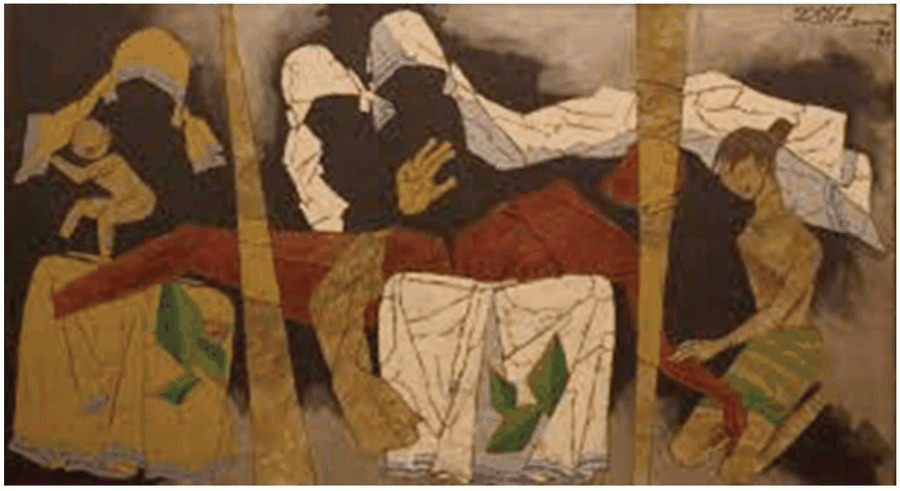
M. F. Husain painted Mother Teresa in the 1980s. Given below are two statements: one is labelled as Assertion (A) and the other is labelled as Reason (R).
Assertion (A): The painting speaks of the artist’s familiarity with European art, especially the Italian Renaissance.
Reason (R): The flat shapes used to depict the scene appear like a collage of paper cutouts.
In the light of the above statements, choose the most appropriate answer from the options given below:
Answer & explanation
Correct answer: option 2
The correct answer is Option (2) → Both (A) and (R) are true but (R) is NOT the correct explanation of (A).
Assertion (A): The painting speaks of the artist’s familiarity with European art, especially the Italian Renaissance. — True. The seated Mother holds a grown up man across her lap, a pose from Michelangelo’s Pieta.
Reason (R): The flat shapes used to depict the scene appear like a collage of paper cutouts. — True. These flat shapes are the modern side of the painting.
Why R does not explain A? R is about the modern, cut-paper look of the shapes, not about any European model. The correct reason for A is the central seated Mother with a grown up man lying on her lap, which recalls Michelangelo’s Pieta.
NCERT (2026-27): “Mother Teresa …The figure of the faceless Mother appears several times, each time holding a baby with a lot of attention given to the hand. The central figure of the seated Mother has a grown up man lying on her lap horizontally. This speaks of the artist’s familiarity with European art, especially, the famous sculpture of Italian Renaissance master, Michelangelo’s Pieta. On the other hand, the flat shapes used to depict the scene are modern. They appear like a collage of paper cutouts.…”
|