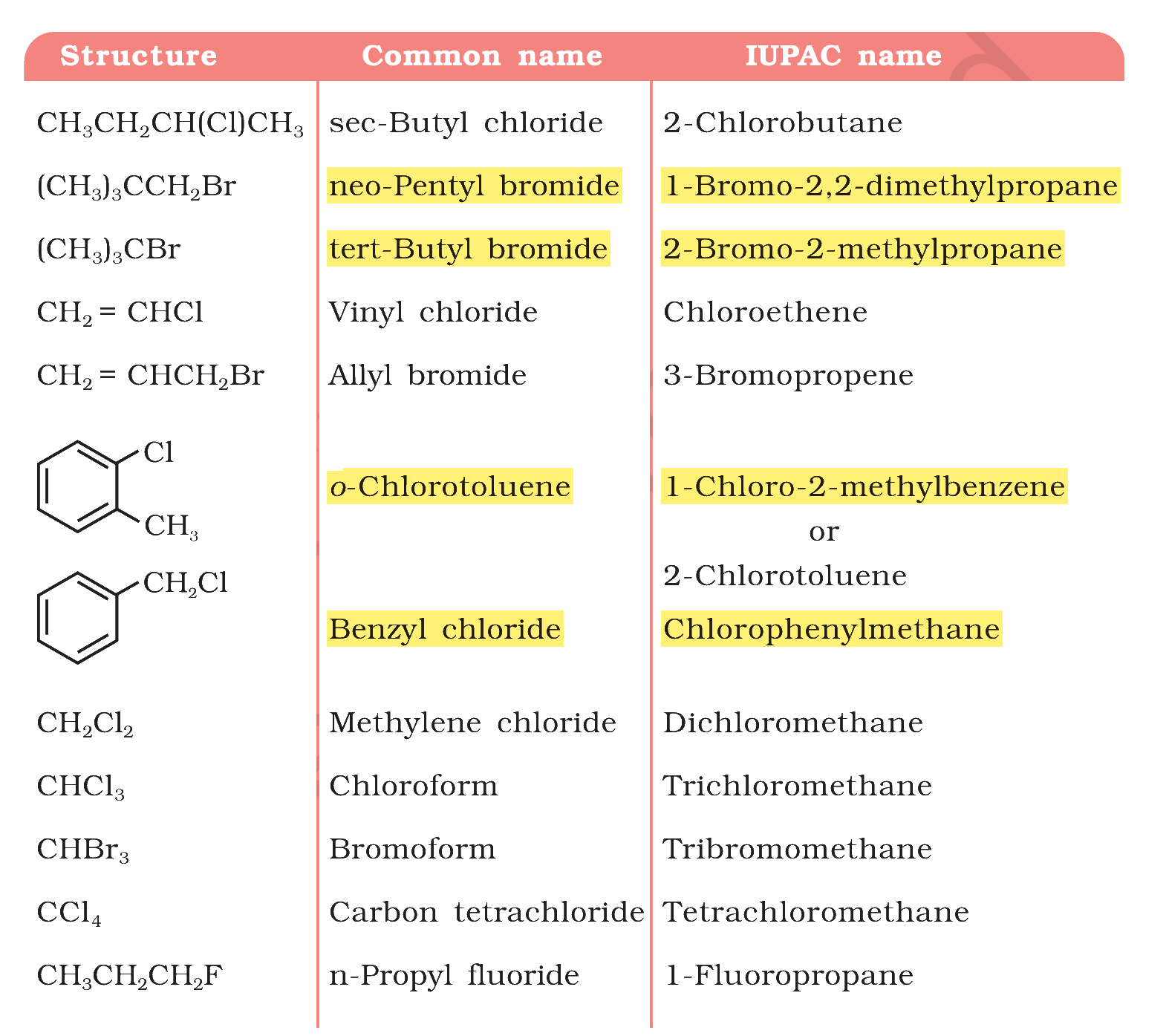
Match the common names of the halides in List-I with their IUPAC names in List-II.
| List-I (Common name) | List-II (IUPAC name) |
|---|---|
| (A) tert-Butyl bromide | (I) 1-Chloro-2-methylbenzene |
| (B) Benzyl chloride | (II) 2-Bromo-2-methylpropane |
| (C) neo-Pentyl bromide | (III) Chlorophenylmethane |
| (D) o-Chlorotoluene | (IV) 1-Bromo-2,2-dimethylpropane |
Choose the correct answer from the options given below:
Answer & explanation
Correct answer: option 4
The correct answer is Option (4) → A-II, B-III, C-IV, D-I
A common name gives the alkyl group followed by the halide. In the IUPAC name the compound is named as a halogen-substituted hydrocarbon: the longest chain (or the ring) is the parent, and the halogen and any alkyl groups are prefixes with their position numbers.
(A) tert-Butyl bromide — This matches (II) 2-Bromo-2-methylpropane. In (CH3)3CBr the longest chain is three carbons; bromine and a methyl group are both on the middle carbon, C-2.
(B) Benzyl chloride — This matches (III) Chlorophenylmethane. In C6H5CH2Cl the chlorine is on the side-chain carbon, so the compound is named as methane carrying a chloro and a phenyl group.
(C) neo-Pentyl bromide — This matches (IV) 1-Bromo-2,2-dimethylpropane. In (CH3)3CCH2Br the chain is numbered from the CH2Br carbon; bromine is on C-1 and two methyl groups on C-2.
(D) o-Chlorotoluene — This matches (I) 1-Chloro-2-methylbenzene. Here chlorine is on a ring carbon next to the methyl group; ortho becomes the locants 1,2 in the IUPAC name. It has the same formula as benzyl chloride, C7H7Cl; the name shows whether the chlorine is on the side chain or on the ring.
NCERT (2026-27 edition):
6.2 Nomenclature – “…The common names of alkyl halides are derived by naming the alkyl group followed by the name of halide. In the IUPAC system of nomenclature, alkyl halides are named as halosubstituted hydrocarbons.”
Table 6.1: Common and IUPAC Names of some Halides