
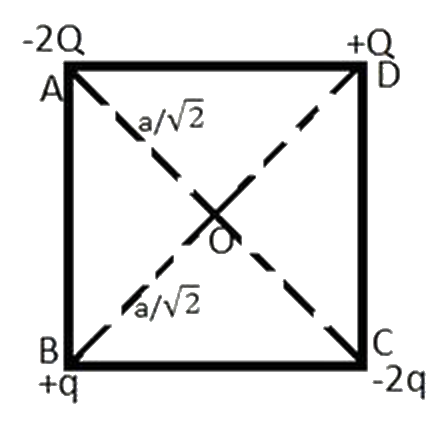
Four point charges \( -2Q \), \( +q \), \( -2q \) and \( +Q \) are placed at four corners of a square A, B, C and D, respectively, as shown in the figure and \( OA = OB = a/\sqrt{2} \). If the potential at the center of a square is zero, what is the relation between Q and q?
Answer & explanation
Correct answer: option 2
The correct answer is Option (2) → \( Q = -q \)
The electric potential at a point due to several point charges is the algebraic sum of the potentials due to the individual charges, \( V = \sum kq_i/r_i \). The centre O is at the same distance \( a/\sqrt{2} \) from all four corners (half a diagonal), so this common distance can be taken out of the sum.
\( \displaystyle V_O = \frac{k}{a/\sqrt{2}}\left(-2Q + q - 2q + Q\right) = \frac{k}{a/\sqrt{2}}\left(-Q - q\right) \)
The potential at O is zero, so
\( \displaystyle -Q - q = 0 \;\Rightarrow\; Q = -q \)