CUETMOCK
  • Pricing
  • Mentors
Log inStart freeStart free mocks→

First test, then trust

Try a free CUET mock test.

Join 5,00,000+ students who rehearsed exam day on the exact NTA screen before sitting CUET. On the web and on Android.

Start free mocks →Get the Android app
CUETMOCK

India's #1 CUET Mock Test Platform. Original NCERT-based questions on the exact NTA exam screen — trusted by 5,00,000+ students since CUET 2022.

Get it onGoogle PlayScan to download the CUETMOCK app

Mock tests

  • CUET mock test series
  • Commerce mocks
  • Humanities (Arts) mocks
  • Science mocks
  • Languages & GAT mocks
  • Free practice questions
  • Pricing

Resources

  • CUET exam guide
  • CUET syllabus
  • Universities accepting CUET
  • Expert blogs
  • News & notifications
  • Webinars & counselling
  • CUET score calculator
  • How we estimate your rank
  • FAQs

Company

  • About us
  • Our leadership & team
  • Our toppers
  • Mentors
  • For schools
  • Contact us
  • Terms
  • Privacy
  • Refund policy

Talk to us

+91 7696 6630 56info@cuetmock.comWhatsApp us

Our other platforms

  • JEE Mock — For IIT-JEE aspirants
  • NEET Mock — For NEET aspirants

Newsletter

Exam updates, study material and offers — no spam.

© 2026 NYC Ventures Pvt. Ltd.

701-702, Royal Business Park, Zirakpur, Punjab - 140603

  • Terms of use
  • Privacy policy
  • Refund policy
  • Contact us

iCUETMOCK is an independent preparation platform, not affiliated with the National Testing Agency (NTA). Always check exam details on the official NTA website.

  • Home
  • Mock tests
  • CUET guide
  • Pricing
  • Log in
Home/Practice questions/Economics
EconomicsMacro Economics: Determination of Income and Employment

Which of the following statements are true:(A). Average propensity to…

Which of the following statements are true:

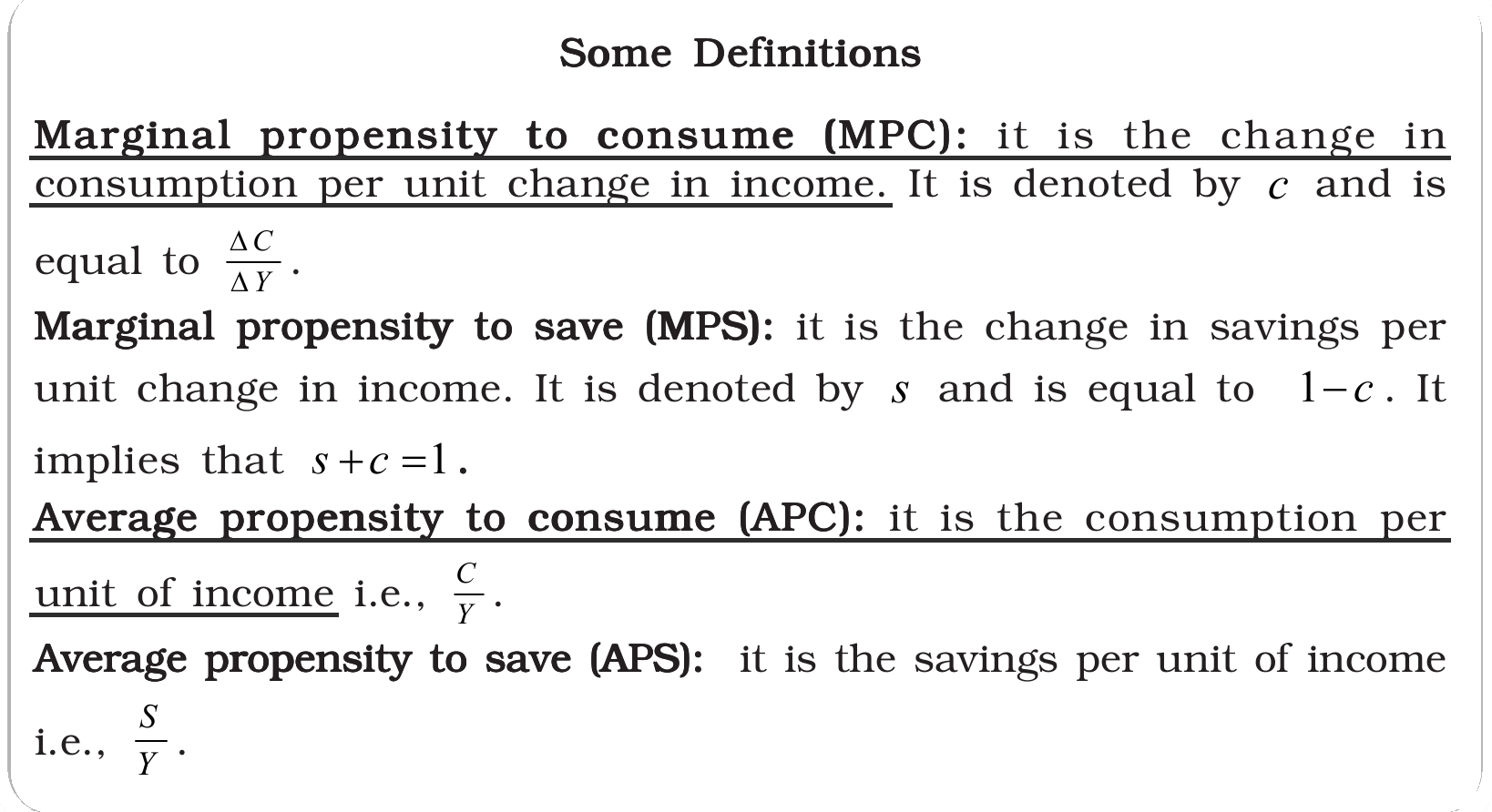
(A). Average propensity to consume is the change in consumption per unit to change in income.

(B). Ex-ante depicts what has been planned.

(C). Ceteris paribus means 'other things remain equal'.

(D). Ex-post depicts what has actually happened.

Choose the correct answer from the options given below:

Answer & explanation+

Correct answer: option 4

The correct answer is Option (4) → (B), (C) and (D) only

(A) Average propensity to consume is the change in consumption per unit to change in income. — False. Average propensity to consume (APC) is consumption per unit of income, C/Y. The change in consumption per unit change in income is the marginal propensity to consume (MPC), ΔC/ΔY.

(B) Ex-ante depicts what has been planned. — True. The planned values of consumption, investment or output are their ex ante measures. A producer who plans to add Rs 100 of goods to her stock has an ex ante investment of Rs 100.

(C) Ceteris paribus means 'other things remain equal'. — True. To study how one variable affects another, we hold all other variables constant. This is the assumption of ceteris paribus.

(D) Ex-post depicts what has actually happened. — True. Suppose the same producer has to sell Rs 30 of her stock because demand was higher. Her stock then rises by only Rs 70, so her actual, or ex post, investment is Rs 70.

NCERT (2026-27): “…It is difficult to account for all the variables at the same time. Thus, when we concentrate on the determination of a particular variable, we must hold the values of all other variables constant. This is a stylisation typical of almost any theoretical exercise and is called the assumption of ceteris paribus, which literally means ‘other things remaining equal’.…

4.1 Aggregate Demand and Its Components …Suppose the producer plans to add Rs 100 worth goods to her stock by the end of the year. Her planned investment is, therefore, Rs 100 in that year. However, due to an unforeseen upsurge of demand for her goods in the market the volume of her sales exceeds what she had planned to sell and, to meet this extra demand, she has to sell goods worth Rs 30 from her stock. Therefore, at the end of the year, her inventory goes up by Rs (100 – 30) = Rs 70 only. Her planned investment is Rs 100 whereas her actual, or ex post, investment is Rs 70 only. We call the planned values of the variables – consumption, investment or output of final goods – their ex ante measures.

In simple words, ex-ante depicts what has been planned, and ex-post depicts what has actually happened.…”

NCERT extract

Advertisement

Practise more on Macro Economics: Determination of Income and Employment

Chapter-wise mocks on the real NTA exam screen, with solutions and your rank. Your first mocks are free.

Start free mocks →

Advertisement

Next questions

  1. Two integers x and y are chosen with replacement out of the set (0, 1, 2, 3,..., 10). Then the probability that |x - y| >5, isMaths. Section B1 · Probability
  2. Which of the following is correct in respect of interest on capital in case partnership deed provides such interest?Accountancy Part A · Accounting for Partnership
  3. A current of 2 A flows through a 2 Ω resistor when connected with a cell. When the resistance is replaced by 10 Ω , a current of 0.5 A flow…Physics · Current Electricity
  4. Consider the following statements about the ways Harappan religious practices have been interpreted:(A) Early archaeologists regarded terra…History · Ancient India: Bricks, Beads and Bones
  5. The benefits (or harms) a firm or an individual causes to another for which they are not paid (or penalized) is referred to as.......Economics · Macro Economics: National Income Accounting
  6. Which physician proposed a typology of personality based on fluid or humour?Psychology · Self and Personality
  7. Five students are standing in a circle and all are facing towards the centre of the circle. Apurva is on the left of Abhishek. Alok is on t…General Aptitude Test · Verbal Reasoning
  8. Identify the incorrect statement about glucoseChemistry · Organic: Biomolecules
  9. How many triangles are there in the given figure?General Aptitude Test · Verbal Reasoning
  10. Infosys shows its people on its balance sheet as assets.This view of people is closest to which development in the evolution of HRM?Business Studies · Staffing