
A manufacturer has employed 5 skilled men and 10 semi-skilled men and makes two models A and B of an article. The making of one item of model A requires 2 hours work by a skilled man and 2 hours work by a semi-skilled man. One item of model B requires 1 hour by a skilled man and 3 hours by a semi-skilled man. No man is expected to work more than 8 hours per day. The O manufacturer's profit on item of model A is ₹15 and on an item of model B is ₹10. How many items of each model should be made per day in order to maximize daily profit? Formulate the above LPP and solve it graphically and find the maximum profit.
Answer & explanation
Correct answer: option 2
The correct answer is Option (2) → 10 items of model A and 20 items of model B, with a maximum profit of ₹350.
Since each man skilled or semi-skilled works for atmost 8 hours per day and 5 skilled men and 10 semi-skilled men are employed, so the maximum number of skilled working hours available $= 5×8=40$ and maximum number of semi-skilled working hours available $= 10 × 8 = 80$. If x items of model A and y items of model B are made, then the LPP is maximise $Z = 15x + 10y$ subject to constraints $2x + y ≤ 40, 2x + 3y ≤ 80, x ≥ 0, y ≥ 0$.
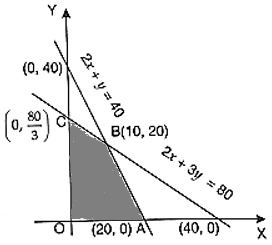
We draw the straight lines $2x + y = 40$ and $2x + 3y = 80$ and shade the region satisfied by the above inequalities.
The shaded region shows the feasible region which is bounded. The point of intersection of the lines 2x + y = 40 and 2x + 3y = 80 is B (10, 20).
The corner points of the feasible OABC are O (0, 0), A(20, 0), B(10, 20) and $C(0,\frac{80}{3})$. The optimal solution occurs at one of the corner points.
At $O(0, 0), Z =15 × 0 + 10 × 0 = 0;$
at $A (20, 0), Z =15 × 20 + 10 × 0 = 300;$
at $B (10, 20) Z = 15 × 10 + 10 × 20 = 350;$
at $C(0, \frac{80}{3}), Z = 15 × 0 + 10 × \frac{80}{3}=\frac{800}{3}=266\frac{2}{3}$
We find that the value of Z is maximum at B (10, 20).
Hence, the manufacturer should produce 10 items of model A and 20 items of model B to get maximum profit of ₹350.