Target Exam

CUET

Subject

Chemistry

Chapter

Inorganic: D and F Block Elements

Question:

Which of the following compounds have T-shaped structure?

A. \(XeOF_2\)

B. \(BrF_5\)

C. \(IF_7\)

D. \(ClF_3\)

E. \(XeO_3\)

Choose the correct answer from the options given below:

Options:

A and B only

A and D only

C and D only

D and E only

Correct Answer:

A and D only

Explanation:

The correct answer is option 2. A and D only.

To determine the molecular geometry of each compound and identify those with a T-shaped structure, we use Valence Shell Electron Pair Repulsion (VSEPR) theory. VSEPR theory helps predict the shape of a molecule based on the repulsion between electron pairs around the central atom.

VSEPR Theory Overview

Electron Domains: Count both bonding pairs and lone pairs around the central atom.

Geometry: Determine the molecular shape based on the arrangement of these electron domains.

Analysis of Each Compound

A. \(XeOF_2\)

Central Atom: Xenon (Xe)

Electron Domains: Xenon has 4 bonding pairs (one with oxygen and two with fluorines) and 1 lone pair.

Electron Domain Geometry: With 5 electron domains (4 bonding pairs and 1 lone pair), the geometry is based on a trigonal bipyramidal arrangement.

Molecular Geometry: The lone pair occupies one of the equatorial positions, leaving 3 positions for the fluorine atoms and 1 for the oxygen. This results in a T-shaped molecular geometry.

B. \(BrF_5\)

Central Atom: Bromine (Br)

Electron Domains: Bromine has 5 bonding pairs and 1 lone pair.

Electron Domain Geometry: With 6 electron domains (5 bonding pairs and 1 lone pair), the geometry is based on an octahedral arrangement.

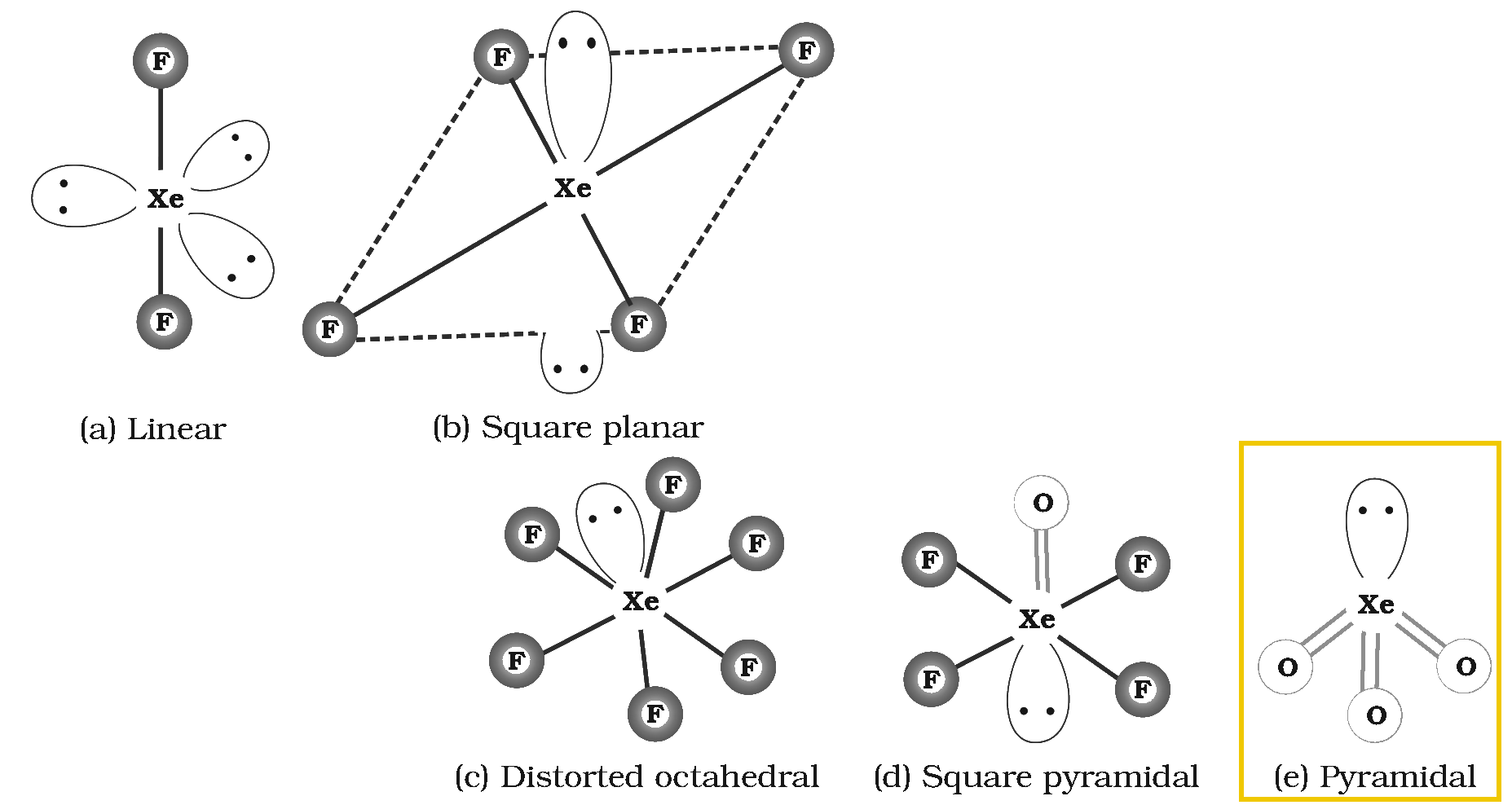
Molecular Geometry: The lone pair occupies one of the apical positions, resulting in a square pyramidal geometry, not T-shaped.

C. \(IF_7\)

Central Atom: Iodine (I)

Electron Domains: Iodine has 7 bonding pairs and no lone pairs.

Electron Domain Geometry: With 7 bonding pairs, the geometry is based on a pentagonal bipyramidal arrangement.

Molecular Geometry: The structure is pentagonal bipyramidal, not T-shaped.

D. \(ClF_3\)

Central Atom: Chlorine (Cl)

Electron Domains: Chlorine has 3 bonding pairs and 2 lone pairs.

Electron Domain Geometry: With 5 electron domains (3 bonding pairs and 2 lone pairs), the geometry is based on a trigonal bipyramidal arrangement.

Molecular Geometry: The two lone pairs occupy the equatorial plane, leaving the fluorine atoms in a T-shaped arrangement.

E. \(XeO_3\)

Central Atom: Xenon (Xe)

Electron Domains: Xenon has 3 bonding pairs and 1 lone pair.

Electron Domain Geometry: With 4 electron domains (3 bonding pairs and 1 lone pair), the geometry is based on a tetrahedral arrangement.

Molecular Geometry: The lone pair occupies one position, resulting in a trigonal pyramidal shape.

The correct answer, therefore, is: 2. A and D only.