
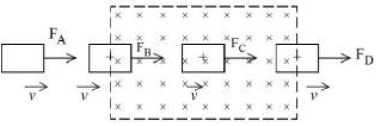
A square loop of copper wire is pulled through a region of uniform magnetic field as shown. Rank the pulling forces \( F_A, F_B, F_C \) and \( F_D \) that must be applied to keep the loop moving with constant speed \( (\vec{v}) \):
Answer & explanation
Correct answer: option 1
The correct answer is Option (1) → \( F_B = F_D,\ F_A = F_C \)
The loop moves at constant speed, so the pulling force must just balance the magnetic force on the loop. That force exists only when a motional emf drives a current, that is, while the flux through the loop is changing.
Position A — the loop is outside the field. There is no flux and no emf, so \( F_A = 0 \).
Position B — the loop is entering the field. The flux increases, the emf is \( \varepsilon = Blv \) and the current is \( I = \frac{Blv}{R} \). The force on the edge in the field is
\( \displaystyle F_B = BIl = \frac{B^{2}l^{2}v}{R} \)
Position C — the loop is wholly inside the uniform field. The flux is constant, so there is no emf, no current and \( F_C = 0 \).
Position D — the loop is leaving the field. The flux decreases, the emf has the same magnitude \( Blv \) (only one edge is in the field) and
\( \displaystyle F_D = \frac{B^{2}l^{2}v}{R} = F_B \)
So \( F_B = F_D \) and \( F_A = F_C \) (both zero).