
Read the given passage and answer the questions that follow:
In prokaryotes such as E. coli, though they do not have a defined nucleus the DNA is not scattered throughout the cell. The DNA is held with some proteins in a specific region. In eukaryotes this organisation is much more complex. There is a set of positively charged basic proteins called histones. Histones are organised to form a unit of 8 molecules called histone octamer. The negatively charged DNA is wrapped around the positively charged histone octamer.
What is the structure called when negatively charged DNA wraps around a positively charged histone octamer?
Answer & explanation
Correct answer: option 1
The correct answer is Option (1) → Nucleosome
Histones are positively charged proteins. Eight of them form a histone octamer. The negatively charged DNA winds around this octamer, and the unit so formed is the nucleosome.
Option (1) Nucleosome — Correct. The DNA wrapped around a histone octamer is called a nucleosome. It is the basic repeating unit of chromatin.
Option (2) Chromatin — Incorrect. Chromatin is the thread-like material made of many nucleosomes in a row (beads-on-string). It is a higher level of packing, not the single unit.
Option (3) Nucleoid — Incorrect. The nucleoid is the region where DNA lies with some proteins in prokaryotes such as E. coli. Prokaryotes have no histone octamers.
Option (4) Chromosome — Incorrect. Chromosomes form when the chromatin fibres coil and condense further at metaphase. They are the most packed form.
NCERT Extract:
Packaging of DNA Helix – “… Histones are organised to form a unit of eight molecules called histone octamer. The negatively charged DNA is wrapped around the positively charged histone octamer to form a structure called nucleosome (Figure 5.4 a). A typical nucleosome contains 200 bp of DNA helix. Nucleosomes constitute the repeating unit of a structure in nucleus called chromatin, thread-like stained (coloured) bodies seen in nucleus.”
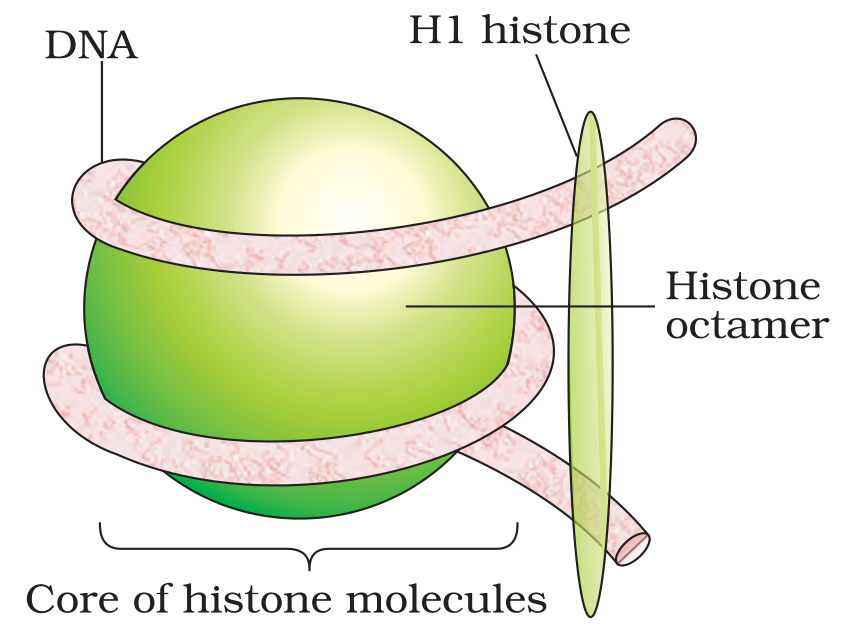
Figure 5.4a Nucleosome