Which one of the following statements is incorrect regarding a catalyst?
Answer & explanation
Correct answer: option 2
The correct answer is Option (2) → It provides an alternate pathway by elevating the activation energy between reactants and products.
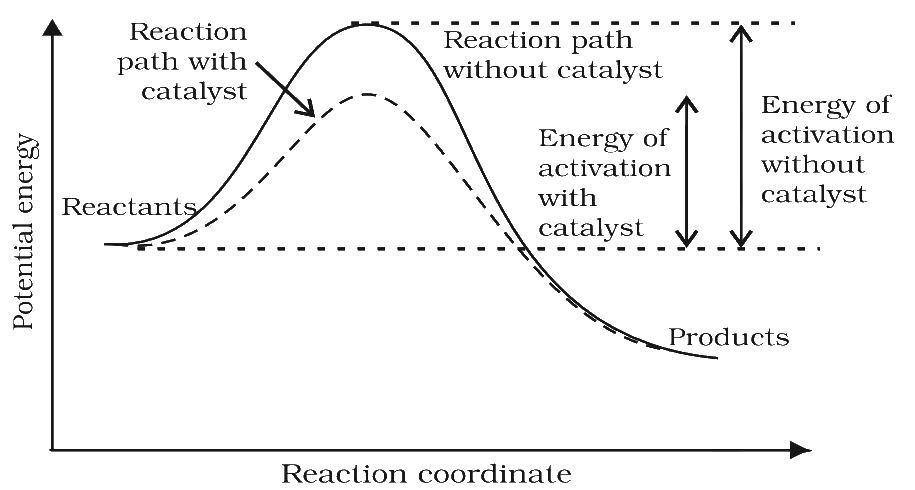
A catalyst increases the rate of a reaction without itself undergoing any permanent chemical change. It forms a temporary complex with the reactants and provides an alternate pathway whose activation energy is lower, which lowers the potential energy barrier between reactants and products. It does not change ΔG, so it speeds up only reactions that are already spontaneous.
Option (1) It increases the rate of reaction without itself undergoing any permanent chemical change. — A correct statement about a catalyst. This is the definition of a catalyst; it is recovered unchanged in mass and composition at the end.
Option (2) It provides an alternate pathway by elevating the activation energy between reactants and products. — The incorrect statement. A catalyst lowers, not raises, the activation energy; a higher barrier would slow the reaction down.
Option (3) It decreases the potential energy barrier between reactants and products. — A correct statement about a catalyst. The potential energy barrier is the activation energy, and the catalyst lowers it.
Option (4) It catalyses the spontaneous reactions but does not catalyse non-spontaneous reactions. — A correct statement about a catalyst. A catalyst does not change ΔG, so it only speeds up reactions that are already spontaneous.
NCERT (2026-27 edition):
Effect of Catalyst – “A catalyst is a substance which increases the rate of a reaction without itself undergoing any permanent chemical change. …”
“It is believed that the catalyst provides an alternate pathway or reaction mechanism by reducing the activation energy between reactants and products and hence lowering the potential energy barrier as shown in Fig. 3.11. … A catalyst does not alter Gibbs energy, ΔG of a reaction. It catalyses the spontaneous reactions but does not catalyse non-spontaneous reactions. …”