Match the LIST-I with LIST-II
| LIST-I | LIST-II | ||
|---|---|---|---|
| A. | When the partners decided to retain goodwill in the business which is brought by new partner in cash | I. | New Partner's Current A/c Dr. To Sacrificing Partners' Capital A/c |
| B. | Goodwill already exist in the books | II. | No Entry |
| C. | New Partner does not bring goodwill in cash | III. | Premium for Goodwill A/c Dr. To Sacrificing Partners' Capital A/c |
| D. | Goodwill is paid privately | IV. | Old Partners' Capital A/c Dr. To Goodwill A/c |
Choose the correct answer from the options given below:
Answer & explanation
Correct answer: option 4
The correct answer is Option (4) → A-III, B-IV, C-I, D-II
Goodwill on admission is the new partner's payment to the old partners for the share of profit they give up, so it always goes to the sacrificing partners in their sacrificing ratio. The entry depends on how the goodwill is settled.
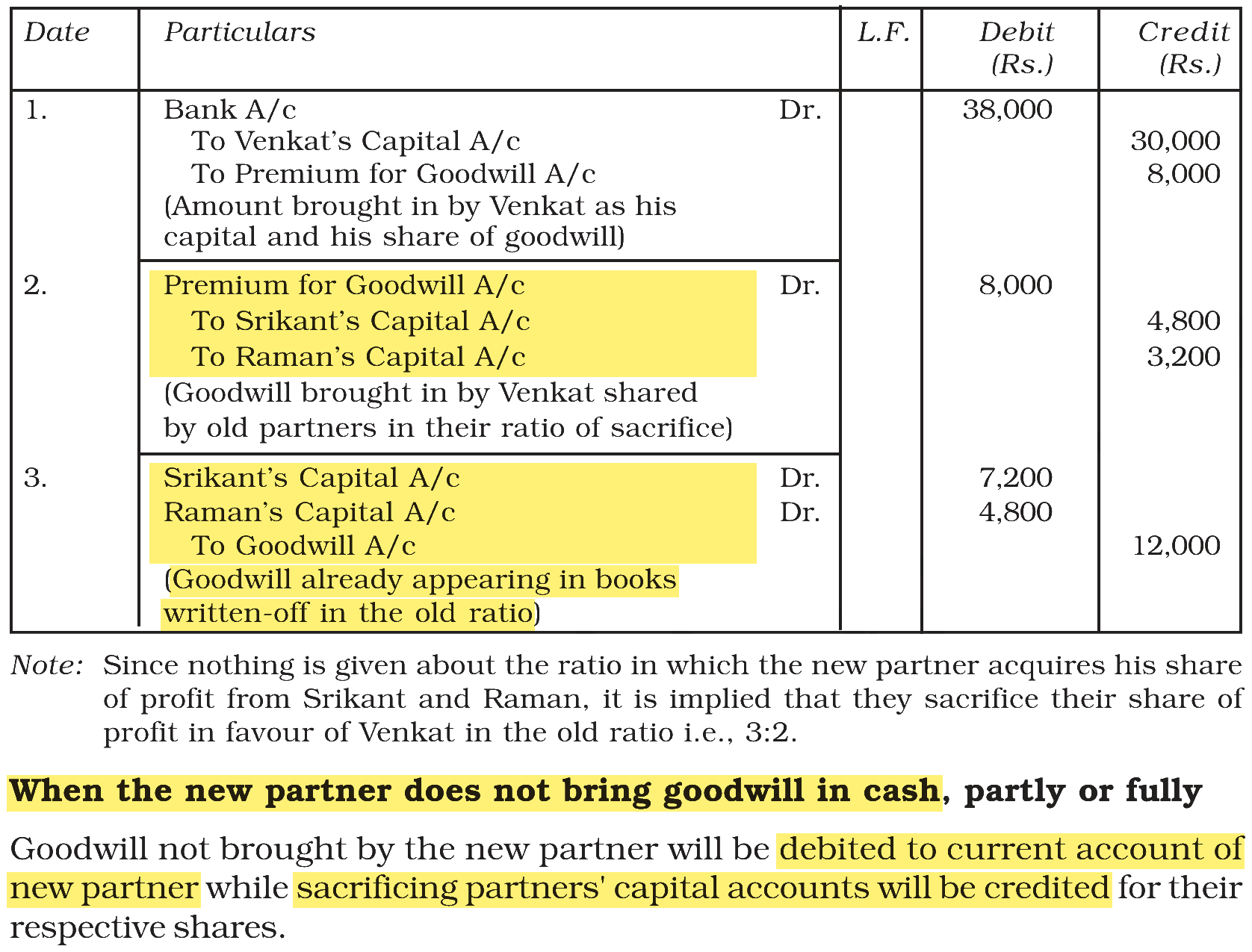
(A) When the partners decided to retain goodwill in the business which is brought by new partner in cash — this matches (III) Premium for Goodwill A/c Dr. To Sacrificing Partners' Capital A/c. The cash is first credited to Premium for Goodwill Account; that account is then closed by crediting the sacrificing partners. The cash stays in the firm because the partners do not withdraw it.
(B) Goodwill already exist in the books — this matches (IV) Old Partners' Capital A/c Dr. To Goodwill A/c. Goodwill already in the books belongs to the old partners. It is written off among the old partners in their old ratio, so that the new partner does not pay for it a second time.
(C) New Partner does not bring goodwill in cash — this matches (I) New Partner's Current A/c Dr. To Sacrificing Partners' Capital A/c. The sacrificing partners must still be compensated, so the new partner's own account (capital or current) is debited with his share of goodwill and the sacrificing partners are credited.
(D) Goodwill is paid privately — this matches (II) No Entry. When the new partner pays the old partners directly, outside the business, the firm receives nothing, so no entry is passed in the books of the firm.
NCERT (2026-27 edition):
|