CUETMOCK
  • Pricing
  • Mentors
Log inStart freeStart free mocks→

First test, then trust

Try a free CUET mock test.

Join 5,00,000+ students who rehearsed exam day on the exact NTA screen before sitting CUET. On the web and on Android.

Start free mocks →Get the Android app
CUETMOCK

India's #1 CUET Mock Test Platform. Original NCERT-based questions on the exact NTA exam screen — trusted by 5,00,000+ students since CUET 2022.

Get it onGoogle PlayScan to download the CUETMOCK app

Mock tests

  • CUET mock test series
  • Browse all papers
  • Commerce mocks
  • Humanities (Arts) mocks
  • Science mocks
  • Languages & GAT mocks
  • Free practice questions
  • Pricing

Resources

  • CUET exam guide
  • CUET syllabus
  • Universities accepting CUET
  • Expert blogs
  • News & notifications
  • Webinars & counselling
  • CUET score calculator
  • How we estimate your rank
  • FAQs

Company

  • About us
  • Our leadership & team
  • Our toppers
  • Mentors
  • For schools
  • Contact us
  • Terms
  • Privacy
  • Refund policy

Talk to us

+91 7696 6630 56info@cuetmock.comWhatsApp us

Our other platforms

  • JEE Mock — For IIT-JEE aspirants
  • NEET Mock — For NEET aspirants

Newsletter

Exam updates, study material and offers — no spam.

© 2026 NYC Ventures Pvt. Ltd.

701-702, Royal Business Park, Zirakpur, Punjab - 140603

  • Terms of use
  • Privacy policy
  • Refund policy
  • Contact us

iCUETMOCK is an independent preparation platform, not affiliated with the National Testing Agency (NTA). Always check exam details on the official NTA website.

  • Home
  • Mock tests
  • CUET guide
  • Pricing
  • Log in
Home/Practice questions/Economics
EconomicsMacro Economics: Money and Banking

The situation where people are willing to hold any amount of money at…

The situation where people are willing to hold any amount of money at a very low interest rate is called?

Answer & explanation+

Correct answer: option 3

The correct answer is Option (3) → Liquidity trap

When the interest rate is very low, everyone expects it to rise, which would mean a fall in bond prices. Nobody wants bonds that promise capital losses, so people are willing to hold any amount of money at that rate, and extra money supply does not lower the rate further. The economy is in a liquidity trap.

Why the other options are incorrect

  • Option (1) Double coincidence of wants — Incorrect. This is the problem of a barter economy: each party to an exchange must want what the other has. Money removes this problem; it has nothing to do with the interest rate.

  • Option (2) Jevons Paradox — Incorrect. This is the observation that a more efficient use of a resource such as coal can raise its total use, because it makes the resource cheaper to use. It concerns resource use, not the demand for money.

  • Option (4) Monetary stagnation — Incorrect. There is no such term.


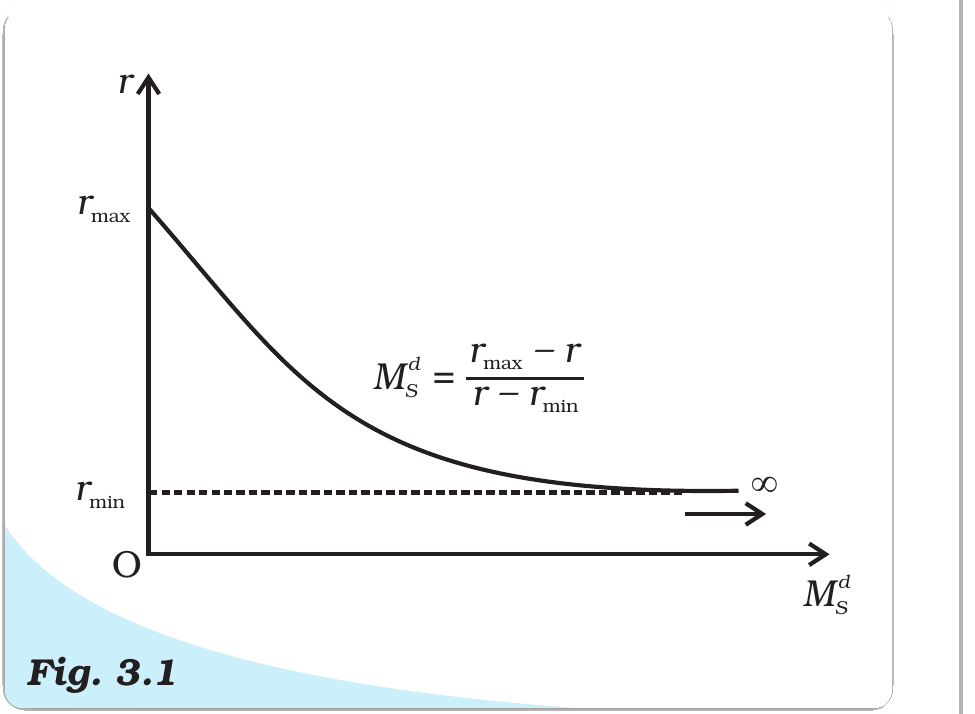
NCERT (2025-26): “The Speculative Motive … However, if the market rate of interest is already low enough so that everybody expects it to rise in future, causing capital losses, nobody will wish to hold bonds. Everyone in the economy will hold their wealth in money balance and if additional money is injected within the economy it will be used up to satiate people’s craving for money balances without increasing the demand for bonds and without further lowering the rate of interest below the floor rmin. Such a situation is called a liquidity trap. The speculative money demand function is infinitely elastic here.…

…In Fig. 3.1 the speculative demand for money is plotted on the horizontal axis and the rate of interest on the vertical axis. When r = rmax, speculative demand for money is zero. The rate of interest is so high that everyone expects it to fall in future and hence is sure about a future capital gain. Thus everyone has converted the speculative money balance into bonds. When r = rmin, the economy is in the liquidity trap. Everyone is sure of a future rise in interest rate and a fall in bond prices. Everyone puts whatever wealth they acquire in the form of money and the speculative demand for money is infinite.…”

NCERT extract

Advertisement

Practise more on Macro Economics: Money and Banking

Chapter-wise mocks on the real NTA exam screen, with solutions and your rank. Your first mocks are free.

Start free mocks →

Advertisement

Next questions

  1. When a number is increased by 40, it becomes 125% of itself. What is the number?General Aptitude Test · Numerical Ability
  2. Let P be a matrix such that P= […] , then which of the following statements are True?A. P is a symmetric matrixB. P is not a skew-symmetric…Maths. Section B1 · Matrices
  3. Arrange the given steps involved life cycle of Plasmodium in correct sequence.(A) Plasmodium enters human body as sporozoites through the b…Biology · Human Health and Disease
  4. Which one of the following statements is incorrect regarding a catalyst?Chemistry · Physical: Chemical Kinetics
  5. IUCN stands for -Biology · Biodiversity and Conservation
  6. The puffed-up appearance of dosa and idli is due to the production -Biology · Microbes in Human Welfare
  7. The matrix which is both symmetric and skew-symmetric, is a:Applied Maths. Section B2 · Algebra
  8. _______ enables an assessment of the number and types of human resources necessary for the performance of various jobs and accomplishment o…Business Studies · Staffing
  9. For the function f(x)=x^3-3x^2+12x-18 , which of the following statement is/are correct? Where R is set of real numbers.(A) f'(x)=3≤ft[(x-1…Maths. Section A · Applications of Derivatives
  10. A pump can fill a water tank in 4 hours but because of the leakage in the tank it took 4displaystyle1/4 hours to fill the tank. How much ti…Applied Maths. Section B2 · Numbers, Quantification and Numerical Applications