
Case: Read the passage and answer the question.
Consider a coil \( C_1 \) connected to a galvanometer G as shown in the figure. Another current-carrying coil \( C_2 \) is placed next to the first coil.
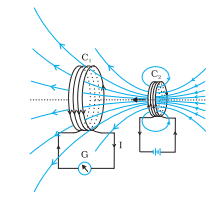
What happens when \( C_1 \) and \( C_2 \) are both moved with the same velocity v along the x-direction?
Answer & explanation
Correct answer: option 4
The correct answer is Option (4) → No current flows at all
A current is induced in \( C_1 \) only while the magnetic flux through it changes. The flux of \( C_2 \) through \( C_1 \) changes only when the coils move relative to each other.
Option (1) The galvanometer shows a clockwise deflection — Incorrect. A deflection needs a changing flux through \( C_1 \). Moving together at the same velocity keeps the separation of the coils fixed, so the flux of \( C_2 \) through \( C_1 \) does not change.
Option (2) The galvanometer shows a counter-clockwise deflection — Incorrect. The sense of a deflection depends on whether the flux through \( C_1 \) increases or decreases. Here it does neither, so there is no deflection in either sense.
Option (3) Twice the current flows — Incorrect. Moving both coils does not add two induced currents. The emf depends on the rate of change of flux through \( C_1 \), which is zero without relative motion.
Option (4) No current flows at all — Correct. With the same velocity there is no relative motion between the coils. So the flux through \( C_1 \) stays constant, no emf is induced and no current flows.
NCERT (2026-27):
The Experiments of Faraday and Henry – “… When the coil C2 is held fixed and C1 is moved, the same effects are observed. Again, it is the relative motion between the coils that induces the electric current.”