
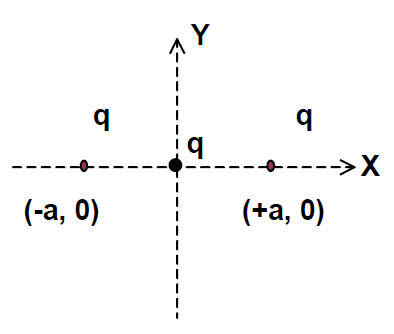
Two point charges, each of charge +q, are fixed at (+a, 0) and (−a, 0). Another positive point charge q placed at the origin is free to move along the x-axis. In equilibrium, the charge q at the origin will have
Answer & explanation
Correct answer: option 4
The correct answer is Option (4) → minimum force and minimum potential energy
A charge is in equilibrium where the net force on it is zero. The equilibrium is stable when its potential energy is least there. Then any small displacement raises the energy, and the force pushes the charge back.
From the figure, the fixed charges \( +q \) sit at \( (-a,0) \) and \( (+a,0) \). When the free charge is moved a small distance \( x \) along the x-axis, its potential energy is:
\( \begin{aligned} U(x) &= \frac{kq^{2}}{a-x}+\frac{kq^{2}}{a+x} \\ &= \frac{2kq^{2}a}{a^{2}-x^{2}} \end{aligned} \)
This is least at \( x=0 \), where \( U=2kq^{2}/a \), and it grows as the charge moves towards either fixed charge.
Option (1) maximum force and minimum potential energy — Incorrect. At the origin the two repulsions are equal and opposite, so the net force is zero, the smallest possible value.
Option (2) minimum force and maximum potential energy — Incorrect. The potential energy rises as the charge moves towards either fixed charge. So the origin is a point of minimum potential energy.
Option (3) maximum force and maximum potential energy — Incorrect. The net force at the origin is zero, and the potential energy there is the least anywhere between the two fixed charges.
Option (4) minimum force and minimum potential energy — Correct. The net force at the origin is zero. Any displacement along the x-axis brings the charge nearer one fixed charge and raises \( U \). The stronger push of the nearer charge then drives it back, so the equilibrium is stable.