Read the passage and answer the questions:
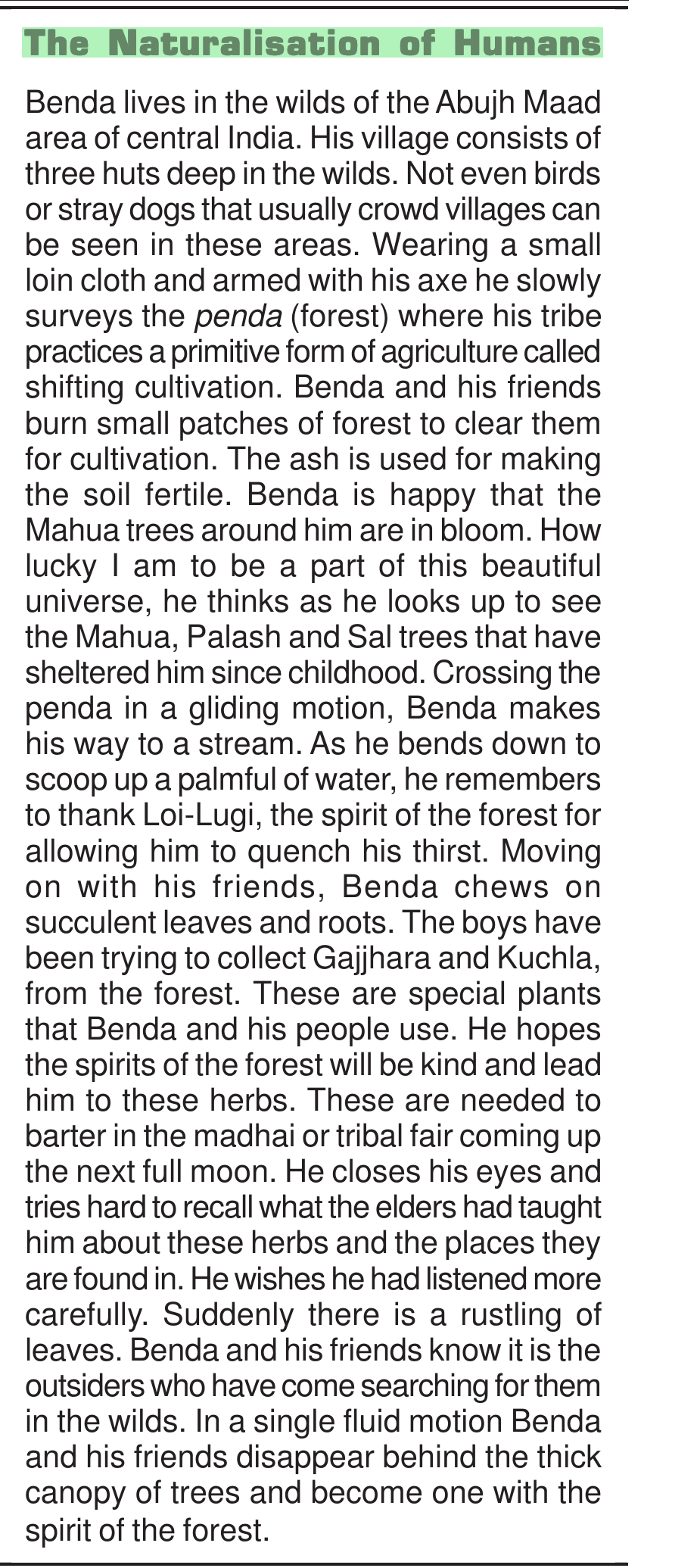
Benda lives in the wilds of the Abujh Maad area of central India. His village consists of three huts deep in the wilds. Not even birds or stray dogs that usually crowd villages can be seen in these areas. Wearing a small loin cloth and armed with his axe he slowly surveys the penda (forest) where his tribe practices a primitive form of agriculture called shifting cultivation. Benda and his friends burn small patches of forest to clear them for cultivation. The ash is used for making the soil fertile. Benda is happy that the Mahua trees around him are in bloom. How lucky I am to be a part of this beautiful universe, he thinks as he looks up to see the Mahua, Palash and Sal trees that have sheltered him since childhood. Crossing the penda in a gliding motion, Benda makes his way to a stream. As he bends down to scoop up a palmful of water, he remembers to thank Loi-Lugi, the spirit of the forest for allowing him to quench his thirst. Moving on with his friends, Benda chews on succulent leaves and roots. The boys have been trying to collect Gajjhara and Kuchla, from the forest. These are special plants that Benda and his people use. He hopes the spirits of the forest will be kind and lead him to these herbs. These are needed to barter in the madhai or tribal fair coming up the next full moon. He closes his eyes and tries hard to recall what the elders had taught him about these herbs and the places they are found in. He wishes he had listened more carefully. Suddenly there is a rustling of leaves. Benda and his friends know it is the outsiders who have come searching for them in the wilds. In a single fluid motion Benda and his friends disappear behind the thick canopy of trees and become one with the spirit of the forest.
The given paragraph represents which of the following?
Answer & explanation
Correct answer: option 1
The correct answer is Option (1) → The Naturalisation of Humans
Option (1) The Naturalisation of Humans — Correct. Benda’s people live in direct dependence on nature: they burn the forest to farm, thank the forest spirit for water and look to the forest for herbs. In such a primitive society humans adapt themselves to nature and nature is a powerful force, worshipped and conserved. This is the naturalisation of humans, the title of the box the story comes from.
Option (2) Humanisation of Nature — Incorrect. It is the opposite process, in which people use technology to leave the imprints of their work on nature.
Option (3) Stop and Go Determinism — Incorrect. It is Griffith Taylor’s neo-determinism, a middle path of using nature within its limits, not a tribe living as nature allows.
Option (4) Neodeterminism — Incorrect. It is the same concept as Option (3), under its other name, so it does not fit for the same reason.
NCERT: Fundamentals of Human Geography — Chapter 1: Human Geography: Nature and Scope, box ‘The Naturalisation of Humans’ (2025-26)
|