
Match List-I with List-II (Symbols have their usual meaning)
| List-I | List-II |
| (a.c. circuit) | (Phasor diagram) |
| (A) Pure Capacitive circuit | (I)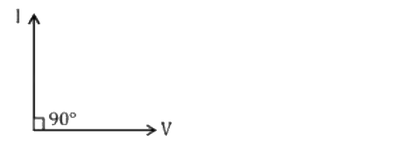 |
| (B) Pure Inductive circuit | (II)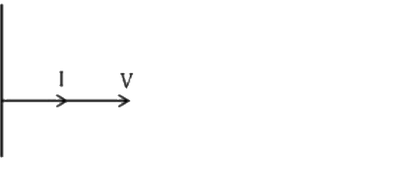 |
| (C) LCR-Series circuit at resonance | (III)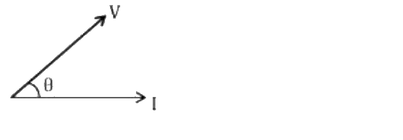 |
| (D) LCR-Series circuit | (IV)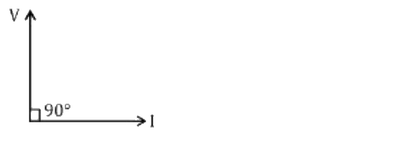 |
Choose the correct answer from the options given below:
Answer & explanation
Correct answer: option 4
The correct answer is Option (4) → (A) - (I), (B) - (IV), (C) - (II), (D) - (III)
Phasors rotate anticlockwise, so the phasor drawn ahead in the anticlockwise sense leads. In a series a.c. circuit the phase difference between voltage and current depends on the reactances:
\( \displaystyle \tan\theta = \frac{X_L - X_C}{R} \)
(A) Pure Capacitive circuit — this matches (I). In a pure capacitor the current leads the voltage by \( \pi/2 \); diagram (I) shows I at 90° ahead of V.
(B) Pure Inductive circuit — this matches (IV). In a pure inductor the voltage leads the current by \( \pi/2 \); diagram (IV) shows V at 90° ahead of I.
(C) LCR-Series circuit at resonance — this matches (II). At resonance \( X_L = X_C \), so Z = R and \( \tan\theta = 0 \). The voltage and current are in phase and their phasors lie along the same line.
(D) LCR-Series circuit — this matches (III). In general V and I differ in phase by an angle \( \theta \) between 0 and 90°; diagram (III) shows V leading I by \( \theta \), the inductive case (\( X_L \gt X_C \)).
Note: Diagram (III) shows the voltage leading the current. This holds only when \( X_L \gt X_C \), a condition the question does not state. (D) can still be matched with (III), because (I), (II) and (IV) are taken by (A), (B) and (C).