Match the LIST-I with LIST-II:
| LIST-I Terms/Positions | LIST-II Meanings | ||
| A. | Muqaddam | I. | Village accountant |
| B. | Patwari | II. | Money changer |
| C. | Muzarian | III. | Village headman |
| D. | Shroff | IV. | Peasant |
Choose the correct answer from the options given below:
Answer & explanation
Correct answer: option 3
The correct answer is Option (3) → A - III, B - I, C - IV, D - II
(A) Muqaddam — this matches (III) Village headman. The village community had three parts: the cultivators, the panchayat and the village headman (muqaddam or mandal). The headman supervised the preparation of village accounts.
(B) Patwari — this matches (I) Village accountant. The headman was assisted by the accountant or patwari of the panchayat.
(C) Muzarian — this matches (IV) Peasant. Indo-Persian sources of the Mughal period most often used raiyat or muzarian for a peasant.
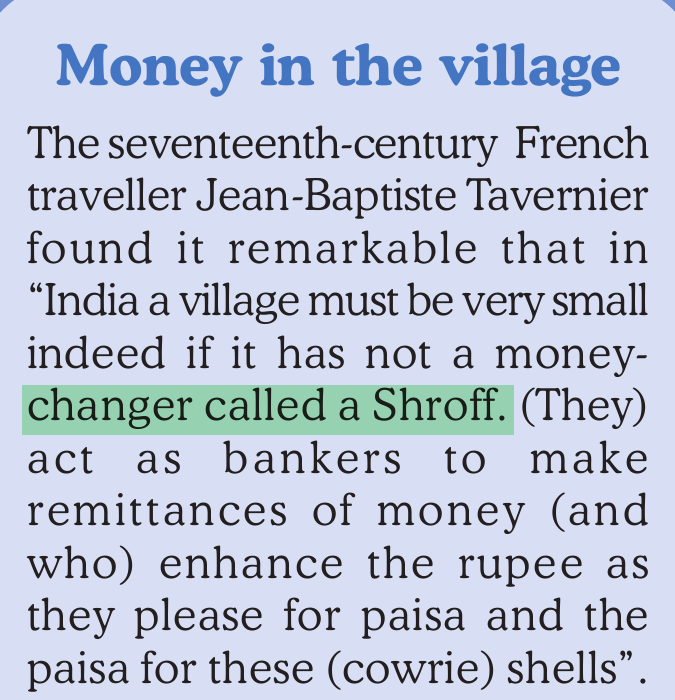
(D) Shroff — this matches (II) Money changer. Tavernier found that even a small Indian village had a moneychanger called a shroff, who acted as a banker for remittances of money.
NCERT (2025-26): “1.2 Peasants and their lands … The term which Indo-Persian sources of the Mughal period most frequently used to denote a peasant was raiyat (plural, riaya) or muzarian.… 2. The Village Community … There were three constituents of this community – the cultivators, the panchayat, and the village headman (muqaddam or mandal).… 2.2 Panchayats and headmen … The chief function of the headman was to supervise the preparation of village accounts, assisted by the accountant or patwari of the panchayat.…”
|